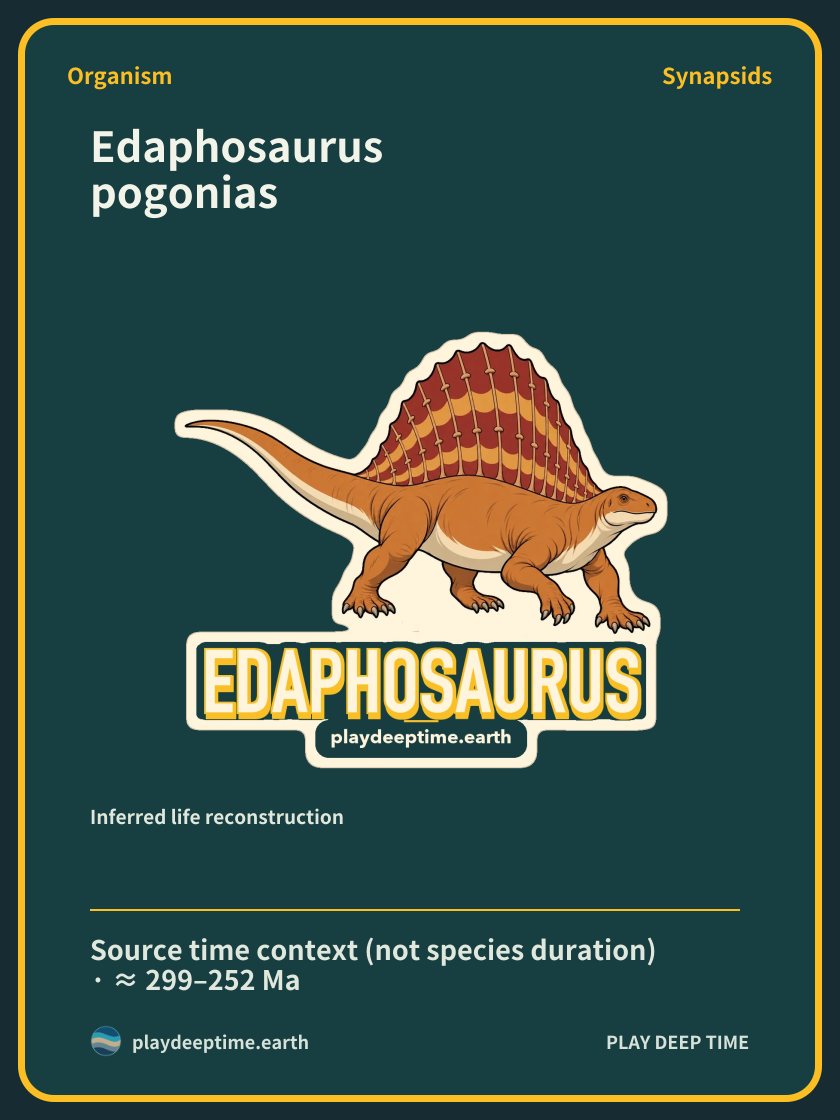
Organism · Synapsids
Edaphosaurus pogonias
Source time context (not species duration) · ≈ 299–252 Ma
Inferred life reconstruction
Edaphosaurus pogonias
Overview
Edaphosaurus pogonias was a synapsid known for a small head and long dorsal spines. The spines bear projections extending sideways. Even within the tall structure on its back, small branches pointing in other directions can be examined.[1][2]
Loading illustration…
Key facts
The dorsal spines combine long upward extensions with transverse projections. Distinguishing the vertical and horizontal components reveals this famous back structure in greater detail.[2]
Time and place
It was a Permian synapsid. The Permian spans approximately 300–250 million years ago. Exhibition records, taxonomic material, and research on dorsal spine tissues provide different information.[1][3]
The time range describes source context, not the complete duration of this species.
Size, form and skeleton
Its body is described as having a small head followed by long dorsal spines. The spines’ transverse projections have been studied histologically. The large back outline and the structure of an individual projection can be compared at different scales.[2]
Paleontological skeletal artist Scott Hartman’s reconstruction gives a body length of about 3.5 m.[4]
Loading illustration…
Habitat and reproduction
What role might the tall back structure have played? Tissue research provides evidence about the structure of the spines and transverse projections. Their form allows comparison of functional questions involving heat or display.[2]
Fossil discovery
A 1953 Field Museum record shows a mounted skeleton of Edaphosaurus pogonias. Research on dorsal spine tissues followed in 2011. The scale of investigation shifts from material showing the whole body to tiny bone tissues.[1][2]
References
- Field Museum (1953) — Edaphosaurus exhibit record
- Huttenlocker et al. (2011) — Tissue structure of the dorsal spines of Edaphosaurus
- International Commission on Stratigraphy (2024) — Geological time chart
- Scott Hartman — Skeletal reconstruction of Edaphosaurus pogonias
- Botha·Smith (2007) — Species composition of Lystrosaurus
- Crompton (1970) — Continental drift and unusual fossil reptiles
Research questions
What changes when dorsal spines are examined through external shape versus tissue? One reveals overall connections; the other provides clues to the organization within bone. This research reads the same structure at several scales.[2]
Observation
Move your gaze from the small head to the tall dorsal spines. Examine vertical spines and transverse projections separately to find different directions within the large outline.[2]
Related organisms
 Lystrosaurus murrayiSynapsidsSource time context (not species duration) · ≈ 252–201 Ma
Different bodies among synapsids
Compare the bodies and backgrounds of Edaphosaurus and Lystrosaurus. Edaphosaurus: Edaphosaurus pogonias was a synapsid with a small head and long dorsal spines bearing transverse projections. Lystrosaurus: Lystrosaurus murrayi is a synapsid described as having a short, curved snout. Genus-level accounts introduce a large head, beak, and one pair of upper tusks.