Organism · Animals
Eiffelia globosa
Source time context (not species duration) · ≈ 539–487 Ma
Inferred life reconstruction
Eiffelia globosa
Overview
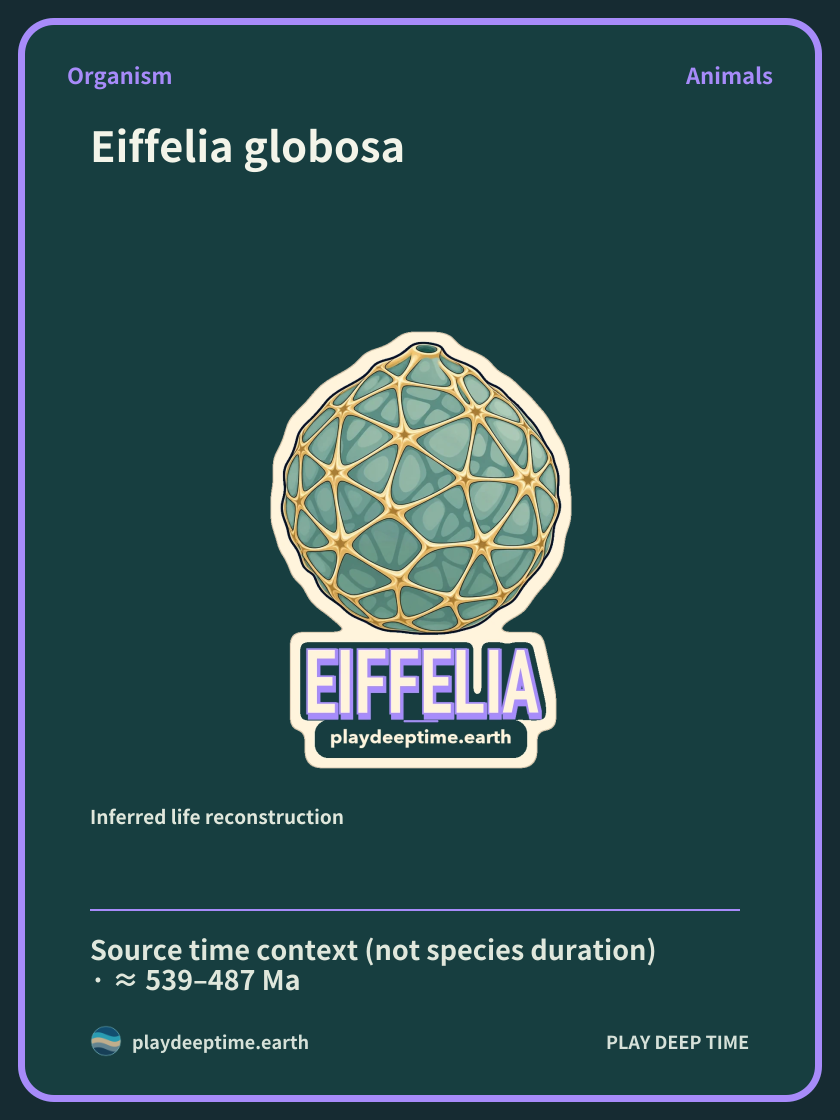
Eiffelia globosa is a sponge with a rounded, thin, sack-like body. Spicules extending in several directions connect within its body wall. Small lattice structures can be found inside the broad outline of the sack.[1]
Loading illustration…
Key facts
Lattices of four-rayed and six-rayed spicules are described together in the body wall. Small spicules of different shapes combine to form the wall’s construction.[1]
Time and place
The main localities for Eiffelia globosa include the Walcott Quarry. This locality is on Fossil Ridge in present-day British Columbia, Canada. The Cambrian as a whole was roughly 540–490 million years ago.[1][2][3][4]
The time range describes source context, not the complete duration of this species.
Size, form and skeleton
Spicules connect in the wall of a rounded, thin, sack-like body. Four-rayed and six-rayed spicules form a lattice-like construction. The overall body outline can be examined separately from small connections within the wall.[1]
The museum account describes the circular outline of the flattened body as 1–6cm in diameter.[5]
Loading illustration…
Habitat and reproduction
The institutional account explains the attached lifestyle of Eiffelia. The overall outline of a body living attached in one place can be examined together with the spicule structures of its wall. This sponge connects consideration of lifestyle with body construction.[1]
Fossil discovery
The museum’s species account introduces the sack-like body together with its wall spicules. Broadening observation from one small spicule to the whole wall helps reveal how structures at different sizes connect.[1]
References
Research questions
What kind of wall forms when small spicules gather? Eiffelia allows four-rayed and six-rayed structures to be compared together. This observation rereads a large sack shape as a collection of small connections.[1]
Observation
Move your gaze from the rounded outline to the thin body wall. Then examine connections among spicules extending in several directions to link the whole body with the small lattice.[1]
Related organisms
 Vauxia gracilentaAnimalsSource time context (not species duration) · ≈ 539–487 Ma
Different bodies among sponges
Explore the bodies of Eiffelia globosa and Vauxia gracilenta together. Eiffelia globosa: Eiffelia globosa is a sponge with a rounded, thin, sack-like body. Vauxia gracilenta: Vauxia gracilenta is a sponge known from simple bodies to forms dividing into several branches.