Organism · Echinoderms
Encope macrophora
Fossil record age bounds · ≈ 5.33–0.774 Ma
Inferred life reconstruction
Encope macrophora
Overview
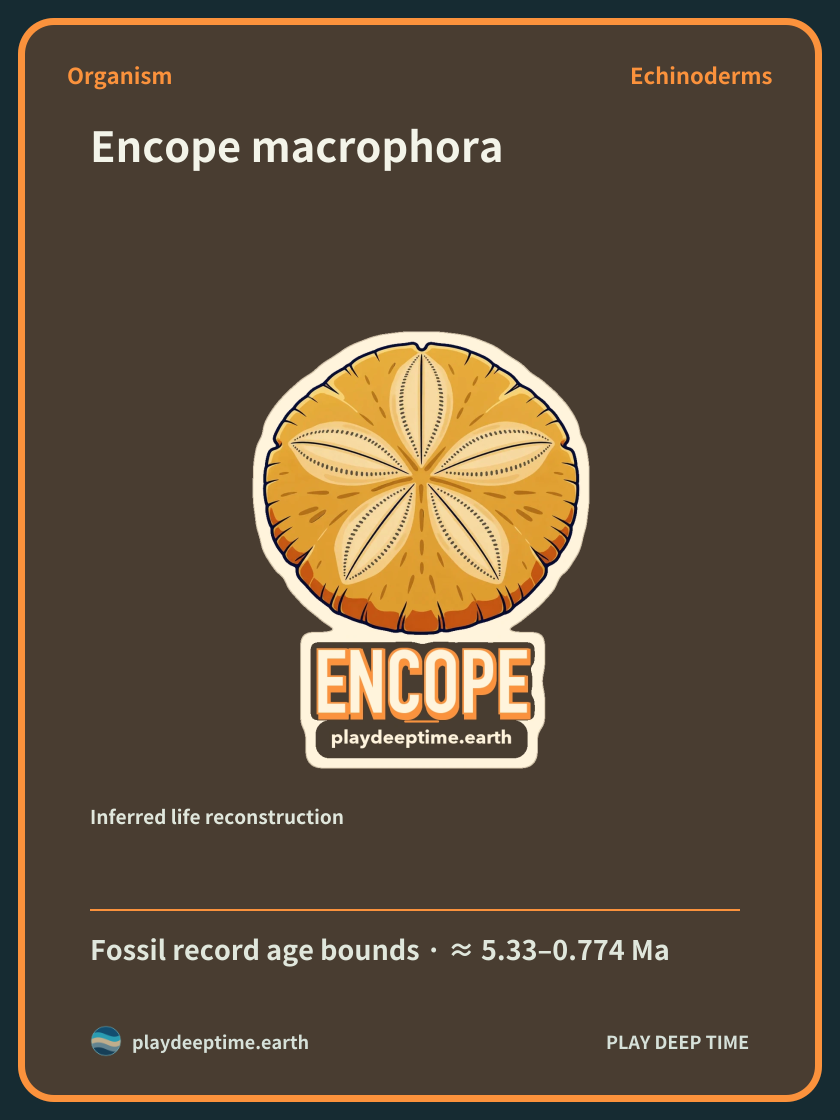
Encope macrophora is a fossil echinoid with a flat, disc-shaped body. Petal-like ambulacra lie on the hard skeleton of Encope. Comparing small structures reveals differences among similar sea urchins.[1][3]
Loading illustration…
Key facts
A flower-like pattern appears on the disc. These are skeletal regions called ambulacra. Their arrangement, as well as the overall outline of the test, is a feature used to compare sea urchins.[3]
Time and place
It has a fossil record in the Pliocene and Pleistocene. The Pliocene spanned approximately 5.3–2.6 million years ago, and the Pleistocene approximately 2.6 million to 12,000 years ago. It provides material for comparing echinoids from these two intervals.[4][5]
The time range describes source context, not the complete duration of this species.
Size, form and skeleton
The body of Encope is described as a hard skeleton forming a flattened disc. Petal-shaped ambulacra stand out on its upper surface. Museum specimen PAL328457 is also associated with the record of this species.[1][3]
Encope macrophora is a sea urchin with a flattened body. A study introducing Pliocene fossils from South Carolina, USA, records Charleston Museum specimen ChM PI 4485 as 4.3 cm in size. Even one small fossil gives a sense of the size of a sea urchin from that ancient sea.[6]
Loading illustration…
Habitat and reproduction
A flattened sea urchin can be examined through both its disc outline and its ambulacral arrangement. Comparisons with related echinoids reveal differences within the same disc-shaped form. Broad shapes and small skeletal regions both provide research clues.[3]
Fossil discovery
The literature traces the naming history from Scutella to Encope. It also treats specimen records such as USNM145411, USNM145410, and PAL328457 separately. This research history connects fossil names with collection records.[2][1]
References
- Smithsonian Institution — Encope macrophora specimen catalogue
- Florida Museum study — Names and specimen records of Encope
- Fossil sea urchin study — Disc-shaped body of Encope
- Paleobiology Database — Age of Encope macrophora
- International Commission on Stratigraphy (2024) — Geological time chart
- Campbell·Campbell (1995) — Fossils of the Goose Creek Limestone, South Carolina
- Muschelkalkmuseum — The sea lily Encrinus
Research questions
How can similar disc-shaped sea urchins be distinguished? Researchers compare body outlines, petal-shaped ambulacra, and other skeletal regions together. Rereading name changes and specimen records also underpins morphological research.[2][3]
Observation
After examining the disc’s rounded outline, follow the petal-shaped ambulacra on top. Distinguishing the broad form from small arrangements helps reveal the flattened sea urchin in greater detail.[3]
Related organisms
 Encrinus liliiformisEchinodermsSource time context (not species duration) · ≈ 252–201 Ma
Different bodies among echinoderms
Explore the bodies and life settings of Encope macrophora and Encrinus together. Encope macrophora: Encope macrophora is a fossil echinoid with a flat, disc-shaped body. Petal-like ambulacra lie on the hard skeleton of Encope. Encrinus: Encrinus liliiformis is a crinoid with several arms spreading above a stalk anchored to the bottom. Small pinnules attach to the arms.