Organism · Arthropods
Enoploclytia leachi
Source time context (not species duration) · ≈ 143–66 Ma
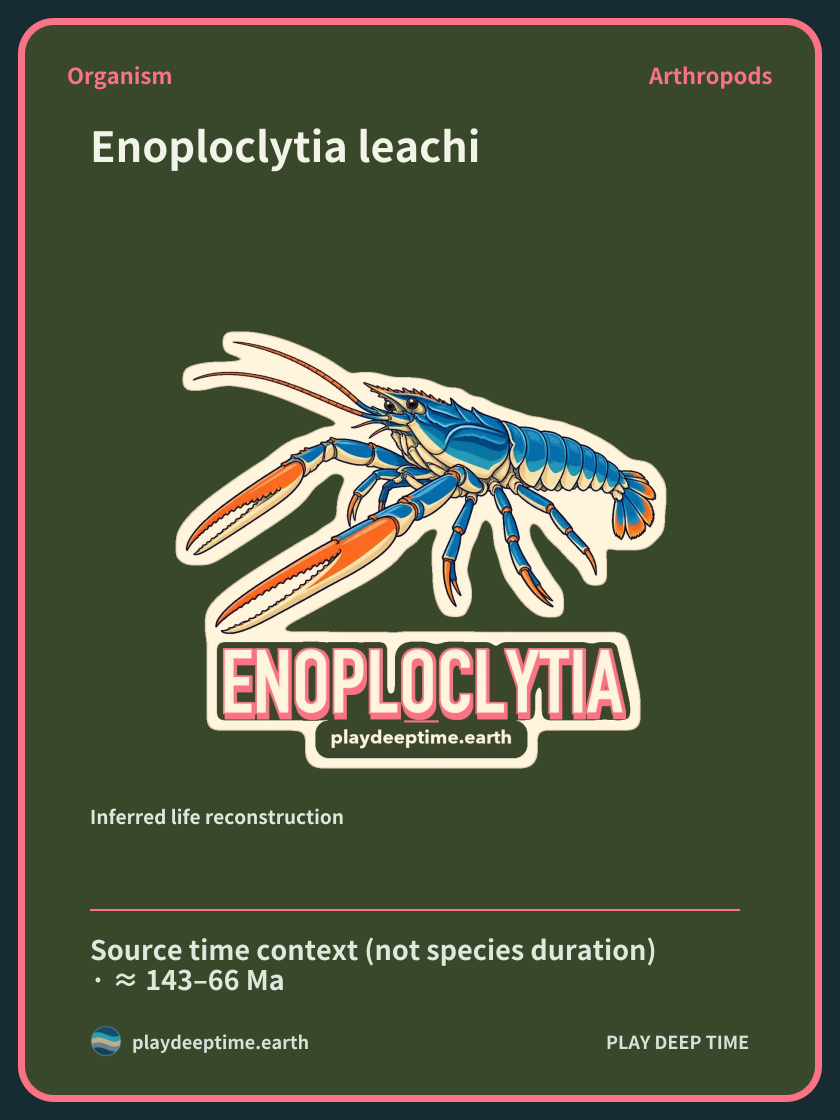
Inferred life reconstruction
Enoploclytia leachi
Overview
Enoploclytia leachi is a Cretaceous decapod with strikingly long, slender, large claw-bearing limbs. A segmented abdomen follows the carapace covering the head and thorax. We can examine the differences between its large claws and smaller appendages together.[1][2]
Loading illustration…
Key facts
O4042 preserves connections among the cephalothorax, first three pairs of legs, and abdomen. The specimen reveals more of the body’s connections than an isolated claw. The arrangement from the front body to the abdomen can be compared within the same fossil.[1]
Time and place
Specimen O4042 is recorded as Early–Middle Turonian material from Bílá Hora in Prague, present-day Czechia. Separate specimens from the Bohemian Cretaceous Basin and Dortmund, Germany, have also been studied. The Cretaceous as a whole spanned approximately 140–66 million years ago.[1][2][3][4]
The time range describes source context, not the complete duration of this species.
Size, form and skeleton
The first pair of claw-bearing limbs is long and slender. Major carapace grooves, a serrated rostrum, and a segmented abdomen are also features used in comparison. Clues at different scales range from the large claws to small structures on the body surface.[1][2]
A complete specimen of Enoploclytia leachi measuring 18 cm long is known from Late Cretaceous marine deposits at Česká Třebová, Czechia. About the length of a small ruler, it gives a sense of the size of this marine crustacean.[11]
Loading illustration…
Habitat and reproduction
The large front claws and smaller appendages that follow differ in size and position within the same body. Material preserving connected carapace, legs, and abdomen helps explain where each part belongs. It lets us move beyond the impressive size of the claws to the arrangement of the whole body.[1][2]
Fossil discovery
A 1998 study compared rare decapod material from Dortmund, and a 2010 report reexamined Bohemian material. O4042 in particular preserves connections between the front body, legs, and abdomen. Descriptions of separate regions and connected specimens together provide clues to the body.[1][2]
References
- Veselská(2010). Revize vybraných skupin dekapodů z české křídové pánve. Zprávy o geologických výzkumech v roce 2009:172–174.
- Wittler (1998) — Enoploclytia from Dortmund
- International Commission on Stratigraphy (2024) — Geological time chart
- City of Prague — Environmental report
- Veselská(2010). Revize vybraných skupin dekapodů z české křídové pánve. Zprávy o geologických výzkumech v roce 2009:172–174.
- Wittler (1998) — Enoploclytia from Dortmund
- International Commission on Stratigraphy (2024) — Geological time chart
- City of Prague — Environmental report
- Micraster study — Microevolution, adaptation and predation
- International Commission on Stratigraphy (2024) — Geological time chart
- Štambergová, Svobodová & Kozubíková (2009), Raci v České republice
Research questions
What different information is provided by an isolated claw and one attached to the body? Connected specimens show where large appendages belong. Research compares equivalent parts in different fossils to understand the overall arrangement.[1][2]
Observation
Move your gaze from the long, slender, large claws to the grooves and rostrum of the carapace. Following the segmented abdomen behind them reveals differences between the front and rear body regions.[1][2]
Related organisms
 Micraster coranguinumEchinodermsSource time context (not species duration) · ≈ 143–66 Ma
Claws and sea urchin skeletons in Late Cretaceous Europe
Enoploclytia and Micraster present different records from Late Cretaceous Europe. Read the decapod record of present-day Czechia and Germany alongside the sea urchin record of Britain, and examine the different arrangements of claw-bearing limbs and a heart-shaped skeleton.