Organism · Placental mammals
Epicyon saevus
Source time context (not species duration) · ≈ 23–4.7 Ma
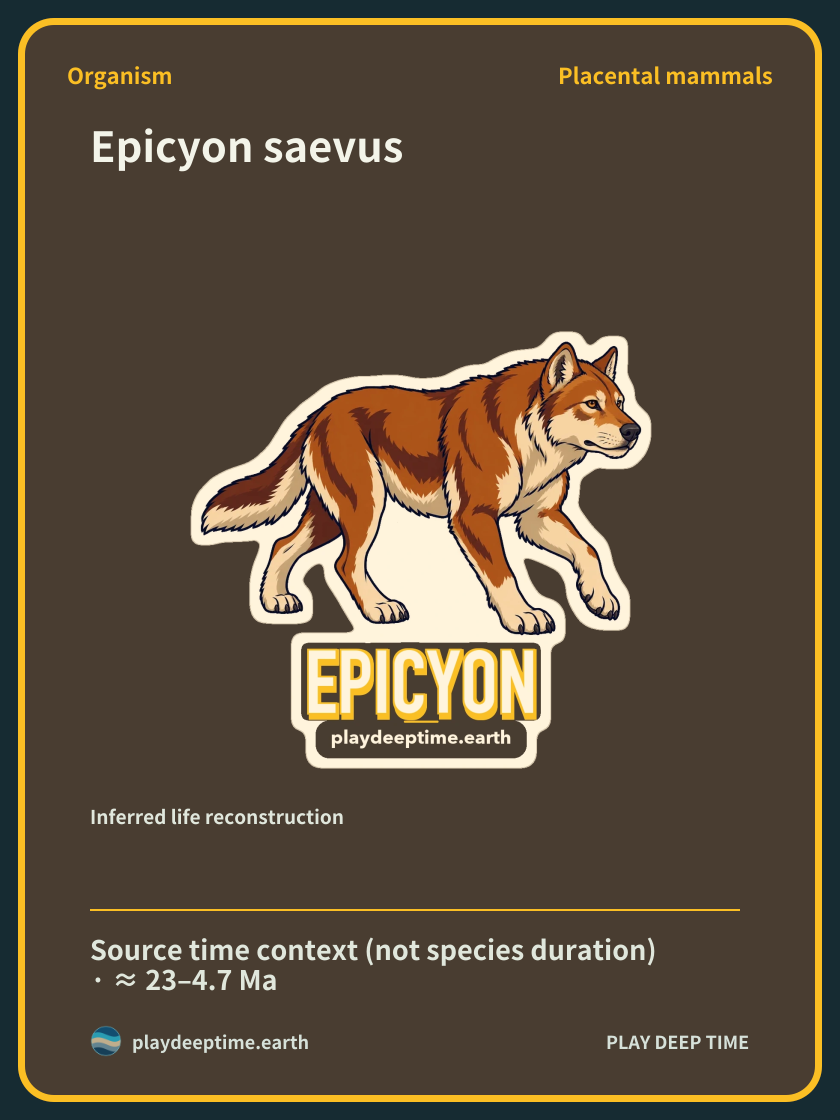
Inferred life reconstruction
Epicyon saevus
Overview
Epicyon saevus is an ancient canid known from a partial lower jaw and teeth. Institutional records also preserve the former name Canis saevus. Connecting the current name with old specimen records helps reveal this animal.[1][2]
Loading illustration…
Key facts
Replicas of reference specimens are also used for morphological comparison. MCZ VPM-8869 is recorded as such a replica. It is another research tool allowing other researchers to examine the original fossil’s form.[2]
Time and place
The Smithsonian record identifies Miocene material from the Loup Fork Formation in present-day Nebraska, USA. Fossil-database summaries place the occurrence-bearing strata within a broad window of approximately 23–4.7 million years ago. Individual institutional specimen records can be considered alongside stratigraphic summaries.[1][3]
The time range describes source context, not the complete duration of this species.
Size, form and skeleton
The main directly recorded parts are a partial lower jaw and teeth. The placement of teeth within the jaw is examined for comparison with other canid material. A small region rather than the whole body can be an important reference for recognizing an organism’s name.[1]
A model based on dental data in the 2021 CarniFOSS study estimates a body mass of approximately 56 kg.[16]
Loading illustration…
Habitat and reproduction
Why examine jaws and teeth closely when studying ancient canids? These hard parts convey several features used to compare species. The record of Epicyon saevus also begins with lower-jaw material and continues into a story of naming and classification.[1][2]
Fossil discovery
Institutional records preserve a connection between collection in 1857 and historical naming. Reading records under the former genus Canis together with the current Epicyon helps locate relevant material. It also allows us to follow how fossils have been studied in museums.[1][2]
References
- Smithsonian Institution — Lower jaw recorded under a historical name of Epicyon
- MCZbase — The name and reference records of Canis saevus
- Paleobiology Database — Stratigraphic records of Epicyon fossils
- Smithsonian Institution — Lower jaw recorded under a historical name of Epicyon
- Paleobiology Database — Stratigraphic records of Epicyon fossils
- MCZbase — The name and reference records of Canis saevus
- Study — Head and teeth of Eucastor from Nebraska
- Paleobiology Database — Strata yielding Eucastor
- Paleobiology Database — Stratigraphic records of Merychyus fossils
- Historical description of a partial Merychyus skeleton
- 2023 study — Classification of Oligocene–Miocene oreodonts
- MCZ — Merychyus elegans cast record MCZ:VP:VPM-16327
- Smithsonian Institution — Lower jaw recorded under a historical name of Epicyon
- Paleobiology Database — Stratigraphic records of Epicyon fossils
- MCZbase — The name and reference records of Canis saevus
- Faurby·Morlo·Werdelin(2021) — CarniFOSS fossil carnivorous mammal body-mass data
Research questions
How are fossil replicas and originals used in research? Replicas broaden opportunities to compare the form of a reference specimen. Checking the material type in collection records underpins connections between names and forms.[2]
Observation
After looking at the outline of the head, move your gaze to the lower jaw and teeth. Consider the role that small jaw material plays in distinguishing an organism’s identity.[1]
Related organisms
 Eucastor tortusPlacental mammalsSource time context (not species duration) · ≈ 23–4.7 Ma
Miocene jaws and teeth from Nebraska
Read the lower jaw of Epicyon alongside the head and dental material of Eucastor. Against the setting of Miocene Nebraska, explore two different mammals: a canid and a rodent.
 Merychyus elegansPlacental mammalsSource time context (not species duration) · ≈ 30–5.3 Ma
Fossil mammals read together through Nebraska records
Merychyus cast records and Epicyon jaw specimens offer different starting points for exploring fossils from present-day Nebraska, USA. Examine the broad Oligocene–Miocene stratigraphic summary for Merychyus alongside the Miocene record of Epicyon.