Organism · Reptiles including birds
Eudibamus cursoris
Fossil record age bounds · ≈ 299–294 Ma
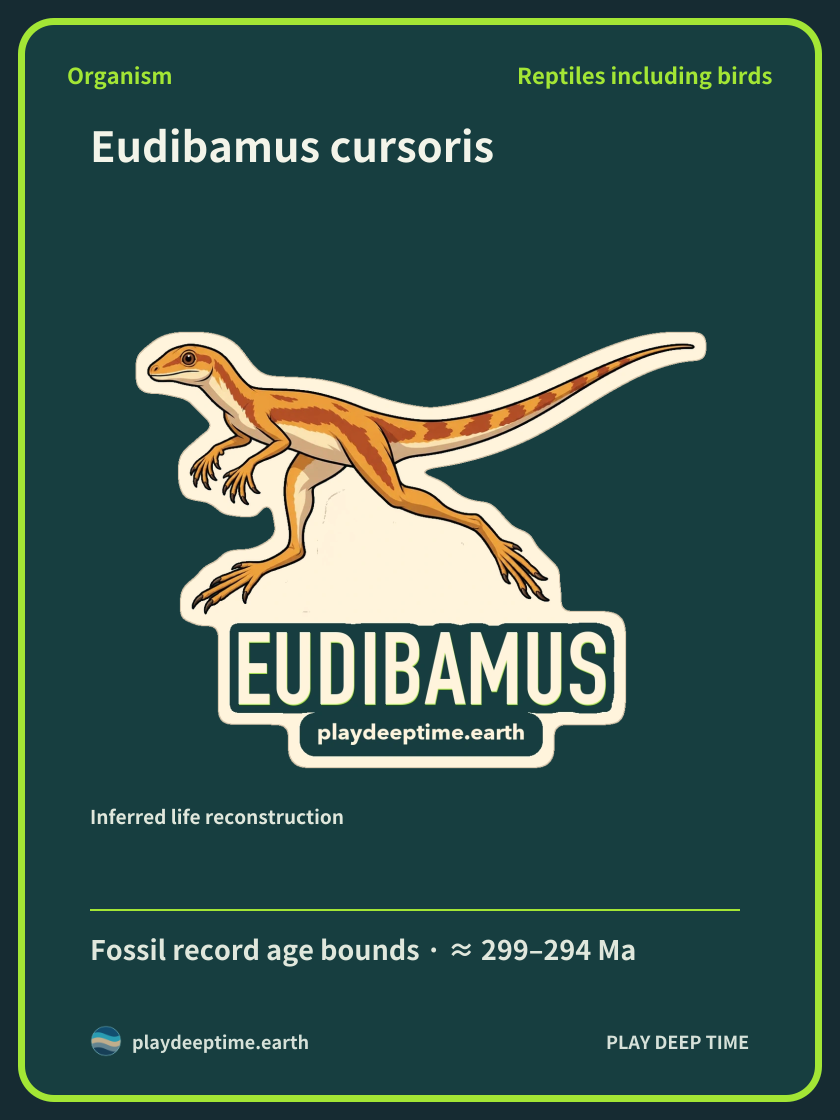
Inferred life reconstruction
Eudibamus cursoris
Overview
Eudibamus cursoris is a small Permian reptile with a slender body, long limbs, and a very long tail. Its hind limbs, longer than its forelimbs, and its elongated feet are striking. Skeletal proportions became clues for exploring the movement of ancient reptiles.[1]
Loading illustration…
Key facts
In a study of the type specimen, the tail was calculated to account for about 64% of the total axial body length. In 2021, researchers discussed how this long tail might have affected the body's center of mass and the maintenance of a two-legged posture. The long portion extending behind the slender body thus contains clues for interpreting movement.[1]
Time and place
It has been studied as Artinskian material of the Early Permian. The fossils came from the Tambach Formation at the Bromacker locality in the Thuringian Forest of present-day Germany. Place names near Tambach-Dietharz and Gotha help locate the home of this ancient terrestrial animal.[1]
The time range describes source context, not the complete duration of this species.
Size, form and skeleton
The type specimen MNG8852 preserves the skeleton of the trunk, limbs, and long tail extending behind them. The ribs are short and very slender, and the limb bones are also slender and long. The lengths of the hind limbs and hind feet are particularly useful features to observe in understanding the body's overall impression.[1]
The type specimen MNG 8852 of Eudibamus has a total skeletal length of about 26 cm. Its small body, preserved with little distortion, continues into elongated hind limbs and a tail.[2]
Loading illustration…
Habitat and reproduction
Bromacker has yielded fossils of various tetrapods, from terrestrial to semiaquatic groups. The paper explains that the Tambach Formation accumulated in an upland inland basin. Researchers interpreted Eudibamus as a small herbivore and suggested that rapid movement may have helped it evade predators rather than catch prey.[1]
Fossil discovery
The type specimen of this species was briefly introduced in 2000, and its skeleton was described in detail in a 2021 study. A second partial skeleton from the same locality, MNG12895, was also used for comparison. The addition of new material expanded descriptions of the skeleton and growth.[1]
References
Research questions
The researchers interpreted differences in the degree of ossification of the ankle bones in the two specimens as differences in growth stage. They also discussed a gait in which the legs moved forward and backward beneath the body, based on the structures of the long limbs, feet, and pelvis. This led to the authors' functional interpretation that both bipedal and quadrupedal running would have been possible.[1]
Observation
The illustration centers on the slender trunk, four limbs, and long, tapering tail of the type specimen MNG8852. Read the overall outline from the skeleton, then move your gaze to the longer hind limbs and feet. Details of the head and hands, the body covering, and the colors and posture are interpretations intended to connect and present the surviving bones.[1]
Related organisms
 Homoeosaurus maximilianiLepidosaursSource time context (not species duration) · ≈ 201–143 Ma
Different bodies among reptiles
Explore the bodies and living contexts of Eudibamus cursoris and Homoeosaurus maximiliani together. Eudibamus cursoris: Eudibamus cursoris is a small Permian reptile with a slender body, long limbs, and a very long tail. Its hind limbs, longer than its forelimbs, and its elongated feet are striking. Homoeosaurus maximiliani: Homoeosaurus maximiliani is a small Jurassic rhynchocephalian reptile. Old descriptions mention a short snout, slender body, and long limbs.