Organism · Vertebrates
Euphanerops longaevus
Source time context (not species duration) · ≈ 420–359 Ma
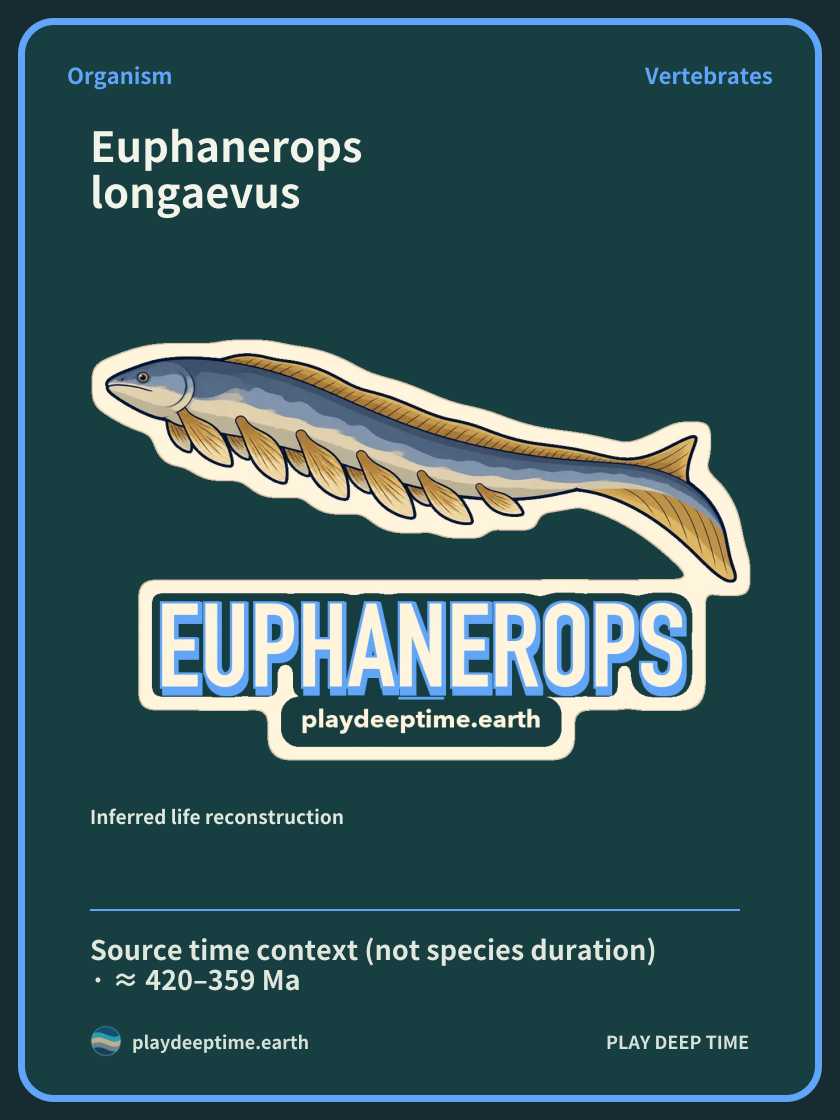
Inferred life reconstruction
Euphanerops longaevus
Overview
Euphanerops is a Late Devonian fish known for an elongated body and a long dorsal fin. A nearly complete adult and separate juvenile material have been studied. Its fin arrangement, different from familiar fishes, attracts interest.[1]
Loading illustration…
Key facts
Repeated fin units are interpreted along the front underside of the body. The researchers proposed these as multiple paired structures. If we usually picture only a single pair of pelvic fins, this suggests a much more varied arrangement.[1]
Time and place
It is known from research on Late Devonian fishes. The Devonian as a whole spanned approximately 420–360 million years ago. A 2018 study compared adult and juvenile specimens to investigate the body and fins.[1][2]
The time range describes source context, not the complete duration of this species.
Size, form and skeleton
An elongated trunk and a long dorsal fin are treated as characteristic features. The authors’ morphological interpretation also includes a tail outline extending farther below. The fish invites separate examination of front and rear, back and belly.[1]
A 2023 growth study listed adult specimens of Euphanerops longaevus as approximately 9–27.8 cm long. Fossils ranging from juveniles to large individuals can be compared side by side to investigate changes during growth.[3]
Loading illustration…
Habitat and reproduction
Where on the body are a fish’s fins positioned? The repeated structures along this organism’s front underside raise questions about diverse fin arrangements. Rather than fitting it into one familiar fish body plan, researchers compare the connections among its parts.[1]
Fossil discovery
The nearly complete adult MHNM 01-123 and separate juvenile specimens were used in research. The researchers presented photographs alongside interpretive drawings to compare structures. Different growth stages and preservation records add information about the body.[1]
References
Research questions
Why were internal structures displaced downward in the fossil? The study explains the possibility of displacement caused by gases after death. A fossil’s appearance can contain both the living body and changes after death.[1]
Observation
Follow the long dorsal fin toward the rear of the body. Examining the repeated ventral structures and the lower tail outline separately helps us consider this fish’s unfamiliar arrangement.[1]
Related organisms
 Remigolepis armataJawed vertebratesSource time context (not species duration) · ≈ 420–359 Ma
Different bodies among fishes
Explore the bodies and life settings of Euphanerops and Remigolepis armata together. Euphanerops: Euphanerops is a Late Devonian fish known for an elongated body and a long dorsal fin. A nearly complete adult and separate juvenile material have been studied. Remigolepis armata: Remigolepis armata is a Devonian fish with hard plates enclosing the head and front of the body. Behind its armored front, a scale-covered body and tail follow.