Organism · Arthropods
Euproops danae
Source time context (not species duration) · ≈ 359–299 Ma
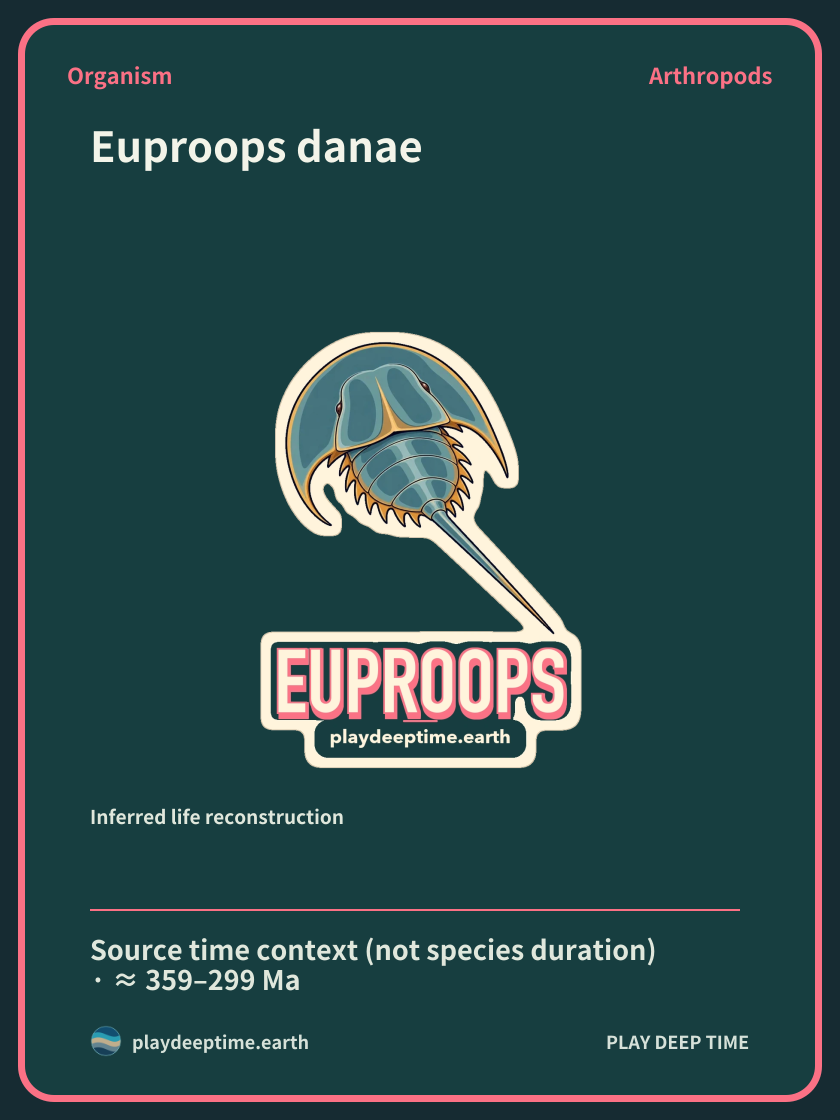
Inferred life reconstruction
Euproops danae
Overview
Euproops danae is an arthropod characterized by a broad front shield, rounded rear body, and long telson. Fossils with the front and rear body connected are known. Its body can be read through the major divisions of the rigid dorsal surface.[1][2]
Loading illustration…
Key facts
In addition to connected front and rear body regions, some specimens preserve the long telson. This helps explain their joined arrangement better than knowing each region separately. The positions of several parts can be compared within one fossil.[1]
Time and place
It is known through studies of Carboniferous specimens. The entire Carboniferous spanned approximately 360–300 million years ago. A study of a specimen preserving several individuals together appeared in 2019.[1][3]
The time range describes source context, not the complete duration of this species.
Size, form and skeleton
The front body forms a broad shield, followed by a rounded rear body. The author’s composite reconstruction includes long spines on either side of the head and radial spines around the rear body’s margins. The broad shield and marginal spines can be examined separately.[2][1]
An Euproops danae exoskeleton fossil presented by paleontologist Loren Babcock is 7.3 cm long. It is a specimen from present-day Indiana, United States, in which the small body’s outer covering survives as mineral replacement.[4]
Loading illustration…
Habitat and reproduction
What questions arise from fossils preserving several individuals together? Research on Euproops has examined group specimens as well as articulated body structures. It leads from examining one individual’s form to asking why several fossils gathered together.[1]
Fossil discovery
Following a 2019 specimen study, a 2020 horseshoe-crab atlas presented a composite reconstruction of Euproops. Specimen descriptions and diagrams synthesizing several kinds of information explain the body in different ways. Connected regions and overall outlines can be explored together.[1][2]
References
- Bicknell et al. (2019) — Euproops specimens preserved together
- Bicknell·Pates (2020) — An atlas of fossil and living horseshoe crabs
- International Commission on Stratigraphy (2024) — Geological time chart
- Loren E. Babcock (2026) — The value of museum fossils and natural history specimens
- Arthropleurid fossils from Writhlington
- Study of new morphological traits in arthropleurids
Research questions
How do a fossil photograph and a researcher’s composite reconstruction differ in what they reveal? A specimen shows the parts actually preserved, while a reconstruction organizes several clues into an accessible form. Understanding their roles helps explain body connections.[1][2]
Observation
Move your gaze from the broad front shield to the rounded rear body and long telson. Examining the spines on either side of the head and around the rear margins separately reveals major divisions alongside smaller outline structures.[2][1]
Related organisms
 Arthropleura armataArthropodsSource time context (not species duration) · ≈ 359–299 Ma
Different bodies among arthropods
Explore the bodies and backgrounds of Euproops danae and Arthropleura together. Euproops danae is an arthropod characterized by a broad front shield, rounded rear body, and long telson. Fossils with the front and rear body connected are known. Arthropleura armata is an arthropleurid species known for broad dorsal plates and many short legs. One fragmentary fossil from Writhlington was assigned to this species.