Organism · Reptiles including birds
Eurysternum wagleri
Source time context (not species duration) · ≈ 201–143 Ma
Inferred life reconstruction
Eurysternum wagleri
Overview
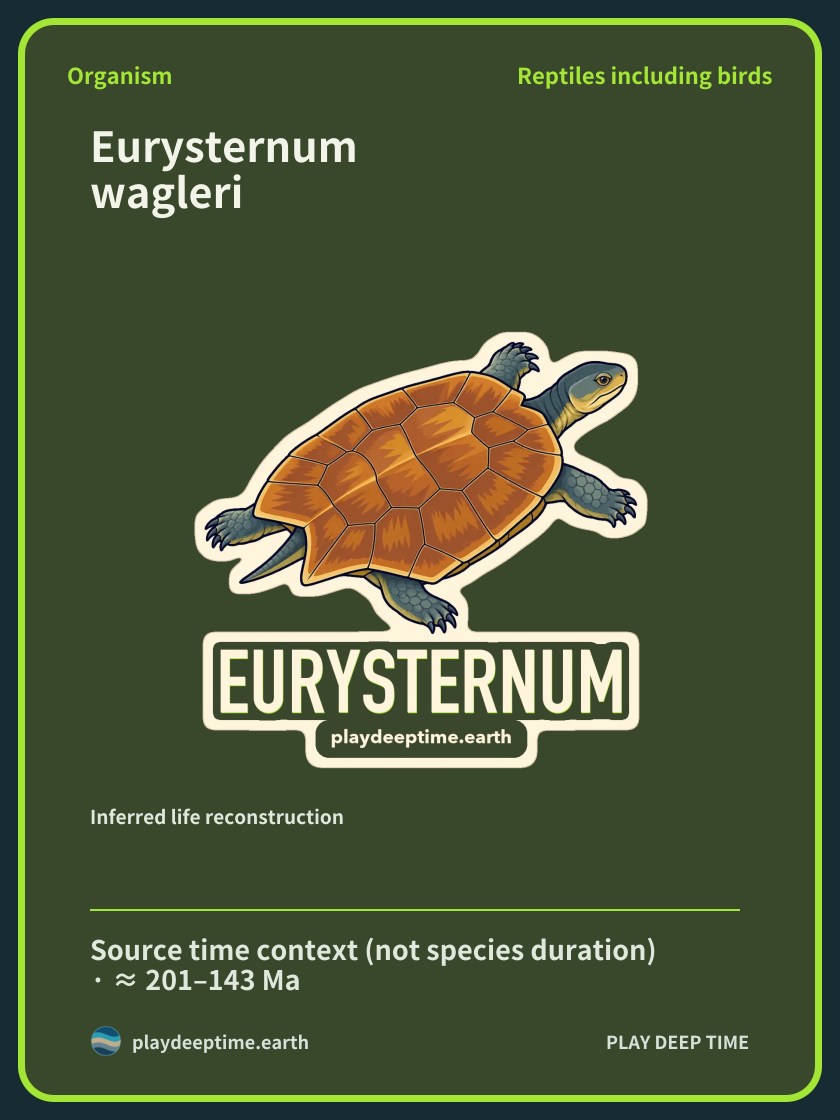
Eurysternum wagleri is a Late Jurassic turtle with a striking pentagonal carapace. The shell is widest slightly behind its midpoint and narrows sharply toward the rear. If you first picture a round turtle shell, discovering this different outline is rewarding.[1]
Loading illustration…
Key facts
A deep notch is described at the center of the rear edge of the carapace. There is also a notch at the front center. These features help in reading the overall outline by following the shell’s margins.[1]
Time and place
Late Jurassic specimens from Denkendorf–Zandt and Solnhofen in present-day Germany have been studied. The entire Jurassic spanned approximately 200–140 million years ago. A 2014 reassessment compared old turtle specimens from this region again.[1][2]
The time range describes source context, not the complete duration of this species.
Size, form and skeleton
The pentagonal carapace is narrower than it is long and tapers rapidly toward the rear. Central notches at the front and back are also characteristic. Several specimens preserve head, neck, and limb bones as well as the carapace, allowing different regions to be compared.[1]
Loading illustration…
Habitat and reproduction
A turtle’s body is more than its carapace. Research on this species includes forelimbs, hind limbs, and tail vertebrae as well as the head and neck. It is rewarding to explore the rigid shell alongside the body extending beyond it.[1]
Fossil discovery
A 2014 study reassigned specimens named Acichelys redenbacheri to this species. MNB R 2440.1 and .2 are two pieces of one specimen, while .3 is a plaster cast. This is an intriguing case in which three numbers do not represent three turtles.[1]
References
Research questions
How do one slab of a fossil, its counterpart impression, and a plaster cast differ in what they reveal? Even material derived from one specimen helps explain different aspects. Reuniting old collection items offers new readings of a turtle’s name and form.[1]
Observation
Follow the carapace outline from its broad region toward the narrowing rear tip. Finding the central notches at the front and rear in turn makes this turtle’s pentagonal outline clearer.[1]
Related organisms
 Mesturus verrucosusRay-finned fishesSource time context (not species duration) · ≈ 201–143 Ma
Fishes and turtles of Solnhofen
Mesturus and Eurysternum can be compared through Late Jurassic material from the Solnhofen region of present-day Germany. Explore different fish and turtle fossils together to broaden the story of life in this region.