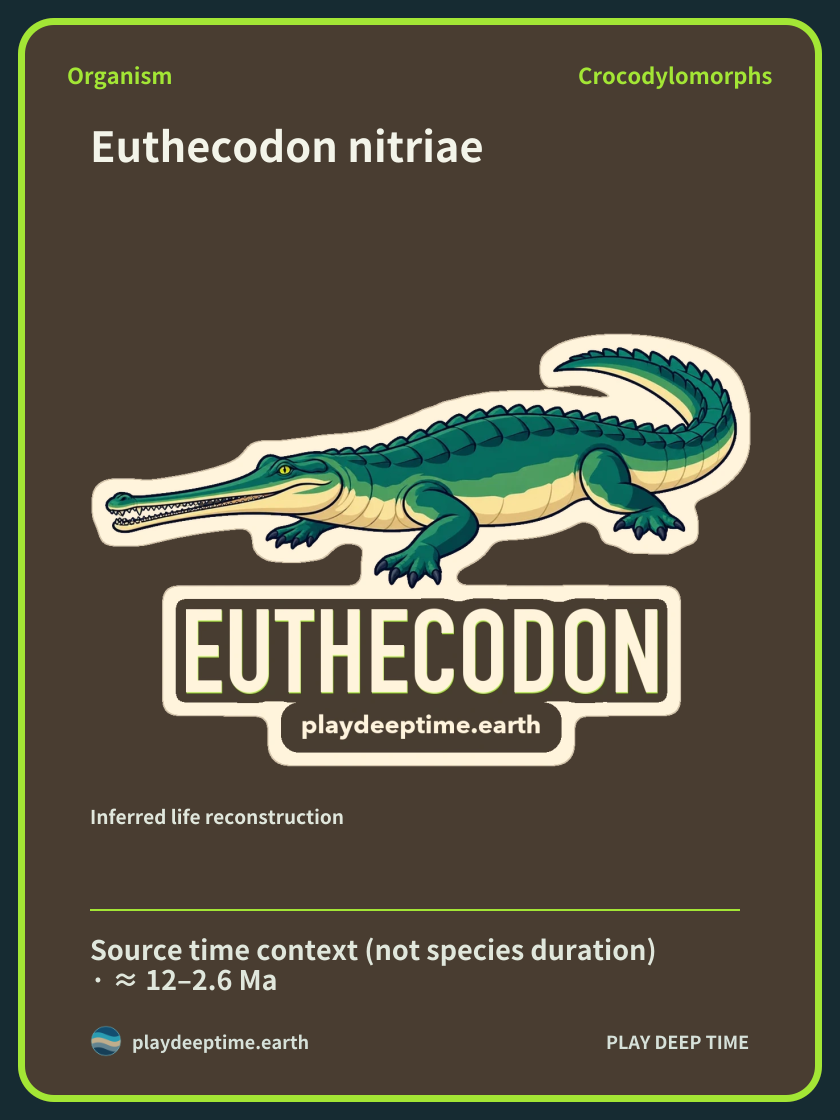
Organism · Crocodylomorphs
Euthecodon nitriae
Source time context (not species duration) · ≈ 12–2.6 Ma
Inferred life reconstruction
Euthecodon nitriae
Overview
Euthecodon nitriae is a fossil member of the crocodile lineage known for a long snout and prominent tooth sockets. Its skull from Wadi Natrun is discussed in the literature. Different structures can be found along the edges of its elongated front head.[1]
Loading illustration…
Key facts
The sockets holding the teeth are described as prominent features of the snout. Repeated tooth positions along its long outline provide clues for comparison.[1]
Time and place
Cranial material from Wadi Natrun appears in research. Recorded fossil-bearing strata are summarized as material spanning the Miocene and Pliocene, approximately 12–2.6 million years ago. Head form and stratigraphic records can be explored together.[1][3]
The time range describes source context, not the complete duration of this species.
Size, form and skeleton
The skull assigned to this species reveals a long snout and prominent tooth sockets. The broad outline of connected bones and the repetition of tooth positions can be read at different scales. Small differences at the front of the head provide clues for taxonomic comparison.[1]
Loading illustration…
Habitat and reproduction
Which parts are compared among long-snouted members of the crocodile lineage? The margin bearing tooth sockets and the head’s broad outline can be examined together. This seeks fine differences within similar external shapes.[1]
Fossil discovery
The bibliographic record of the original 1920 description survives, and evolution within Euthecodon was studied in 1978. Later publications also discussed the Wadi Natrun skull of nitriae. Material of an old species thus contributed to comparisons across the genus.[2][1]
References
Research questions
Where do protruding tooth sockets appear along a long snout? Examining individual tooth positions along the broad outline reveals repeated forms. This research reads one body region as several smaller structures.[1]
Observation
Move your gaze along the long snout from front to back. Examining the arrangement of tooth sockets along its margins helps reveal repeated features within the broad outline.[1]
Related organisms
 Gryposuchus jesseiCrocodylomorphsSource time context (not species duration) · ≈ 12–5.3 Ma
Different bodies among crocodyliforms
Explore the bodies of Euthecodon and Gryposuchus together. Euthecodon nitriae is a fossil member of the crocodile lineage known for a long snout and prominent tooth sockets. Gryposuchus jessei is a fossil member of the crocodile lineage known from material at the front tip of its long snout.