Organism · Molluscs
Exogyra ponderosa
Source time context (not species duration) · ≈ 143–66 Ma
Inferred life reconstruction
Exogyra ponderosa
Overview
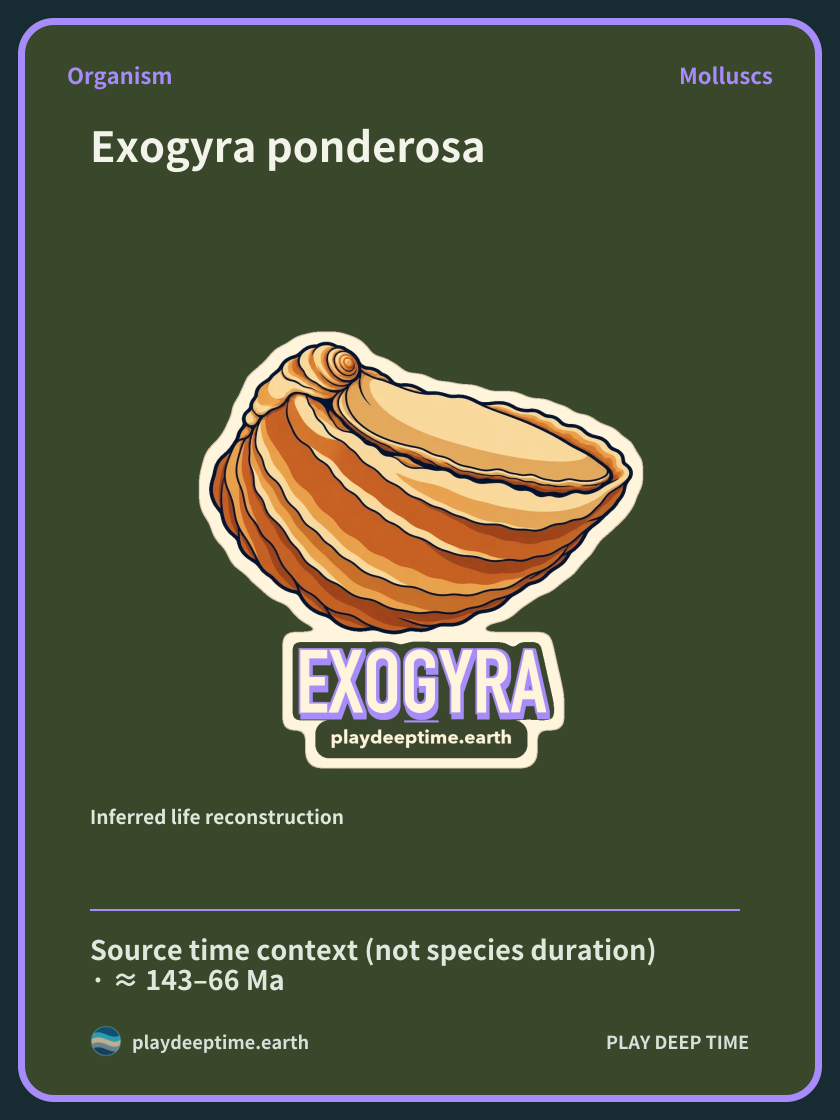
Exogyra ponderosa is a Cretaceous bivalve in which a flat right valve fits against a large, convex left valve. The two valves differ markedly in shape. Explore how two different pieces form the covering of one animal.[1]
Loading illustration…
Key facts
The small right valve fits inside the projecting margin of the large left valve. The contrast between a flat, lid-like valve and a convex valve relates to their articulation. Comparing the two reveals the body’s asymmetry more clearly.[1]
Time and place
Specimen USGS coll.6405d in the 1914 literature came from Blufftown in present-day Chattahoochee County, Georgia, USA. Its fossil-bearing unit is recorded as the Tombigbee Sand Member of the Eutaw Formation. The material is Late Cretaceous; the Cretaceous as a whole spans roughly 140–66 million years ago.[1][2][3]
The time range describes source context, not the complete duration of this species.
Size, form and skeleton
The left valve is large and convex, while the right is flat or slightly concave and lid-like. A spirally coiled umbo and concentric growth layers are also described. Examine the outline of the large valve separately from the smaller valve that fits within it.[1]
Exogyra ponderosa was an oyster with a thick, heavy shell. One adult described by the United States Geological Survey reaches a shell height of 17.7 cm, with a smaller upper valve covering a strongly inflated lower valve.[4]
Loading illustration…
Habitat and reproduction
The two valves surrounding the body are not matching shapes facing each other. A small, lid-like valve fits within the rim of a large valve. Following their differences and connections reveals varied ways of constructing a bivalve body.[1]
Fossil discovery
Figures 5–7 in an old plate show the same individual with both valves attached, viewed from several directions. Another plate shows the left and right valves and internal surfaces of a separate individual. Changing the viewing direction helped explain convexity and articulation.[1]
References
- Stephenson(1914). Cretaceous deposits of the eastern Gulf region and species of Exogyra. USGS Professional Paper 81.
- International Commission on Stratigraphy (2024) — Geological time chart
- US Census Bureau — Population statistics for Chattahoochee County
- Stephenson (1914), Species of Exogyra from the Eastern Gulf Region and the Carolinas, USGS Professional Paper 81
- García-Barrera (1995) — Toucasia from southwestern Mexico
Research questions
Do several illustrations always represent several different fossils? Following specimen numbers distinguishes different views of one individual from separate individuals. Separating the number of illustrations from the number of specimens helps comparisons of form.[1]
Observation
Move your gaze from the large convex valve to the flat, lid-like valve. Find where they meet inside the rim and locate the spiral umbo to understand the construction of Exogyra.[1]
Related organisms
 Toucasia hancockensisMolluscsSource time context (not species duration) · ≈ 143–66 Ma
Different bodies among bivalves
Explore the bodies of Exogyra ponderosa and Toucasia hancockensis together. Exogyra ponderosa: a Cretaceous bivalve with a flat right valve fitting against a large, convex left valve. Toucasia hancockensis: a Cretaceous bivalve with two valves of different sizes.