Organism · Molluscs
Fordilla troyensis
Source time context (not species duration) · ≈ 530–510 Ma
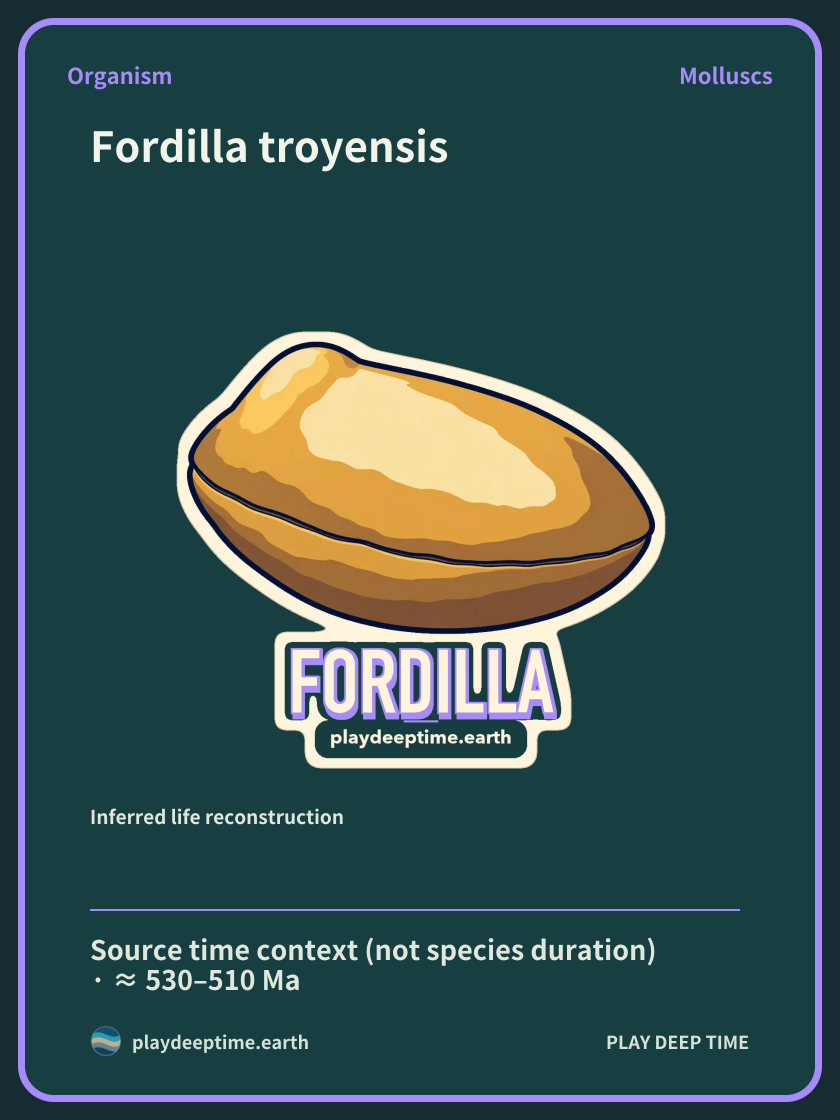
Inferred life reconstruction
Fordilla troyensis
Overview
Fordilla troyensis was a small early Cambrian bivalve. It is known from oval internal molds and material with both valves articulated. The outside and inside of its hard shell were preserved in different ways.[1]
Loading illustration…
Key facts
The off-center position of the umbo is used in genus-level discussions distinguishing Fordilla from Pojetaia. Even a small difference in position can help compare related organisms.[1]
Time and place
Early Cambrian material from the Bastion Formation in present-day northeastern Greenland has been studied. Registered fossil-bearing layers are summarized as approximately 530–510 million years old. Oval molds and articulated valves convey the form of bivalves of that time.[1][3]
The time range describes source context, not the complete duration of this species.
Size, form and skeleton
MGUH27014 is described as an internal mold of a left valve, and MGUH27015 as a damaged internal mold with both valves articulated. Its oval outline can be examined together with the off-center umbo.[1]
Fordilla troyensis was a very small two-shelled mollusk. Comparative values in a study based on illustrations of adults give a shell length of about 4 mm and a height of 2.4 mm. Comparing the length and height of a shell much smaller than a fingernail helps convey the compact form of an early bivalve.[4]
Loading illustration…
Habitat and reproduction
How did the two shells form a pair? Articulated material provides clues to their connection. Placing an internal mold of one valve alongside material preserving both together helps reveal the arrangement surrounding the body.[1]
Fossil discovery
Research on mollusks of the Bastion Formation described internal molds of a left valve and articulated paired valves. In 2011, internal shell microstructure was also studied. This illustrates research expanding from the overall outline to tiny structures within the shell wall.[1][2]
References
- Study of Early Cambrian molluscs from the Bastion Formation, northeast Greenland
- 2011 study — Internal shell microstructure of Fordilla
- Paleobiology Database — Age of fossil-bearing strata of Fordilla
- Elicki·Gürsu (2009) — Comparisons of the Cambrian bivalve Fordilla
- Witbaard (1997) — Reading the sea through shell growth lines
Research questions
Which parts of a shell does an internal mold reveal? The shape filling the shell’s interior and ornament on its outer surface provide different information. Fordilla material invites us to consider how the mode of fossil preservation determines what can be read.[1]
Observation
Move your gaze from the oval outline to the off-center umbo. Comparing material from one valve with articulated paired valves reveals both shell form and the connection between them.[1]
Related organisms
 Arctica islandicaMolluscsPresent
Different bodies among bivalves
Compare the bodies of Fordilla troyensis and Arctica islandica. Fordilla troyensis: a small early Cambrian bivalve. Arctica islandica: a bivalve whose shell growth records enable studies of the ocean.