Organism · Vascular plants
Gangamopteris cyclopteroides
Fossil record age bounds · ≈ 299–247 Ma
Inferred life reconstruction
Gangamopteris cyclopteroides
Overview
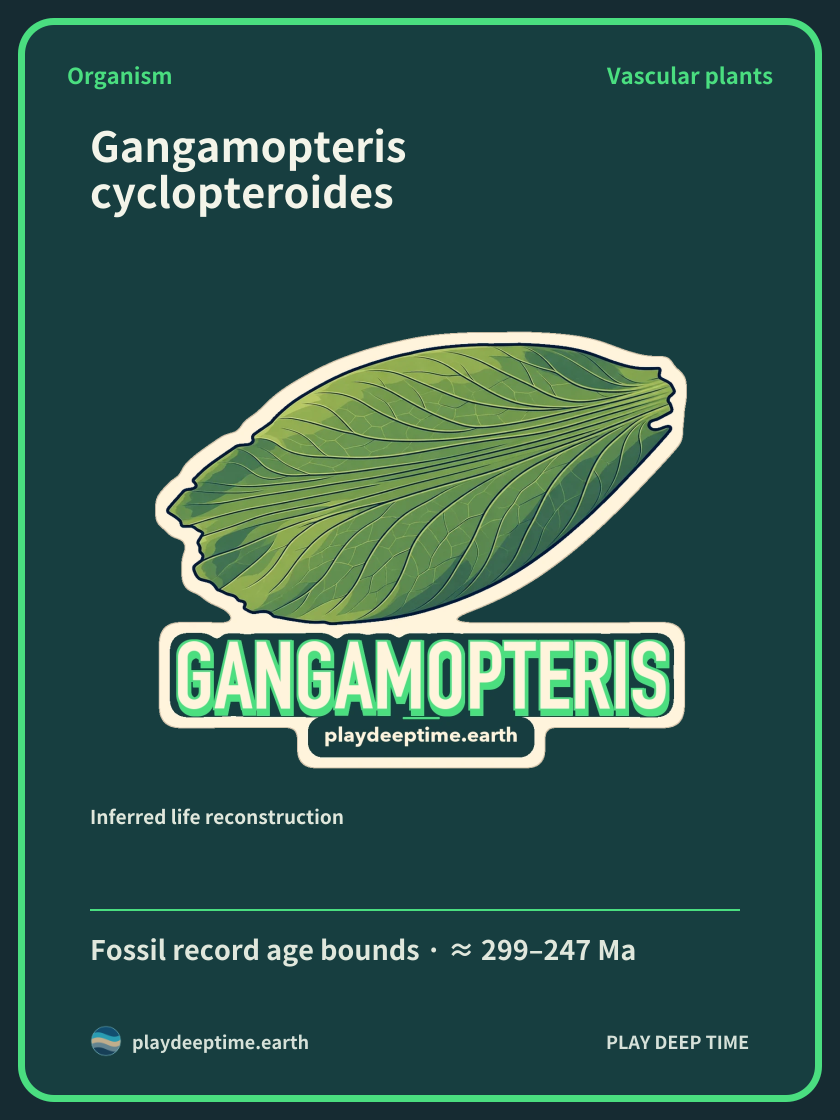
Gangamopteris cyclopteroides is an ancient plant encountered through fossil leaves. Its oval blade and veins running parallel along the center draw attention. Reading the outline and lines of a single leaf reveals a plant from the distant past.[1]
Loading illustration…
Key facts
A single leaf can also serve as the reference preserving a plant’s name. When the whereabouts of the original specimens became difficult to establish, researchers in 1968 selected GSI 5013 as the reference type. This leaf preserves its surface cuticle, but its tip and base are incomplete.[1]
Time and place
This species was first described from Early Permian leaves in the Talchir Group of India. Fossils of the species have also been studied at Chirimiri in the Son Basin of present-day central India. Following modern place names helps locate the setting of Permian Gondwanan plants.[1][2]
The time range describes source context, not the complete duration of this species.
Size, form and skeleton
A study comparing Indian specimens highlighted an oval outline widest around the middle of the blade. Parallel veins appear centrally. Viewing the outer outline together with the internal veins makes the leaf’s distinctive form clearer.[1]
Gangamopteris cyclopteroides has veins extending from the lower leaf and joining into a network. Sixteen leaf fossils in a 2025 study of India’s Talchir Formation had preserved lengths of approximately 4.6–9 cm. All were incomplete, so the original leaves may have been longer.[9]
Loading illustration…
Habitat and reproduction
The flora containing this species at Chirimiri is interpreted as representing surroundings of cool, wet terrestrial wetlands. This ancient landscape was reconstructed by combining several leaves, stems, and sediments found together. From damage patterns in the Gangamopteris leaves, the researchers also suggested that the plants may have grown some distance from the depositional site.[2]
Fossil discovery
The first description in 1876 began with a short account without illustrations. Descriptions and plates were added in 1879, and later researchers repeatedly compared those leaves. Connecting old illustrations with surviving specimens is also part of the story of fossil discovery.[1]
References
- Fernández·Césari (2019) — Leaf shape and the classification story of Gangamopteris
- Gupta et al. (2025) — Early Permian flora and environment of the Talchir Formation, Son Basin, India
- McLoughlin et al. (2005) — Permian plant fossils from Antarctica
- Fernández·Césari (2019) — Leaf shape and the classification story of Gangamopteris
- Gupta et al. (2025) — Early Permian flora and environment of the Talchir Formation, Son Basin, India
- Tewari et al. (2012) — Permian leaf fossils from the Umrer Coalfield, India
- Fernández·Césari (2019) — Leaf shape and the classification story of Gangamopteris
- Gupta et al. (2025) — Early Permian flora and environment of the Talchir Formation, Son Basin, India
- Gupta et al. (2025) — Early Permian flora of the Talchir Formation
Research questions
How can similar leaves be distinguished? Research compares this species with Gangamopteris obovata through leaf shape, the presence or absence of a central bundle of parallel veins, and the proportions of the vein meshes. Leaves wider toward the upper part have also been reported at Chirimiri.[1][2]
Observation
First find the widest area around the middle of the leaf. Then follow the parallel veins at its center. Even a seemingly simple leaf reveals new features when its outline and pattern are read separately.[1]
Related organisms
 Phyllotheca australisFern lineageFossil record age bounds · ≈ 290–251 Ma
Permian plants encountered through stems and leaves
Phyllotheca and Gangamopteris are Permian plant records from different regions and times. Examine the jointed stems and whorled leaves from Antarctica separately from the broad leaves and venation from India to compare the varied forms of Gondwanan plants.
 Noeggerathiopsis hislopiSeed plantsFossil record age bounds · ≈ 323–274 Ma
Permian leaves found in India
Compare Early Permian leaves found in present-day India. Noeggerathiopsis is known from the Barakar Formation of the Umrer Coalfield, while Gangamopteris cyclopteroides is known from Talchir Group material. Examine the outlines of an elongated leaf and an oval leaf, then move your gaze to their internal veins.