Organism · Reptiles including birds
Garjainia prima
Source time context (not species duration) · ≈ 252–201 Ma
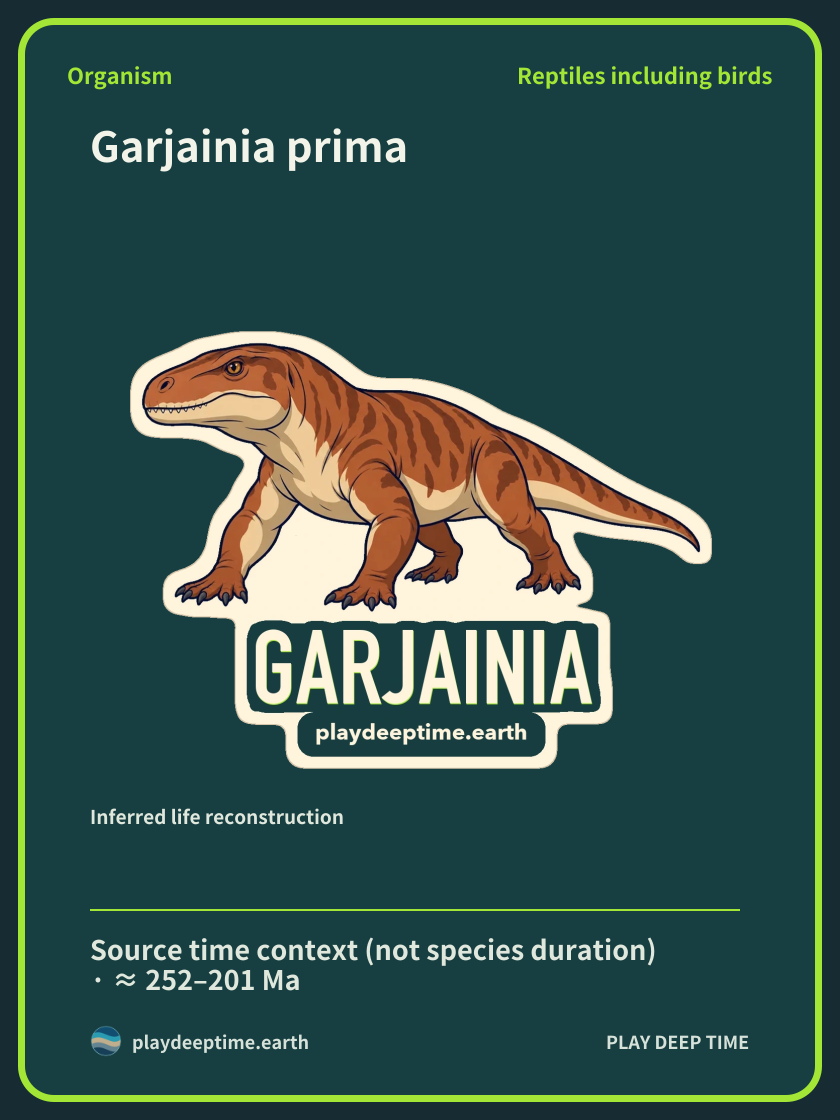
Inferred life reconstruction
Garjainia prima
Overview
Garjainia prima is an Early Triassic reptile studied for a large head, deep trunk, and long tail. Several bones of the trunk, shoulder, and forelimbs have been described in detail. Questions can broaden from the impression of its large head to structures supporting the body.[1]
Loading illustration…
Key facts
The scapula, clavicle, humerus, and ulna provide evidence extending from the trunk to the forelimb. Examining each bone’s shape reveals where body-supporting regions connect. There is a shoulder story hidden behind the head.[1]
Time and place
Early Triassic material from the European part of present-day Russia was studied. The Triassic as a whole was roughly 250–200 million years ago. A 2020 study examined body bones assigned to the species in detail.[1][2]
The time range describes source context, not the complete duration of this species.
Size, form and skeleton
The axial skeleton, shoulder region, clavicle, humerus, and ulna assigned to the species are described. The construction of a large head and trunk, four limbs, and a long tail is compared through several sources. Clues from the front and rear of the body can be examined separately.[1]
The skull alone of the type specimen of Garjainia prima is about 44cm long. Looking at skull length separately from total body length conveys how striking its long, robust head was.[3]
Loading illustration…
Habitat and reproduction
Where do the trunk and forelimbs connect? Research on Garjainia addresses the shoulder girdle, clavicle, and arm bones together. It is a way of reading a long body’s silhouette as several connections of shoulder and limbs.[1]
Fossil discovery
Researchers also reclassified material under the old name Vjushkovia triplicostata as this species. The 2020 study of body bones compared several specimens while clarifying these species assignments. This connects the history of names with skeletal descriptions.[1]
References
- Maidment et al. (2020) — Postcranial bones of Garjainia
- International Commission on Stratigraphy (2024) — Geological time chart
- Ezcurra et al. (2019) — The skeleton of the type specimen of Garjainia prima
- Mestriner et al.2026 — Tooth attachment and growth in rhynchosaurs
- Ezcurra, Montefeltro & Butler2016 — Early evolution of rhynchosaurs
Research questions
Why does organizing specimen names matter for research on body structure? Bringing together material regarded as belonging to one species makes comparisons of different bones easier. Garjainia research shows classification and anatomical description proceeding together.[1]
Observation
Move your gaze from the large head to the shoulder and forelimbs. Following the trunk to the long tail helps you consider several supporting structures within the broad outline.[1]
Related organisms
 Stenaulorhynchus stockleyiReptiles including birdsSource time context (not species duration) · ≈ 252–201 Ma
Different bodies among reptiles
Explore the bodies and living backgrounds of Garjainia prima and Stenaulorhynchus stockleyi together. Garjainia prima: Garjainia prima is an Early Triassic reptile studied for a large head, deep trunk, and long tail. Several bones of the trunk, shoulder, and forelimbs have been described in detail. Stenaulorhynchus stockleyi: Stenaulorhynchus stockleyi is a Triassic reptile with a short, robust head. It belongs to the plant-eating rhynchosaurs.