Organism · Birds and early avialans
Genyornis newtoni
Fossil record age bounds · ≈ 2.58–0.0117 Ma
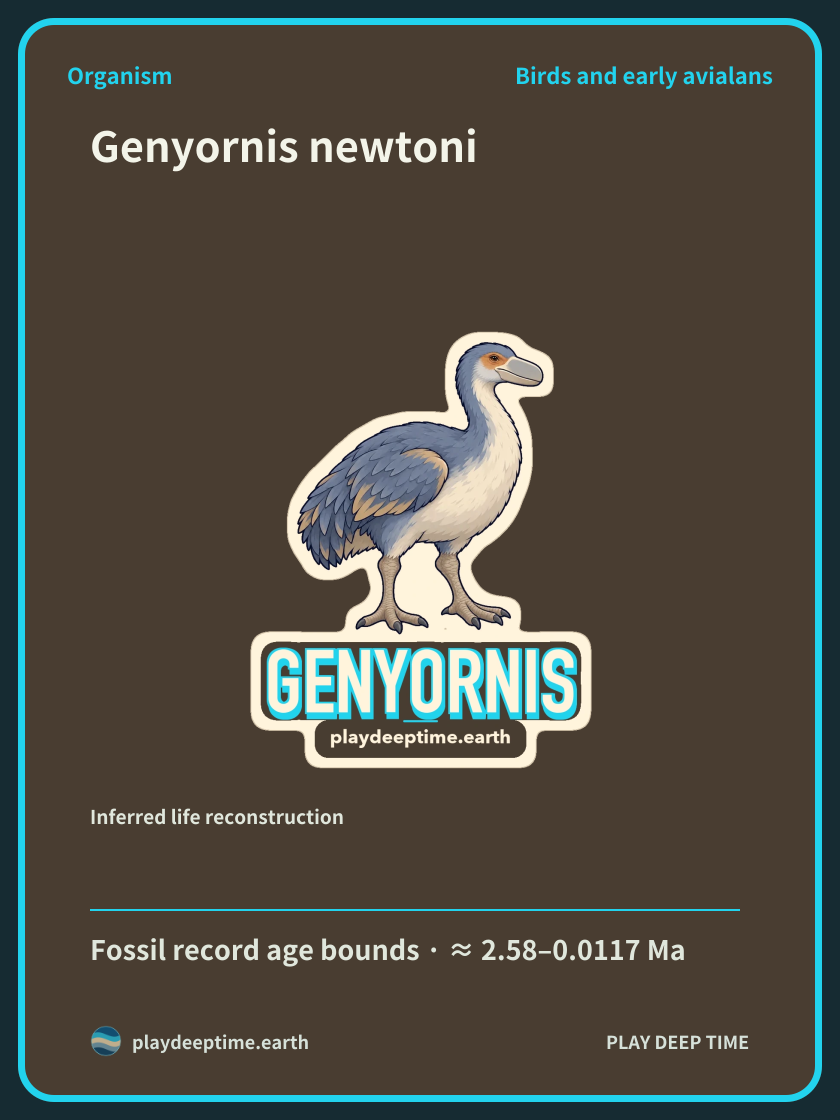
Inferred life reconstruction
Genyornis newtoni
Overview
Genyornis newtoni is a large flightless bird from Pleistocene Australia. Skulls from the Lake Callabonna locality provided clues for a fresh look at its beak and head structures. It offers a way to explore differences among giant fossil birds.[1]
Loading illustration…
Key facts
In 2024, researchers compared skull material from six specimens to redescribe the beak and head structures. Its beak shape differed even from related fossil birds. This is a case of finding distinctive features among birds that look similarly large.[1]
Time and place
It is known as a bird from Pleistocene Australia. The Lake Callabonna material used in the head study has a Late Pleistocene context. The Pleistocene as a whole was roughly 2.6 million–12,000 years ago.[1][2]
The time range describes source context, not the complete duration of this species.
Size, form and skeleton
It is a large flightless bird whose head and beak are important areas of research. The redescription compared head structures in six specimens side by side. You can focus on differences in the head rather than the overall body size.[1]
The Australian Museum gives Genyornis a height of about 2–2.25m.[3]
The same account gives an estimated body mass of about 220–240kg.[3]
Loading illustration…
Habitat and reproduction
Did all large flightless birds have similar heads? Research on Genyornis revealed a beak shape different from those of related fossil birds. The question narrows from a general impression of large birds to detailed form.[1]
Fossil discovery
Head fossils from Lake Callabonna led to a 2024 redescription. Researchers compared six specimens to reexamine this bird’s head. It is a case in which new material prompted a fresh look at a familiar fossil animal.[1]
References
Research questions
What becomes clearer when several skulls are compared together? The shapes of individual regions can be examined alongside differences from related fossil birds. A question beginning with one specimen expands into comparisons among several sources of evidence.[1]
Observation
Narrow your gaze from the impression of the large body to the head and beak. Imagining it beside the heads of related fossil birds helps you focus on the differences found in the redescription of Genyornis.[1]
Related organisms
 Titanis walleriBirds and early avialansFossil record age bounds · ≈ 5.33–1.8 Ma
Different bodies among birds
Explore the bodies and living backgrounds of Genyornis newtoni and Titanis walleri together. Genyornis newtoni: Genyornis newtoni is a large flightless bird from Pleistocene Australia. Skulls from the Lake Callabonna locality provided clues for a fresh look at its beak and head structures. Titanis walleri: Titanis walleri is a large flightless terror bird known from North America. It has been studied for its small wings and large bipedal body.