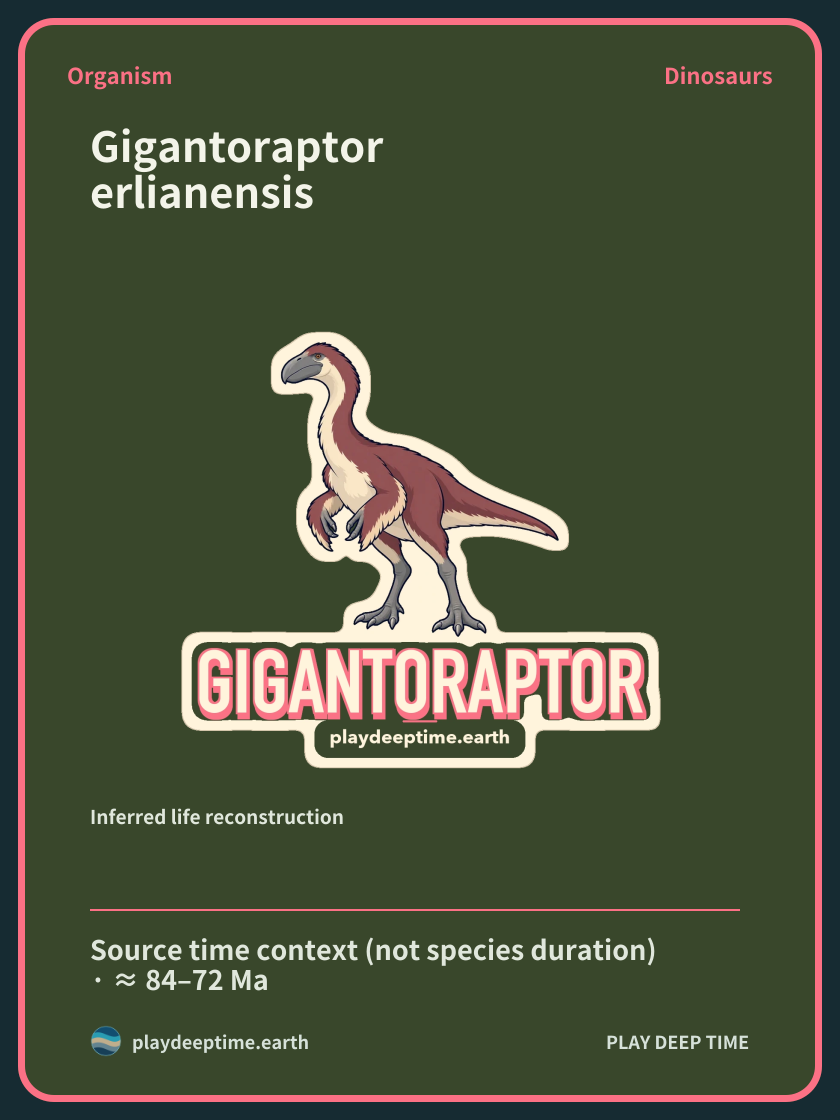
Organism · Dinosaurs
Gigantoraptor erlianensis
Source time context (not species duration) · ≈ 84–72 Ma
Inferred life reconstruction
Gigantoraptor erlianensis
Overview
This dinosaur combined a huge body with a bird-like beak. Gigantoraptor erlianensis dramatically changed the familiar image of oviraptorosaurs as small animals. Its size and bird-like features are fascinating to consider together.[2]
Loading illustration…
Key facts
A large beak did not necessarily mean a powerful bite. A 2017 study examined the deep, rounded lower jaw and discussed the possibility that closely related groups differed in how they sliced and crushed food. Beak shape leads to questions about food processing.[1]
Time and place
It is known from Late Cretaceous strata within an approximate age range of 84–72 million years ago. The locality is in the Iren Dabasu area of present-day Inner Mongolia, China. An unexpectedly huge, bird-like body thus appeared in a world of diverse Asian dinosaurs.[3][2]
The time range describes source context, not the complete duration of this species.
Size, form and skeleton
A 2007 study estimated its body mass at about 1.4 tonnes. The lower jaw is toothless, with a deep, rounded outline. Imagining it alongside smaller oviraptorosaur relatives makes it clear why this dinosaur attracted so much interest.[2][1]
Loading illustration…
Habitat and reproduction
How it handled food can be investigated through the structure of the jaw joint and the action of the muscles. Gigantoraptor's deep beak is also compared with those of some living birds. Rather than assigning it one particular diet, we can examine what traces slicing and crushing leave in the body's structure.[1]
Fossil discovery
It was introduced as a new dinosaur in Nature in 2007, expanding the known body-size range of oviraptorosaurs. The type specimen LH V0011 later became the subject of detailed study of the lower jaw. After the enormous discovery came the task of reading the jaw's small contours.[2][1]
References
- Ma et al. (2017), Functional anatomy of a giant toothless mandible from a bird-like dinosaur: Gigantoraptor and the evolution of the oviraptorosaurian jaw, Scientific Reports.
- Xu et al. (2007), A gigantic bird-like dinosaur from the Late Cretaceous of China, Nature 447:844–847.
- Paleobiology Database — Fossil occurrence records for Gigantoraptor erlianensis
- American Museum of Natural History — The crest of Corythosaurus
- Maidment et al. (2012) — Limb proportions and posture of ornithischians
- Brown (1914) — Description of Corythosaurus casuarius
- International Commission on Stratigraphy (2024) — Geological time chart
Research questions
How did bird-like body features and gigantic size evolve together? Comparing its jaws with those of smaller relatives suggests that food processing, as well as body size, may have differed. What makes this dinosaur special is that it was not simply an enlarged copy.[1][2]
Observation
Examine the deep beak, long legs and overall body proportions together.[1][2]
Related organisms
 Corythosaurus casuariusDinosaursSource time context (not species duration) · ≈ 143–66 Ma
Different bodies in two beaked dinosaurs
Explore the bodies and living contexts of Gigantoraptor erlianensis and Corythosaurus together. Gigantoraptor erlianensis: This dinosaur combined a huge body with a bird-like beak. Gigantoraptor erlianensis dramatically changed the familiar image of oviraptorosaurs as small animals. Corythosaurus: Corythosaurus casuarius is a dinosaur known for a tall, helmet-shaped crest and a long, narrow beak. Genus-level accounts also describe the nasal passages extending into the crest. Gigantoraptor erlianensis: It is known from Late Cretaceous strata within an approximate age range of 84–72 million years ago. The locality is in the Iren Dabasu area of present-day Inner Mongolia, China. Corythosaurus: It was a Cretaceous dinosaur. The Cretaceous spans roughly 140–66 million years ago.