Organism · Seed plants
Ginkgo adiantoides
Source time context (not species duration) · ≈ 56–23 Ma
Inferred life reconstruction
Ginkgo adiantoides
Overview
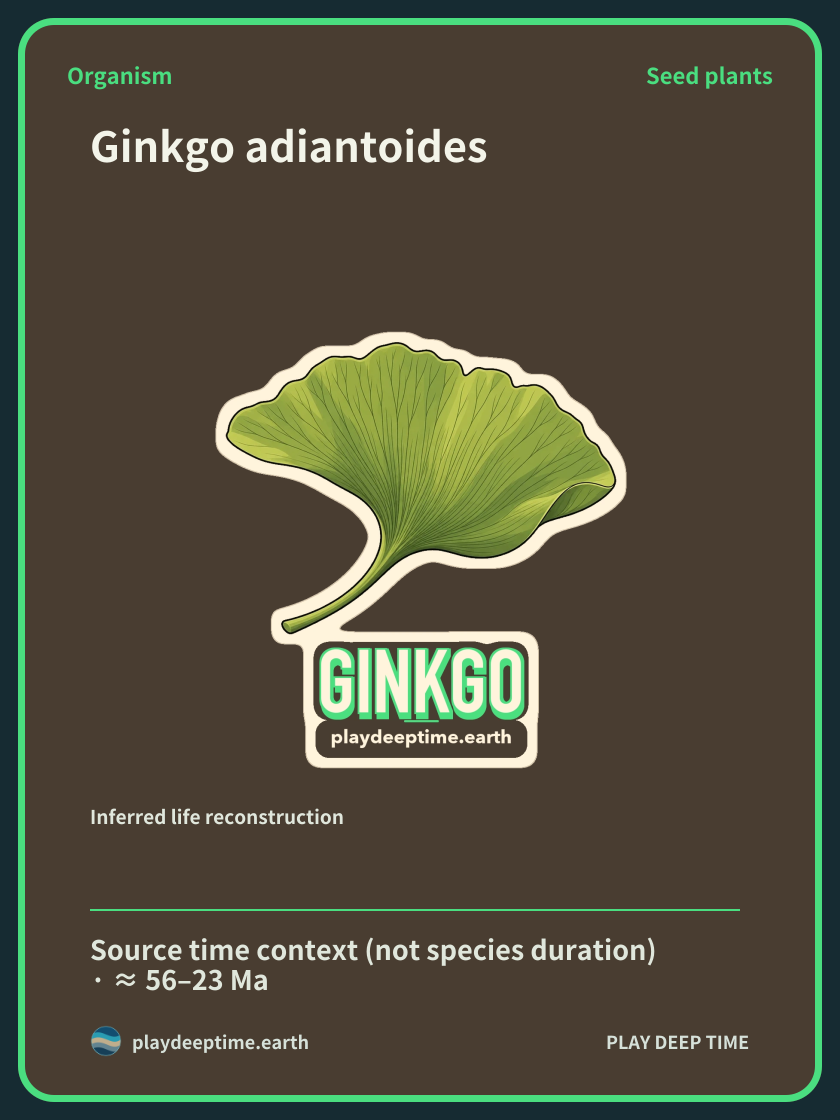
Ginkgo adiantoides is a ginkgo relative known from fan-shaped fossil leaves. Researchers compare veins that fork in two and varied leaf margins. Its close resemblance to living ginkgo invites side-by-side examination of ancient and modern leaves.[1][2][3]
Loading illustration…
Key facts
The leaves resemble familiar ginkgo leaves so closely that their identity as the same species has been debated. Some researchers proposed treating the fossil leaves and living ginkgo as one species. This raises questions about how far similar leaves should be grouped under one name.[1]
Time and place
UCM40801 is presented as a fossil leaf from the Kuchin Formation in present-day Siberia. The formation is described as late Eocene or early Oligocene, approximately 35–30 million years old. This leaf provides comparative material for Cenozoic ginkgo form.[1]
The time range describes source context, not the complete duration of this species.
Size, form and skeleton
The leaves are fan-shaped, with veins dividing in two and extending in an open pattern. Variants with undivided or slightly lobed margins are described. Overall leaf outlines and small vein branches can be examined separately.[2][3]
Two leaves studied from Austria’s Lavanttal Basin had blade lengths of 35–46 mm. This measures the fan-shaped portion excluding the leaf stalk.[4]
Loading illustration…
Habitat and reproduction
Leaf shape and epidermis help researchers study the organization of fossil plant organs. Comparisons have continued between Siberian specimens and ginkgo-like leaves from other regions. One small leaf becomes evidence for ancient plant diversity.[1][2]
Fossil discovery
Museums present Siberian specimen UCM40801 as a leaf resembling living ginkgo. Other studies compared veins, margins, and epidermal structures. Leaves from different regions connect through research on ginkgo form.[1][2]
References
- Fossil ginkgo leaves from Siberia
- Study of leaves and cuticles of Cenozoic ginkgoaleans from the Mediterranean
- Falkland fossil flora — Ginkgo-like leaves
- Meller et al. — Ginkgo adiantoides fossils from the Lavanttal Basin
- Wolfe & Wehr (1987) — USGS Bulletin 1597 · Species description of Macginitiea gracilis
- Burke Museum — Republic Macginitiea gracilis leaf
Research questions
Do all similar leaves belong to the same species? Researchers compare fossils with living species by examining lobing, veins, and epidermis together. This raises questions about the features most important for connecting ancient leaves with modern trees.[1][2][3]
Observation
After examining the overall fan-shaped outline, follow points where veins divide into two. Finally, look at the lobing along the margin to reveal differences among ginkgo-like leaves.[2][3]
Related organisms
 Macginitiea gracilisFlowering plantsSource time context (not species duration) · ≈ 61–34 Ma
Different bodies among plants
Explore ginkgo leaves and Macginitiea gracilis together. Ginkgo leaves: Ginkgo adiantoides is a ginkgo relative known from fan-shaped fossil leaves. Macginitiea gracilis: an ancient plant with leaves spreading into five lobes like a hand.