Organism · Dinosaurs
Giraffatitan brancai
Source time context (not species duration) · ≈ 201–143 Ma
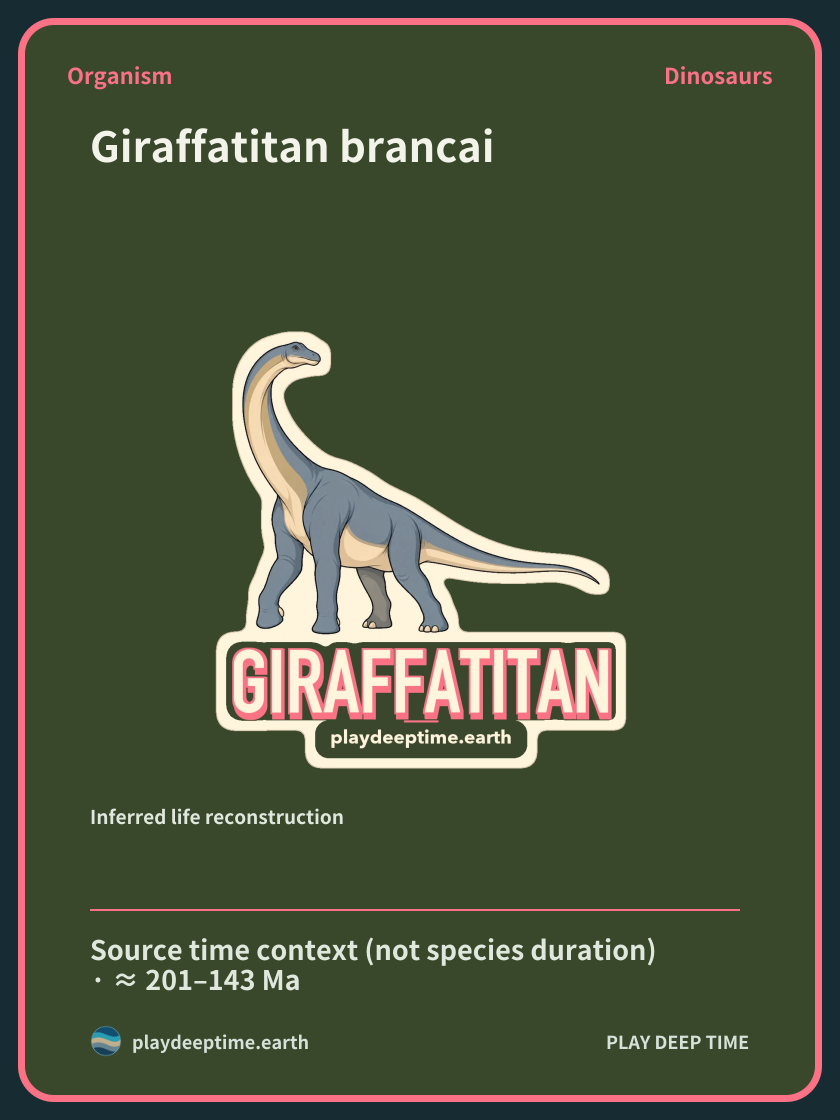
Inferred life reconstruction
Giraffatitan brancai
Overview
Giraffatitan brancai was a sauropod distinguished by high shoulders and a long neck. A relatively short trunk connects to the elevated front of the body. Multiple fossils have helped reveal the complete skeleton of this giant dinosaur.[1][2]
Loading illustration…
Key facts
Even an enormous mounted skeleton brings together the stories of several specimens. Nearly every skeletal region of Giraffatitan is known through multiple individuals. Individual bones combine to explain its high-shouldered, long-necked body.[1][2]
Time and place
It is known from the Late Jurassic of Tendaguru in present-day Tanzania. Its fossil-bearing layers date to around the Kimmeridgian and Tithonian, approximately 155–145 million years ago. A museum display in present-day Berlin is connected to the African locality where the fossils were found.[1][2][3]
The time range describes source context, not the complete duration of this species.
Size, form and skeleton
The shoulders are high, the neck is long, and the trunk is relatively short. Postcranial bones, neck vertebrae, and forelimbs and hind limbs can be compared across several specimens. The relationship between the high front of the body and the trunk is as distinctive as the long neck’s outline.[1]
The composite skeleton mounted at Berlin’s Museum für Naturkunde stands 13.27 m high. This is its height in the display pose with the neck raised, conveying the scale of the dinosaur.[5]
Loading illustration…
Habitat and reproduction
Its body allows comparisons of a sauropod with a long neck and high shoulders. The museum explains the posture of holding the tail above the ground in relation to body support and movement. It encourages exploration of how the parts of a large body balance one another.[1][2]
Fossil discovery
Multiple fossils collected at Tendaguru led to research and display of a large skeleton. A 2009 reassessment compared it with Brachiosaurus and treated Giraffatitan as a separate genus. Even a famous mounted skeleton can change in name and interpretation through comparative research.[1][2]
References
- Taylor (2009) — Reassessment of Brachiosaurus and Giraffatitan
- Museum für Naturkunde Berlin — The world of dinosaurs
- International Commission on Stratigraphy (2024) — Geological time chart
- Mallison (2011) — The tail and defensive function of Kentrosaurus
- Museum für Naturkunde Berlin — Giraffatitan display skeleton
Research questions
How did similar long-necked dinosaurs differ? Researchers compare the proportions of the neck, shoulders, trunk, and limbs together. Reading small differences in the body is an important way to distinguish sauropods.[1]
Observation
Follow the neck rising from the high shoulders. Examining the relatively short trunk behind the shoulders and the long tail further reveals this sauropod’s body plan.[1]
Related organisms
 Kentrosaurus aethiopicusDinosaursSource time context (not species duration) · ≈ 201–143 Ma
Another Jurassic dinosaur known from Tendaguru
Giraffatitan and Kentrosaurus are known from Late Jurassic fossils at Tendaguru. A long-necked sauropod and a dinosaur with plates and spines can be compared within the background of the same region and period.