Organism · Foraminifera
Globigerina bulloides
Fossil record age bounds · ≈ 85.7–0 Ma
Inferred life reconstruction
Globigerina bulloides
Overview
Globigerina bulloides, also known by the Korean common name Keun-al-gyeop-gong-yugongchung, is a tiny marine organism with a series of rounded chambers. Although it looks like several compartments, its body is a single cell. Specimens from today's seas can be studied alongside a long fossil record.[2][1]
Loading illustration…
Key facts
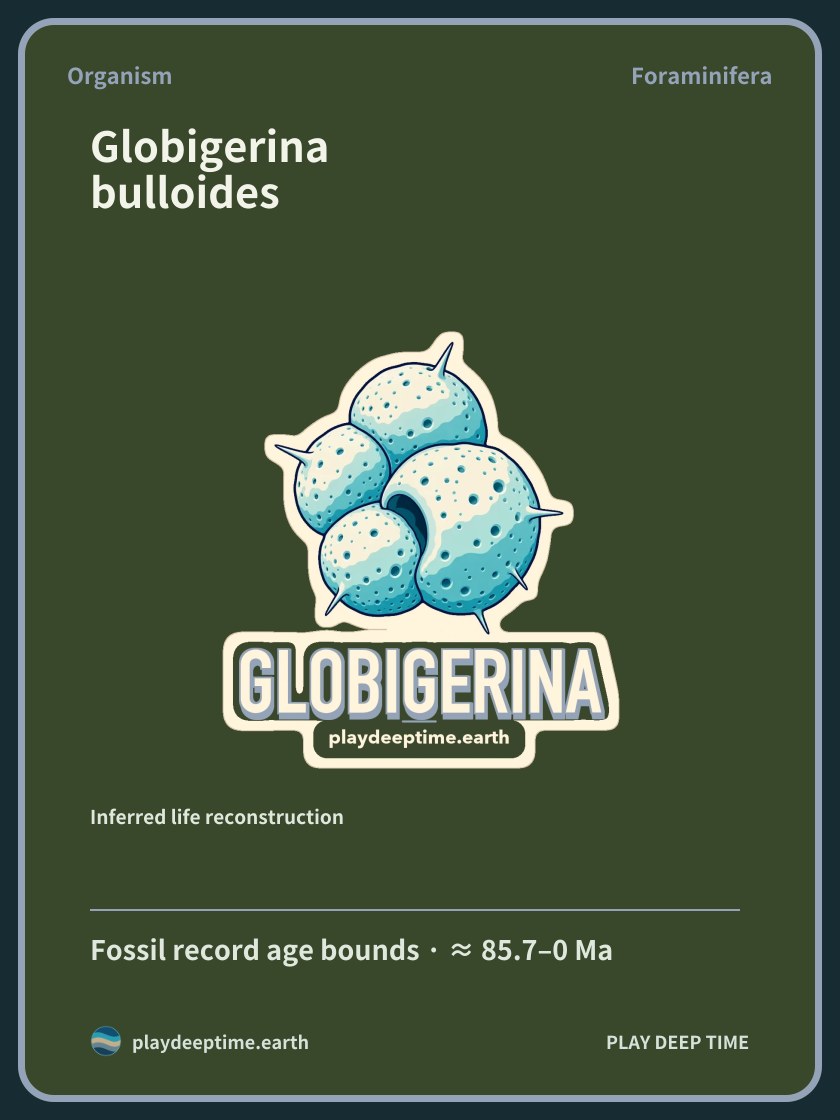
Rather than forming one smooth sphere, several rounded chambers form a spiral. The four chambers of the final whorl and the large central opening catch the eye. Even similar-looking foraminifers differ in wall texture and openings when examined closely.[2]
Time and place
Its record extends from around 28 million years ago in the Late Oligocene to the present. Today it occurs in seas ranging from temperate toward polar regions. It can also be found in upwelling areas where cold deep water rises.[2][3]
The time range describes source context, not the complete duration of this species.
Size, form and skeleton
Rounded chambers become progressively larger along a low spiral. A broad, arch-shaped opening lies toward the central umbilical region. Small pores and spines on the shell surface, along with grooves between chambers, are also characteristic.[2][1]
In a study of northeastern Atlantic specimens, the shell's Feret diameter was about 163–446 µm. Feret diameter refers to a width measured across the shell's outer outline.[6]
Loading illustration…
Habitat and reproduction
It is a planktonic foraminifer living suspended in seawater. Its present distribution helps researchers study cold-water and upwelling environments. Comparing the environments of living specimens with shells in sediments allows exploration of ancient seas.[2]
Fossil discovery
The name dates back to d'Orbigny's classification in 1826. Subsequent research refined its characteristics by comparing similar shells. It was addressed again in a 2019 taxonomic study of living foraminifers.[2][1]
References
- Symphonia & Senthil2019 — Taxonomy of living foraminifera from the Bay of Bengal
- Mikrotax — Morphology and classification of Globigerina bulloides
- Mikrotax — Temporal distribution of Globigerina
- Symphonia & Senthil2019 — Taxonomy of living foraminifera from the Bay of Bengal
- Symphonia & Senthil2019 — Taxonomy of living foraminifera from the Bay of Bengal
- Study of seasonal shell calcification in northeastern Atlantic planktonic foraminifera
Research questions
How does a shell made of a series of rounded chambers differ from one enclosed in a single large sphere? Comparison with Orbulina reveals different ways foraminifers grow. Distinguishing similar shells is a starting point for reading the history of the sea.[2]
Observation
Follow the chambers around the spiral and find the large opening toward the umbilical region. Within the rounded overall outline, look for chambers of different sizes and variations in surface texture.[2]
Related organisms
 Orbulina universaForaminiferaFossil record age bounds · ≈ 85.7–0 Ma
Different ways shells grow
Orbulina ultimately encloses its early chambers in a spherical chamber. In Globigerina, the rounded chambers arranged in a spiral remain visible externally. Compare these different ways of building a body among foraminifers that float in the sea.