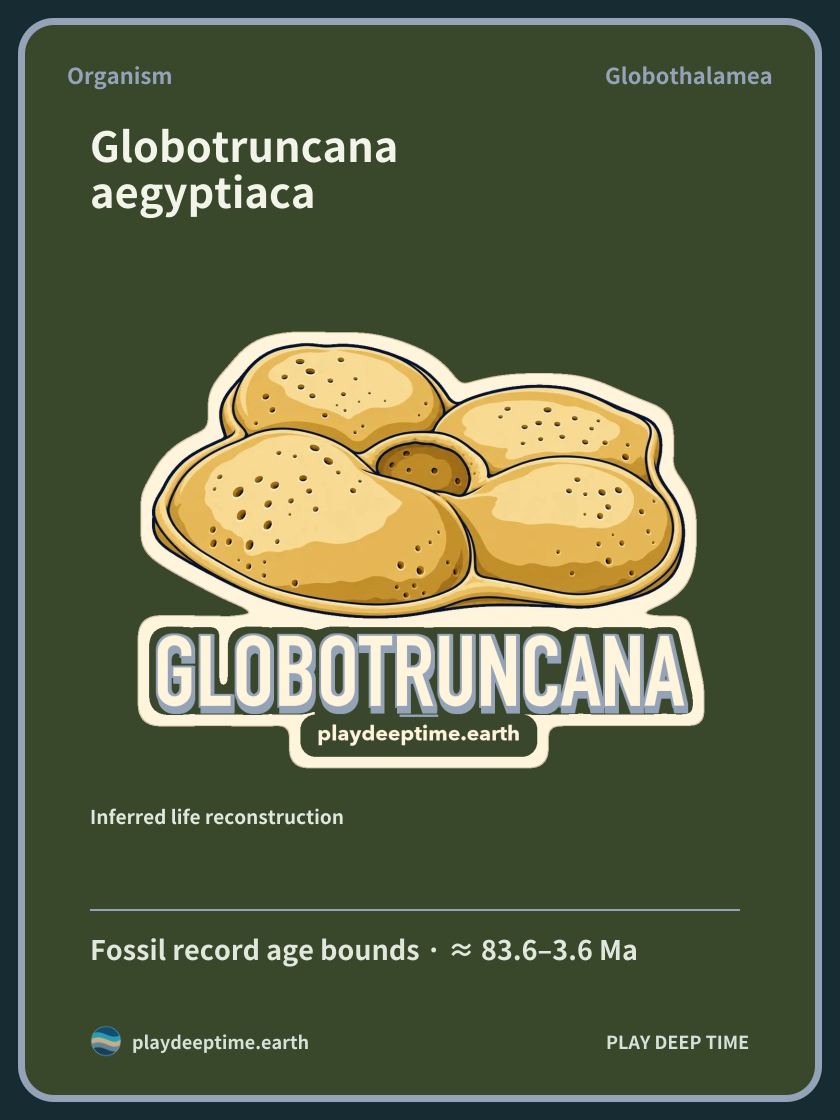
Organism · Globothalamea
Globotruncana aegyptiaca
Fossil record age bounds · ≈ 83.6–3.6 Ma
Inferred life reconstruction
Globotruncana aegyptiaca
Overview
Globotruncana aegyptiaca is a foraminifer that forms chambers spreading like petals. A single cell built a small shell divided into several chambers. It is one of the microfossils used to read time in the seas of the dinosaur age.[1][2]
Loading illustration…
Key facts
The same shell can look like a different object when turned over. Its dorsal side is flat, while its ventral side is convex. Seen from above, the outlines of the four chambers in the final whorl recall small petals.[1]
Time and place
It is associated with seas of the Late Cretaceous Campanian and Maastrichtian. Its occurrence range in microfossil catalogs extends approximately from 74 to 68 million years ago. The study that first named it examined Cretaceous strata in present-day Egypt.[3][2]
The time range describes source context, not the complete duration of this species.
Size, form and skeleton
The final whorl usually contains four chambers. In the original description, a single sharp rim, or keel, stands out along the shell margin. An arched aperture opens into the broad umbilical area.[1]
The shell of the type specimen in the original description is 0.50 mm long.[4]
Loading illustration…
Habitat and reproduction
This organism belongs to a group of planktonic marine foraminifera. As a single cell grew, it added chambers to a small shell that survived in marine sediments. It offers a view of ancient Earth at a scale entirely different from large dinosaur fossils on land.[1][2]
Fossil discovery
In 1950, Nakkady described this species while studying Cretaceous microfossils from Egypt. Current specialist catalogs connect the original description with later taxonomic research. The form of this tiny shell has been compared for decades.[2][1]
References
- Mikrotax — Original description and morphology of Globotruncana aegyptiaca
- Nakkady1950 — Study of Cretaceous microfossils from Egypt
- Mikrotax — Stratigraphic distribution of Globotruncana
- Nakkady (1950) — Transcription of the original description of Globotruncana aegyptiaca
- Nuttall (1930) — Original description of Morozovella
- Berggren·Pearson (2006) — Morphology and classification of Morozovella
Research questions
Does a difference in a rim reflect growth or a feature of a different species? Taxonomic studies examine chambers and keels across several specimens. Which forms belong under the same name is also reconsidered over time.[1]
Observation
Alternate between the flat dorsal and convex ventral sides. Count the chambers in the final whorl and find the marginal rim and umbilical aperture to reveal the structure of the small shell.[1]
Related organisms
 Morozovella aragonensisGlobothalameaSource time context (not species duration) · ≈ 56–33.9 Ma
Different bodies among foraminifera
Explore the bodies of Globotruncana aegyptiaca and Morozovella aragonensis together. Globotruncana aegyptiaca: Globotruncana aegyptiaca is a foraminifer that forms chambers spreading like petals. Morozovella aragonensis: Morozovella aragonensis is an Eocene foraminifer with a calcareous shell whose small chambers form a spiral.