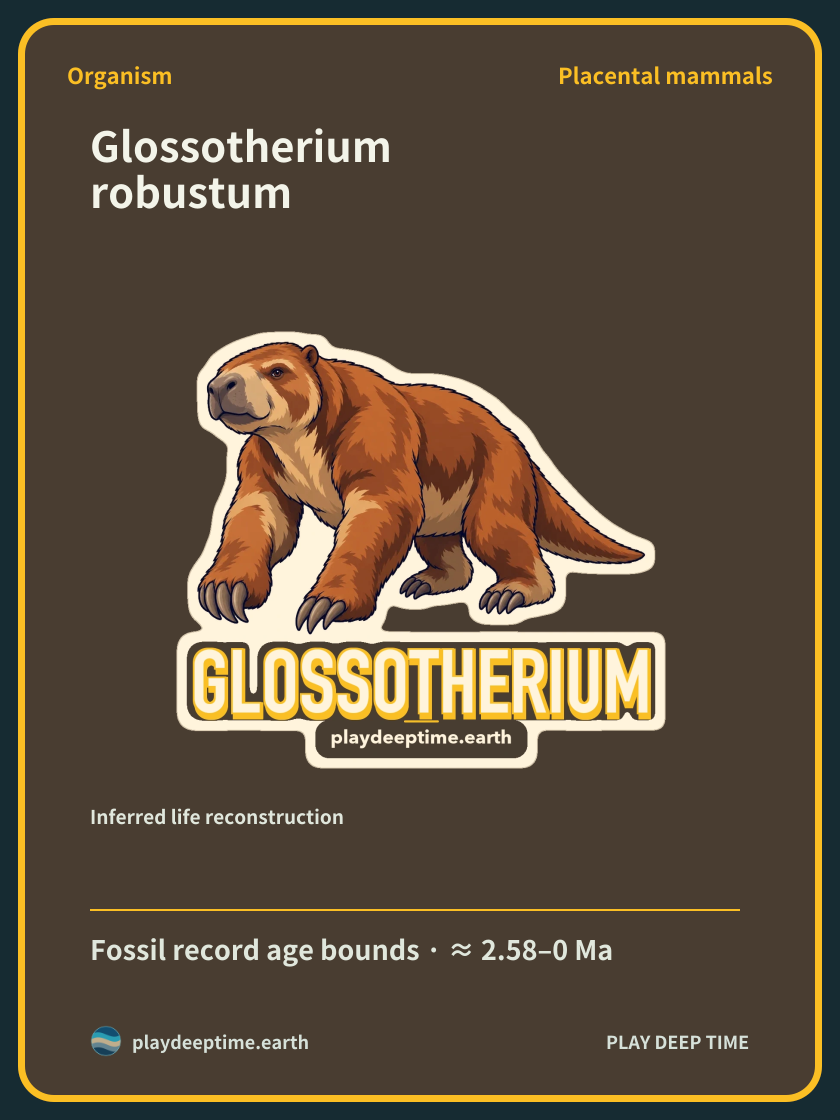
Organism · Placental mammals
Glossotherium robustum
Fossil record age bounds · ≈ 2.58–0 Ma
Inferred life reconstruction
Glossotherium robustum
Overview
Glossotherium robustum is an extinct ground sloth known from skull, jaw, trunk, and limb material. It belongs to Mylodontidae. A reexamination of a specimen from Chile gives a detailed account of its form and classification.[1]
Loading illustration…
Key facts
Material associated with SGO.PV.2 from Chile included nine small bony ossicles from within the skin. Such ossicles in mylodontid ground sloths differ from the interlocking armor of armadillos. Beyond the body’s large outline, a story of small bones also survives.[1]
Time and place
SGO.PV.2 appears in a study of Late Pleistocene material from present-day central Chile. The Pleistocene was roughly 2.6 million–10,000 years ago. Fossils held at Chile’s National Museum of Natural History offer a view of South American ground sloths.[1][2]
The time range describes source context, not the complete duration of this species.
Size, form and skeleton
This specimen includes the skull and lower jaw, neck and back vertebrae, ribs, and several bones of the forelimbs and hind limbs. The description also addresses the head widening toward the rear and the broadly flared front of the lower jaw. Different parts of the head and body can be compared separately.[1]
Specimen SGO.PV.2, studied in Chile, has an upper tooth-row length of 145mm. Rather than the length of the whole body, this number shows the scale of the jaw used for chewing.[3]
Loading illustration…
Habitat and reproduction
Large skeletons are not the only evidence for examining the body. Small ossicles within the skin raise questions about the relationship between bones and the tissues covering the body. Even within the same broad family tree, ground-sloth ossicles and the articulated armor of armadillos have different constructions.[1]
Fossil discovery
This specimen was previously treated under the name Glossotherium lettsomi. A 2017 study compared head shape and described the body skeleton, reassigning it to robustum. This is a case in which a fresh reading of a museum specimen changed the species record.[1]
References
- 2017 study — A Glossotherium specimen from Chile
- International Commission on Stratigraphy (2024) — Geological time chart
- TAXONOMIC COMMENTS OF A GLOSSOTHERIUM SPECIMEN FROM THE PLEISTOCENE OF CENTRAL CHILE
- Colombian Geological Survey — Megatherium and Eremotherium
- La Brea Tar Pits — The Peruvian megafaunal animal Eremotherium
Research questions
What should we examine when reassigning an old specimen to a species? This study used comparisons of skull form together with phylogenetic analysis. Rather than simply following a familiar name, researchers explore classification by comparing the preserved features anew.[1]
Observation
Move your gaze from the broad rear of the head to the front of the jaw. Then examine the trunk and limbs separately to consider together the information from several parts preserved in one specimen.[1]
Related organisms
 Eremotherium laurillardiPlacental mammalsSource time context (not species duration) · ≈ 2.58–0.0117 Ma
Different bodies among ground sloths
Explore the bodies of Glossotherium robustum and Eremotherium together. Glossotherium robustum: Glossotherium robustum is an extinct ground sloth known from skull, jaw, trunk, and limb material. Eremotherium: Eremotherium laurillardi is an extinct ground sloth with large limbs, a long tail, and large foreclaws.