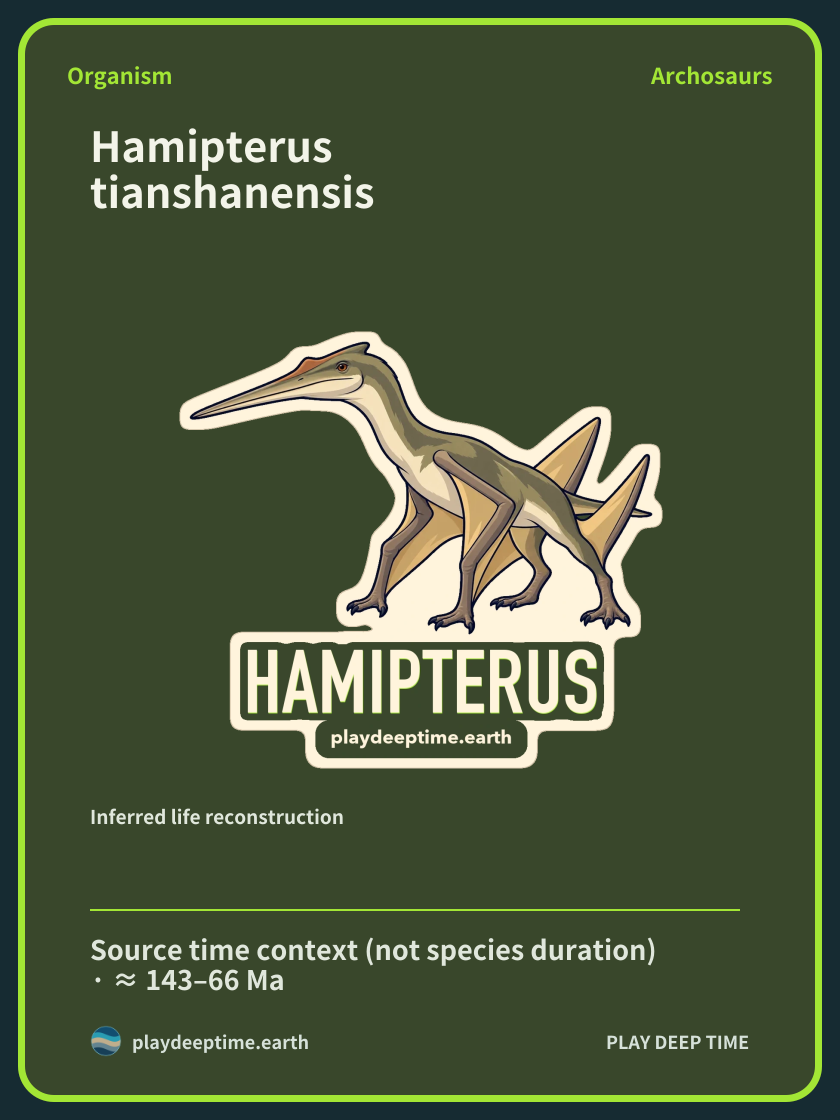
Organism · Archosaurs
Hamipterus tianshanensis
Source time context (not species duration) · ≈ 143–66 Ma
Inferred life reconstruction
Hamipterus tianshanensis
Overview
Hamipterus tianshanensis is an Early Cretaceous pterosaur. Skulls and postcranial bones from several individuals and separate articulated forelimb material have been studied. Even one fossil block can preserve the stories of several animals.[1][2]
Loading illustration…
Key facts
One fossil block does not necessarily represent one animal. V18931 contains several skulls, forelimbs, and other postcranial bones together. Identifying each bone is a starting point for understanding the pterosaur’s appearance.[1]
Time and place
It is studied through Early Cretaceous material from present-day China. The Cretaceous spanned approximately 140–66 million years ago. Research comparing pterosaur bodies continues through fossils left by several individuals.[1][3]
The time range describes source context, not the complete duration of this species.
Size, form and skeleton
V18931.1 is the skull specimen anchoring the name. A separate specimen, V33949, preserves a nearly complete articulated right forelimb. It reveals the wing’s arrangement of bones connecting the shoulder, elbow, and wrist.[1][2]
Wingspans of approximately 40 Hamipterus tianshanensis individuals reported in 2014 were estimated at approximately 1.5–3.5 m. Individuals of different sizes were found together at one locality, allowing changes during growth to be compared.[4]
Loading illustration…
Habitat and reproduction
A 2014 study addressed three-dimensionally preserved pterosaurs together with eggs. Alongside evidence from several body regions, this provides a setting for exploring reproduction. Articulation in the forelimb separately offers clues to the arrangement of wing bones.[1][2]
Fossil discovery
The 2014 description addressed material containing the heads and postcranial bones of several individuals. A 2026 forelimb study explained shoulder, elbow, and wrist articulation in the separate specimen V33949. Discoveries of new body regions reveal an already known pterosaur in greater detail.[1][2]
References
- Wang et al. (2014) — Hamipterus and eggs preserved in three dimensions
- 2026 study — An articulated forelimb of Hamipterus
- International Commission on Stratigraphy (2024) — Geological time chart
- Chinese Academy of Sciences (2014) — Hamipterus fossil assemblage and eggs
- Young (1964) — New pterosaurs from Xinjiang
Research questions
How can the features of a species be identified in material preserving several individuals together? Researchers compare skulls and examine connections among postcranial bones to organize the information each specimen provides. A newly articulated forelimb also serves as an important reference for comparing isolated wing bones.[1][2]
Observation
Move your gaze from the head to the shoulder, elbow, and wrist. Imagining several connected arm bones within the broad outline of the wing makes the pterosaur’s body more tangible.[2]
Related organisms
 Dsungaripterus weiiArchosaursSource time context (not species duration) · ≈ 143–66 Ma
Different bodies among pterosaurs
Explore the bodies of Hamipterus tianshanensis and Dsungaripterus weii together. Hamipterus tianshanensis is an Early Cretaceous pterosaur. Dsungaripterus weii is a pterosaur characterized by an upturned beak tip and a crest along the middle of its head.