Organism · Animals
Haplophrentis carinatus
Source time context (not species duration) · ≈ 539–487 Ma
Inferred life reconstruction
Haplophrentis carinatus
Overview
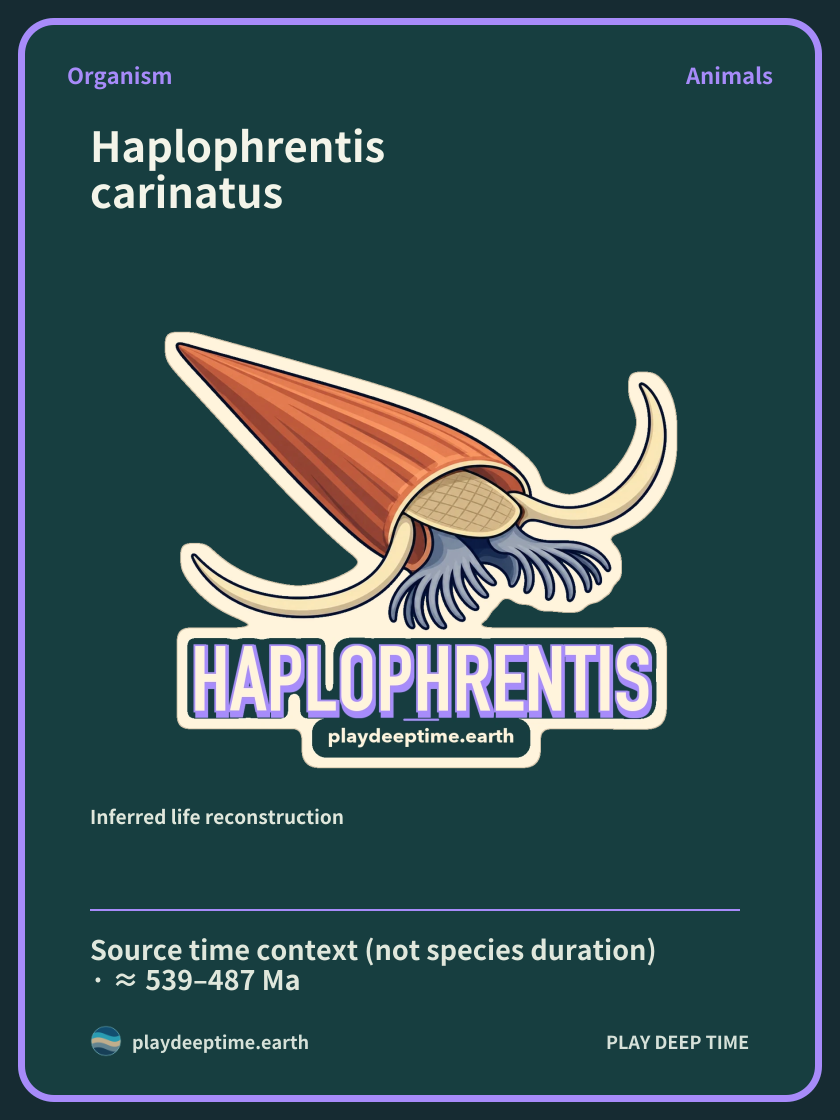
Haplophrentis carinatus is an organism known for a conical shell, a lid, and two structures curving outward to either side. Different parts can be found at the front, back, and around its small body. Research on the shell and soft body has developed together.[1][2]
Loading illustration…
Key facts
The curved hard structures on either side are called helens. Later research interpreted them as supports that held the shell opening above the seafloor.[1][2]
Time and place
The museum presents it as a Middle Cambrian occurrence from around 505 million years ago. The entire Cambrian spanned approximately 540–490 million years ago. Shell, lid, and helens reveal its body arrangement.[1][4]
The time range describes source context, not the complete duration of this species.
Size, form and skeleton
A lid lies at the opening at the front of the conical shell, with two helens curving to either side. The institution distinguishes a broader shell than in other Haplophrentis species, surface grooves, and reticulate ornament on the lid. Broad outlines and small surface features can be examined together.[1]
According to the museum account, typical length is approximately 25 mm, with some specimens reaching 40 mm.[9]
Loading illustration…
Habitat and reproduction
Later research discussed semi-sessile suspension feeding, with helens supporting the opening above the seafloor. Studies of Haplophrentis also describe paired tentacle bands around the mouth. Structures around the shell and soft-body clues lead to questions about its lifestyle.[2][3]
Fossil discovery
Following the museum species account, a 2017 study investigated hyolith bodies and relationships. A 2019 discussion revisited the identity of the tentacle bands and affinities with brachiopods. New anatomical clues thus led to taxonomic questions.[1][2][3]
References
- Royal Ontario Museum — Haplophrentis carinatus
- Moysiuk et al. (2017) — Bodies and relationships of hyoliths
- 2019 study — Reconsidering the relationships of hyoliths
- International Commission on Stratigraphy (2024) — Geological time chart
- Wrona (2003) — Cambrian shells from Antarctica transported by glaciers
- Royal Ontario Museum — Haplophrentis carinatus
- Moysiuk et al. (2017) — Bodies and relationships of hyoliths
- International Commission on Stratigraphy (2024) — Geological time chart
- Royal Ontario Museum — Haplophrentis carinatus
Research questions
What relationships might tentacle bands around the mouth reveal? Discussion continues over whether they form a true lophophore and over relationships with brachiopods. This research reads one structure through morphological, functional, and phylogenetic perspectives.[2][3]
Observation
Move your gaze from the conical shell to the front lid and curved helens on either side. Imagining the soft body around the opening helps compare the rigid outline with clues to lifestyle.[1][2]