Organism · Dinosaurs
Heterodontosaurus tucki
Source time context (not species duration) · ≈ 201–143 Ma
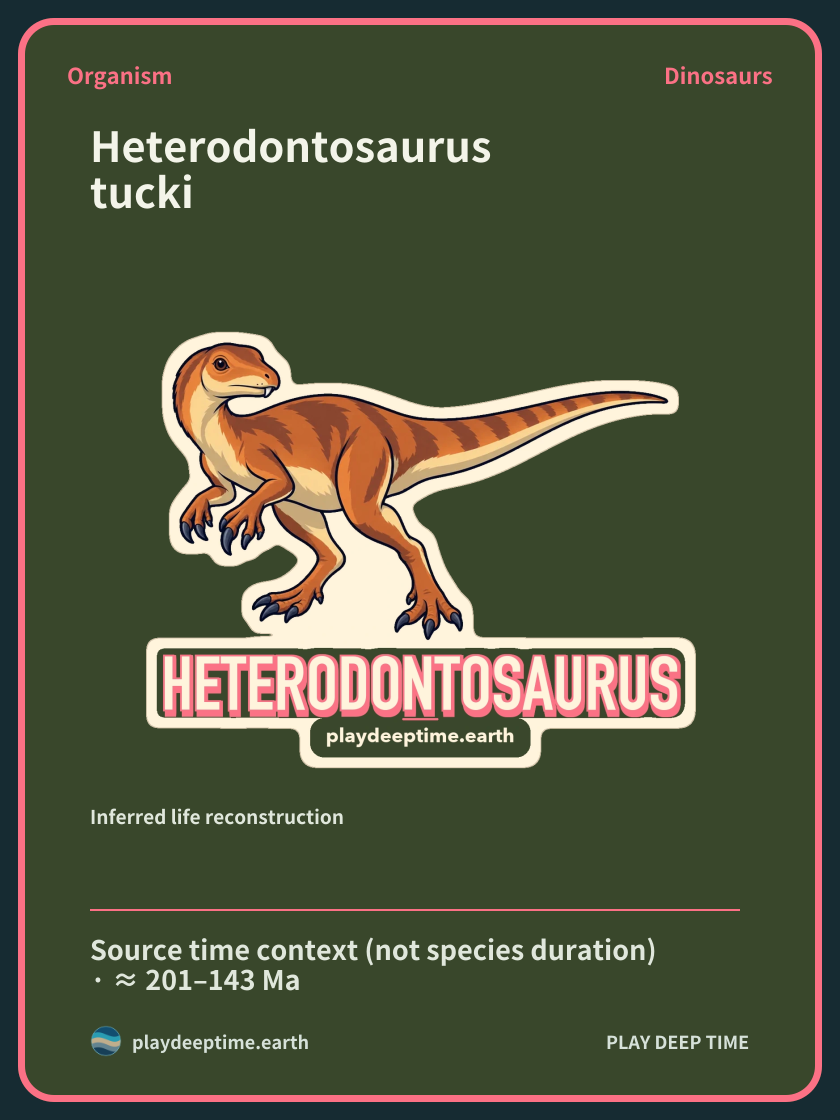
Inferred life reconstruction
Heterodontosaurus tucki
Overview
Heterodontosaurus tucki is a dinosaur with differently shaped teeth in one mouth. Canine-like teeth are known alongside teeth of other forms. Its small head reveals the diversity of dinosaur feeding tools.[1]
Loading illustration…
Key facts
Its fingers, like its teeth, were not all alike. Fingers with large claws are distinguished from reduced outer fingers. Head and hands offer comparisons of different parts sharing roles within one body.[1]
Time and place
This dinosaur is known from the Early Jurassic of present-day southern Africa. Material from the upper Elliot and Clarens formations has been studied. The Hettangian and Sinemurian stages fall in the Early Jurassic, roughly 200–193 million years ago.[1][2]
The time range describes source context, not the complete duration of this species.
Size, form and skeleton
Features include canine-like teeth, varied tooth shapes, and fingers with large claws. One specimen’s skull was reported as approximately 11.5 cm from its front tip to the occipital condyle at the rear. Small outer fingers are also distinguished alongside the large claws.[1]
Loading illustration…
Habitat and reproduction
Differently shaped teeth offer clues to food processing. Researchers compare tooth-crown shapes, jaw articulation, the skull, and hands and feet together. Different tools within one mouth invite questions about the way of life they supported.[1]
Fossil discovery
A 2012 synthesis examined the group’s classification, body form, chewing function, and relationships together. Teeth, skulls, and front and rear limbs were compared specimen by specimen. Details of small bones contribute to broader questions about dinosaur relationships.[1]
References
Research questions
Why did one dinosaur possess differently shaped teeth? Researchers compare tooth form, worn areas, and jaw structure. Questions about feeding function extend to differences and evolution among related dinosaurs.[1]
Observation
Move your gaze from the enlarged teeth at the front of the head to the other teeth along the jaw. In the hand, distinguish large claws from small outer fingers to see differences across the body.[1]
Related organisms
 Kentrosaurus aethiopicusDinosaursSource time context (not species duration) · ≈ 201–143 Ma
Different bodies among dinosaurs
Explore the bodies and backgrounds of Heterodontosaurus tucki and Kentrosaurus together. Heterodontosaurus tucki: a dinosaur with differently shaped teeth in one mouth, including canine-like teeth alongside other forms. Kentrosaurus: Kentrosaurus aethiopicus is a Late Jurassic stegosaur with bony plates and tail spines, whose outline draws the eye from the ornaments on its back toward the tail tip.