Organism · Cnidarians
Hexagonaria davidsoni
Fossil record age bounds · ≈ 443–372 Ma
Inferred life reconstruction
Hexagonaria davidsoni
Overview
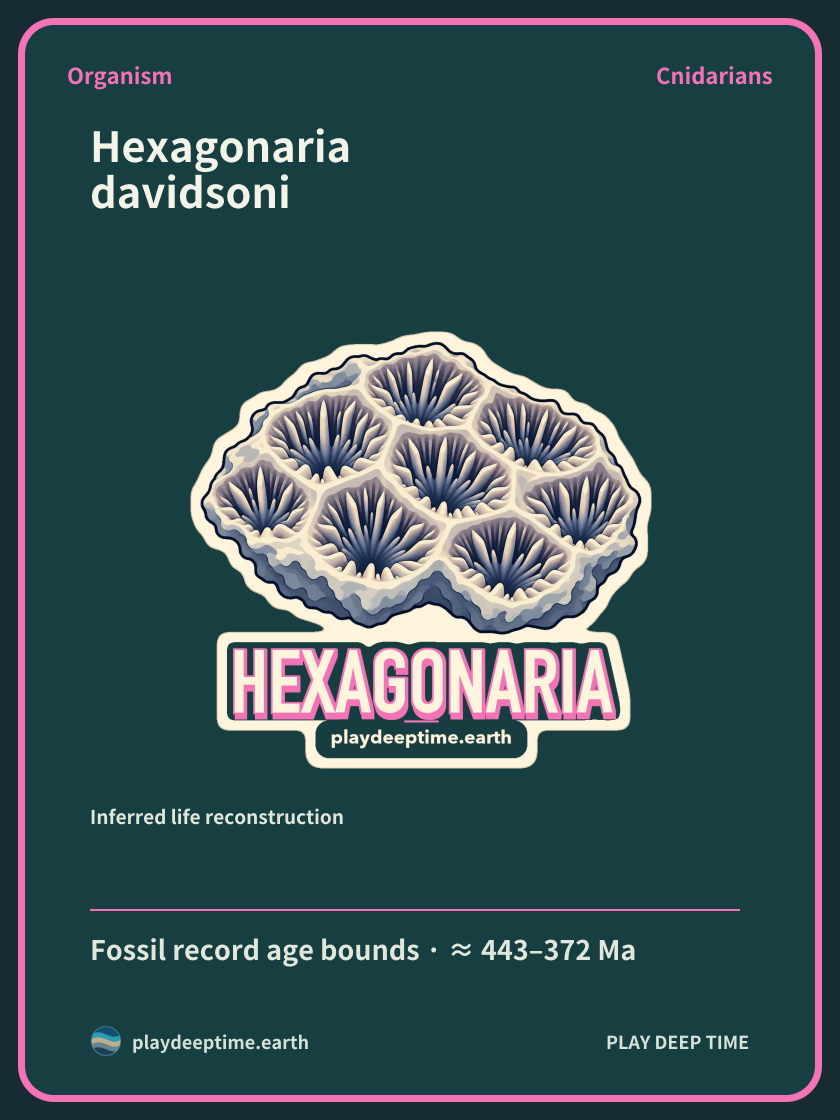
Hexagonaria davidsoni is a Devonian colonial coral whose neighboring corallites meet wall to wall. Examine the deep, cup-shaped openings in its polygonal arrangement and the thin walls inside them.[1]
Loading illustration…
Key facts
A 2018 study reported this species for the first time from Iran’s Khoshyeilagh Formation. By comparing skeletons with material from other regions, it explored connections between widely separated Devonian seas.[1]
Time and place
The studied specimens date to the Frasnian of the Late Devonian. The locality is near Khoshyeilagh in the Elburz Mountains of present-day northeastern Iran.[1]
The time range describes source context, not the complete duration of this species.
Size, form and skeleton
The cup-shaped spaces that housed the corals are deep and bell-like, with distinct long and short septa inside. The long septa meet at the center, while the short ones extend less far inward.[1]
In Hexagonaria davidsoni, small corals joined together to build a mass-like skeleton. Colonies studied from Devonian strata in present-day Iran were reported to be approximately 5–20 cm in diameter. Within each coral’s chamber, slender partitions extend toward the center.[6]
Loading illustration…
Habitat and reproduction
The study interpreted the Frasnian Elburz region as part of a broad tropical and subtropical marine belt in which corals and reefs developed. Comparing a fossil leads to a larger geographical picture of ancient seas.[1]
Fossil discovery
The researchers prepared five thin sections from two pieces of coral material. Through sections housed at Damghan University in Iran, they studied both the exterior and the internal skeletal arrangement.[1]
References
- Falahatgar et al. (2018) — Devonian colonial corals found in Iran
- Seward (1910) — Kilkenny leaf fossils and changes in their names
- Falahatgar et al. (2018) — Devonian colonial corals found in Iran
- Falahatgar et al. (2018) — Devonian colonial corals found in Iran
- Ma·Day (2003) — Brachiopod species concepts examined through Ferques specimens
- Falahatgar·May·Sarfi (2018) — Devonian Hexagonaria corals from Iran
Research questions
The study compared skeletal features with material described from France, Canada, and elsewhere. Investigating whether material previously given different names belonged to the same species was also an important part of the research.[1]
Observation
Follow the adjoining walls in the illustration to find the boundaries between neighboring corallites. Examine in turn the long and short septa extending from the rim of each cup toward its center.[1]
Related organisms
 Archaeopteris hibernicaVascular plantsFossil record age bounds · ≈ 382–359 Ma
Late Devonian leaves and coral skeletons
Read the overlapping leaf fragments of Archaeopteris alongside the adjoining corallites of a Hexagonaria colony. Different Late Devonian records from present-day Ireland and Iran convey contrasting forms of plants and marine animals.
 Cyrtospirifer verneuiliBrachiopodsFossil record age bounds · ≈ 388–359 Ma
Frasnian corals and brachiopods
Hexagonaria and Cyrtospirifer each appear in studies of Late Devonian Frasnian material. Compare the septa inside corals with the radiating folds of brachiopod shells in different specimens from present-day Iran and France.