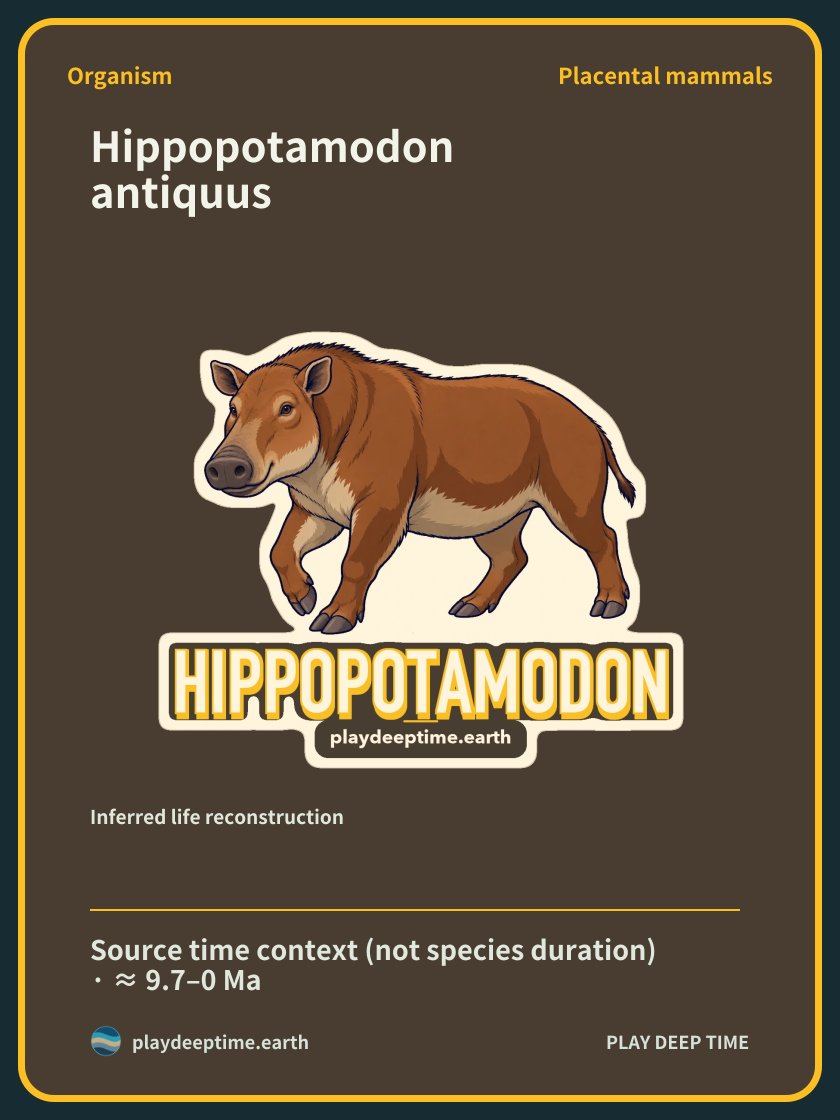
Organism · Placental mammals
Hippopotamodon antiquus
Source time context (not species duration) · ≈ 9.7–0 Ma
Inferred life reconstruction
Hippopotamodon antiquus
Overview
Hippopotamodon antiquus was a large suine studied from dental material. The name Microstonyx antiquus also appears in the literature. Its teeth and names together reveal an ancient pig relative.[1][2]
Loading illustration…
Key facts
Research connects the dental material with characteristics of a large suine. Different combinations of names for the same animal in the literature also raise questions about classification.[2]
Time and place
The species has an entry in a revision of Late Miocene Eurasian suids. The Miocene as a whole spans approximately 23–5.3 million years ago. Dental material and taxonomic records provide clues to the diverse pigs of this interval.[1][3]
The time range describes source context, not the complete duration of this species.
Size, form and skeleton
Dental material provides direct species-level evidence. The author describes it as a large suine. Small regions within the jaws and body organization of related pigs can be compared at different scales.[2]
Lower jaw specimen TTMEU-CY-49 of Hippopotamodon antiquus preserves a second molar 30 mm long. Premolars in the same jaw also exceed 2 cm in length, revealing a jaw lined with thick teeth.[4]
Loading illustration…
Habitat and reproduction
What differences among ancient pigs can teeth reveal? Tooth types, positions, and correspondence with other material can be considered together. Questions of classification begin in small regions rather than the overall impression of the body.[2]
Fossil discovery
A revision of Late Miocene suids reexamined the problem of Hippopotamodon and Microstonyx. Separate dental material is associated with the name antiquus. This research reads old names alongside fossils.[1][2]
References
- Revision — Classification of Late Miocene Suidae from Eurasia
- Carolinea tooth study — Microstonyx antiquus
- International Commission on Stratigraphy (2024) — Geological time chart
- Geraads et al. (2005) — Miocene large mammals from Turkey, Acta Palaeontologica Polonica 50:523–544
- Harington (2007) — The flat-headed peccary of the Ice Age
Research questions
What should be compared when combinations of names change? Species entries, tooth descriptions, and the context in which names were used must be examined together. Hippopotamodon connects small fossils with the history of classification.[1][2]
Observation
Imagine the body of a large suine, then narrow your gaze to the dental material. Reading names together with records of each region helps compare several sources for one animal.[2]
Related organisms
 Platygonus compressusPlacental mammalsFossil record age bounds · ≈ 3.6–0 Ma
Different bodies among mammals
Compare the bodies and backgrounds of Hippopotamodon and the flat-headed peccary. Hippopotamodon: Hippopotamodon antiquus was a large suine studied from teeth; the name Microstonyx antiquus also occurs in the literature. Flat-headed peccary: Platygonus compressus was an Ice Age North American peccary with a short, deep snout and relatively long legs.