Organism · Seed plants
Hirmeriella muensteri
Source time context (not species duration) · ≈ 201–143 Ma
Inferred life reconstruction
Hirmeriella muensteri
Overview
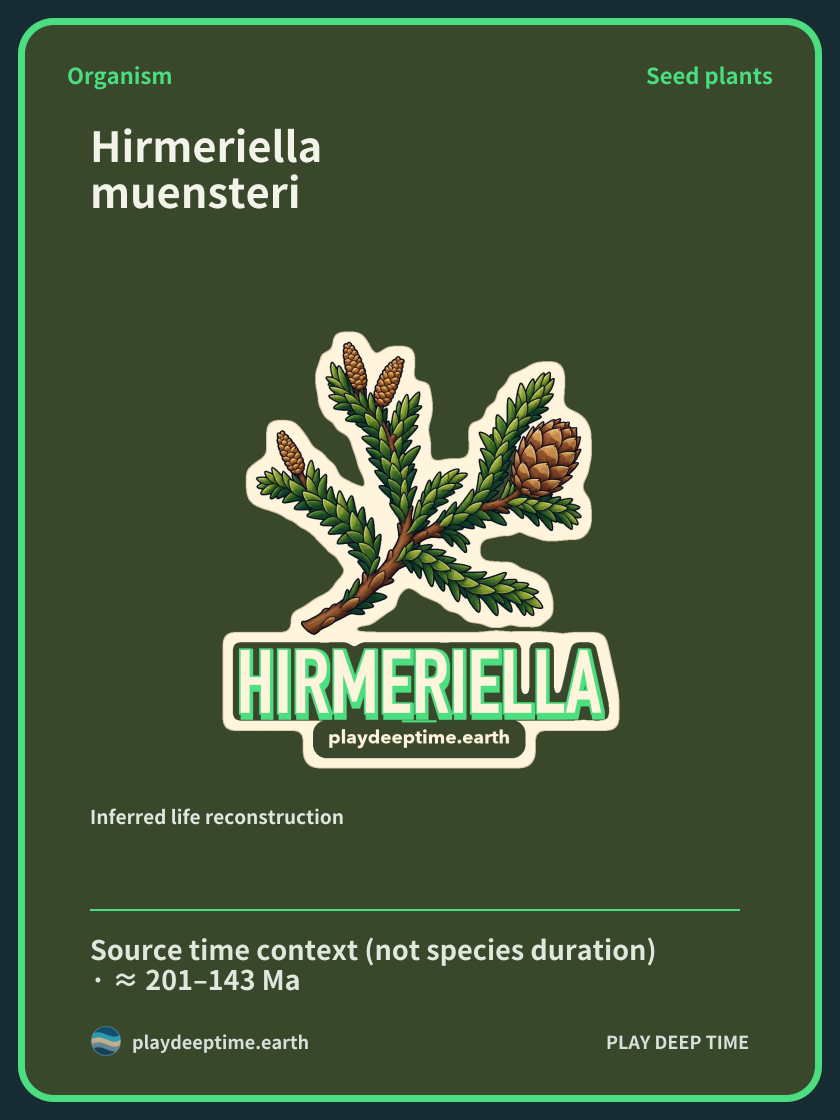
Hirmeriella muensteri is an Early Jurassic tree known for scale-like leaves and cones. Associations between its branches, leaves, and male and female cones have been studied. It offers a way to understand several plant organs that often survive separately.[1]
Loading illustration…
Key facts
Captions in the literature describe how scale leaves and male and female cones attach to branches. These provide clues to which branches bore the small organs. In research, small connections can sometimes matter more than the outline of a large tree.[1]
Time and place
It is known from literature on Early Jurassic conifers. The Jurassic as a whole spanned approximately 200–140 million years ago. Later cone studies also treated the associations among Hirmeriella organs as an example of the whole-plant concept.[1][2][3]
The time range describes source context, not the complete duration of this species.
Size, form and skeleton
Scale-like leaves attach to branches, and connections with male and female cones are described. The authors proposed an overall tree form with branching in several directions. A portion of a branch and the arrangement of a large crown can be examined at different scales.[1]
Hirmeriella muensteri was a conifer of Early Jurassic forests. Male cones found at Odrowąż in present-day Poland—the small cone-like organs that produce pollen—were 3.8–6.8 mm long. Some even retained pollen, providing clues that linked leafy branches and reproductive organs to the same tree.[4]
Loading illustration…
Habitat and reproduction
What can leaves, pollen, and male and female cones tell us about the same plant? Hirmeriella is an example in which associations among these organs were brought together. Research connects reproductive and vegetative organs to understand the whole plant.[2][1]
Fossil discovery
Literature on Jurassic conifers described the attachment relationships of branches, leaves, and cones. Later research presented these records through the whole-plant concept. It moves beyond the names of separately preserved plant organs to questions about a single organism.[1][2]
References
- Conifers in the Lower Jurassic — Organs of Hirmeriella
- Conifer cone study — Whole-plant concept of Hirmeriella
- International Commission on Stratigraphy (2024) — Geological time chart
- Barbacka et al. (2007) — Branches and male and female cones of Hirmeriella
- Heřmanová et al. (2020) — Small plant fossils from Lower Silesia
Research questions
How can a plant known from leaves be connected with one known from cones? Material attached to the same branch and associations between organs are important clues. Small preserved connections become the starting point for understanding a whole tree.[1][2]
Observation
Move your gaze from the branching of large limbs to small shoots bearing scale leaves. Picturing the positions of male and female cones connects the whole tree with the arrangement of its small organs.[1]
Related organisms
 Geinitzia formosaSeed plantsFossil record age bounds · ≈ 101–72.2 Ma
Different bodies among conifers
Explore the bodies and life settings of Hirmeriella muensteri and Geinitzia formosa together. Hirmeriella muensteri: Hirmeriella muensteri is an Early Jurassic tree known for scale-like leaves and cones. Associations between its branches, leaves, and male and female cones have been studied. Geinitzia formosa: Geinitzia formosa is a conifer encountered through fossil branches with short, spirally arranged needle-like leaves. Even a small branch fragment provides clues to its identity through leaf arrangement and cross-section.