Organism · Molluscs
Hoplites riveroi
Source time context (not species duration) · ≈ 143–66 Ma
Inferred life reconstruction
Hoplites riveroi
Overview
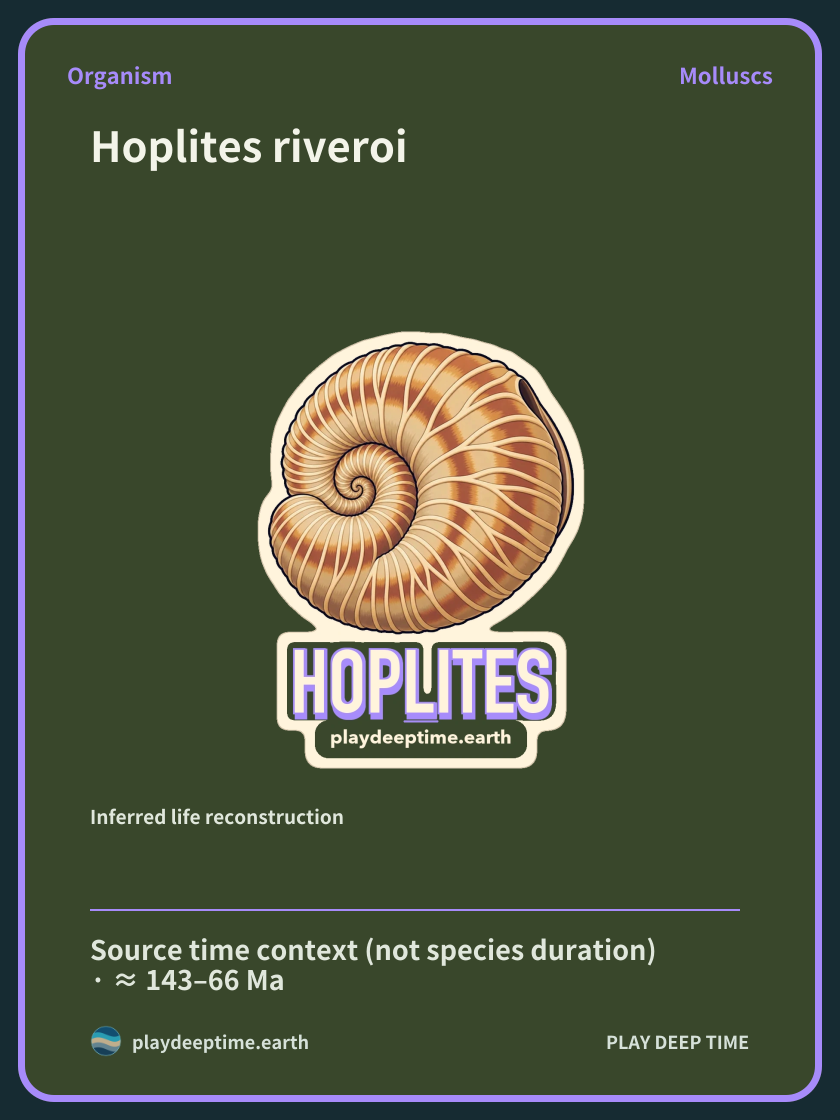
Hoplites riveroi is a Cretaceous ammonite also studied under the name Lissonia riveroi. Its coiled shell and branching ribs can be examined. It is an intriguing example of different-looking names connecting to the same historical fossil material.[1][2]
Loading illustration…
Key facts
Specimen CAL4141-2 in a 2015 study is presented as Lissonia riveroi. Reference literature connects Hoplites riveroi with the type species of Lissonia. Before counting them as separate animals with different names, follow the links in the literature.[1][2]
Time and place
A 2015 study examined Early Cretaceous material from the Rosablanca Formation in present-day Colombia. The Cretaceous spans roughly 140–66 million years ago. The connection between the illustrated shell and its historical name helps explain this ammonite.[1][3]
The time range describes source context, not the complete duration of this species.
Size, form and skeleton
The shell is described as coiled, with branching ribs along its sides. The lateral view of CAL4141-2 provides specimen evidence associated with the species. Broad shell outlines and rib patterns can be examined together.[1][2]
Loading illustration…
Habitat and reproduction
The shell surrounding the body is the main research material for this ammonite. Researchers compare coiling and the connections between ribs in side view. One hard shell provides clues for distinguishing an animal and maintaining continuity of its name.[1][2]
Fossil discovery
A historical account of the type species associated with the 1907 name connects with a specimen caption from 2015. Later references help locate material whose genus name has changed. Ammonite research involves reading shell form alongside the history of names.[1][2]
References
Research questions
Why does the same fossil appear under two genus names? Researchers read the literature by linking the original naming basis with later generic classification. Material with different-looking names can still lead to the same specimen and species.[2]
Observation
Move from the inner to the outer coil and find where the ribs branch along the sides. Examining broad coiling separately from small surface structures reveals the shell’s construction.[2][1]
Related organisms
 Scaphites equalisMolluscsSource time context (not species duration) · ≈ 143–66 Ma
Different bodies among ammonites
Explore the bodies of Hoplites riveroi and Scaphites aequalis together. Hoplites riveroi: a Cretaceous ammonite also studied as Lissonia riveroi. Scaphites aequalis: an ammonite whose shell end departs from the coil before curving back.