Organism · Land plants
Horneophyton lignieri
Source time context (not species duration) · ≈ 420–359 Ma
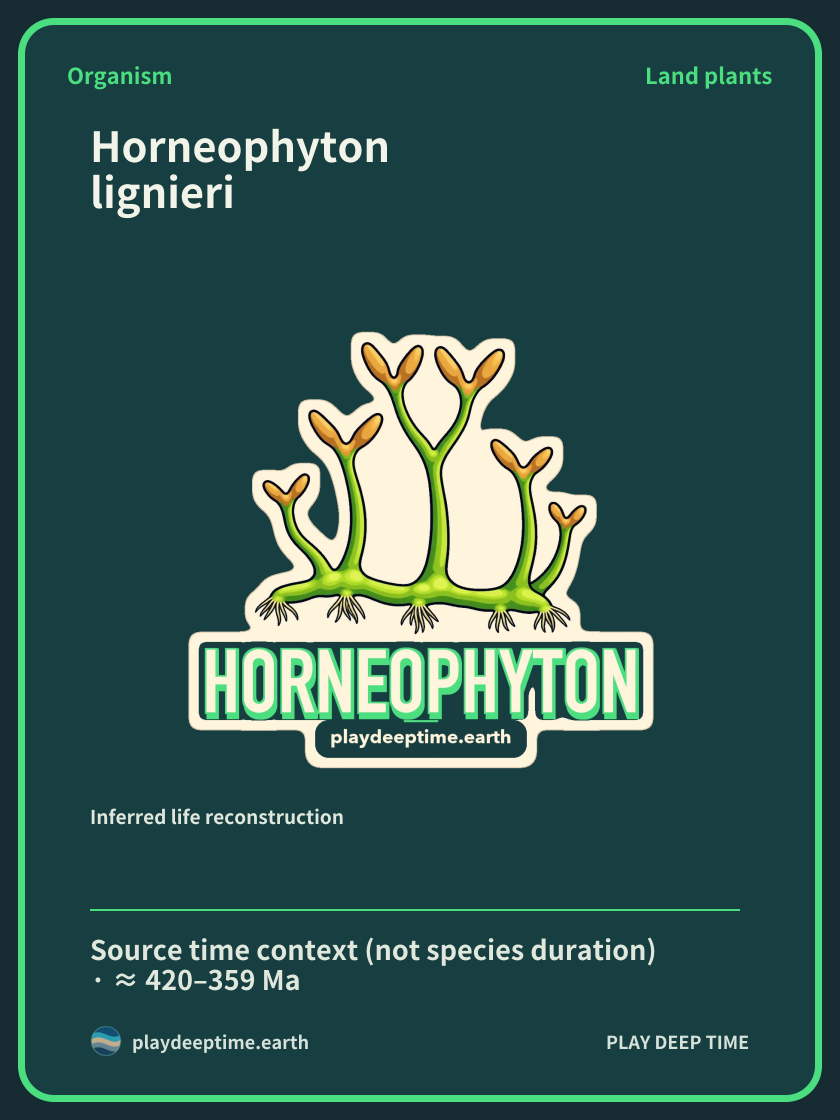
Inferred life reconstruction
Horneophyton lignieri
Overview
Horneophyton lignieri is an early land plant with leafless stems that fork in two. Branched, spore-bearing sporangia occur at their tips. Research has examined not only its aboveground form but also the tissues that transported materials inside.[2][1]
Loading illustration…
Key facts
Rhizoids occurred on the lower parts contacting the ground. These differ from the true roots of plants today. Examining how early plants established themselves on land offers a fresh view of familiar plant roots.[2]
Time and place
It is studied from Early Devonian material near the village of Rhynie in present-day northern Scotland. A museum account explains that Horneophyton fossils there were discovered in the early 1900s. The Devonian spanned approximately 420–360 million years ago.[2][5][4]
The time range describes source context, not the complete duration of this species.
Size, form and skeleton
Leafless aerial stems rise from a horizontal rhizome and fork in two. Branched cylindrical sporangia occur at the tips. Distinguishing the rhizoids below from the sporangia above reveals separate body parts.[2]
The sporophyte of Horneophyton is reconstructed as approximately 20 cm tall. Its stems extend upward with spore sacs at their tips.[11]
Loading illustration…
Habitat and reproduction
The sporangium-bearing sporophyte and the gametophyte are different life-cycle stages. A 2004 study treated male and female gametophytes of Rhynie plants separately. It invites comparison of the bodies an organism has during its life cycle.[2][3]
Fossil discovery
A synthesis of sporophytes from Rhynie and Windyfield reviewed branches, sporangia, and internal structures. New research published online in late 2025 reexamined the conducting tissues. The body of an ancient plant became the subject of new tissue research.[2][1]
References
- 2025–2026 study — Conducting tissues of Horneophyton
- Study of sporophytes of Rhynie and Windyfield plants
- 2004 study — Gametophytes of early plants from Rhynie
- Ashworth(2025-12-18). A 400-million-year-old fossil is revealing how plants grew into giants. Natural History Museum.
- International Commission on Stratigraphy (2024) — Geological time chart
- Study of sporophytes of Rhynie and Windyfield plants
- 2025–2026 study — Conducting tissues of Horneophyton
- International Commission on Stratigraphy (2024) — Geological time chart
- Ashworth(2025-12-18). A 400-million-year-old fossil is revealing how plants grew into giants. Natural History Museum.
- Hetherington et al. (2021) — Asteroxylon reconstructed from serial sections
- Bilaterally symmetric axes with rhizoids composed the rooting structure of the common ancestor of vascular plants
Research questions
How did this early plant transport materials internally? Research in 2025–2026 reported that distinct xylem and phloem were not identified. Comparison with the familiar tissues of vascular plants prompts reconsideration of conducting structures in early plants.[1]
Observation
From the lower rhizome and rhizoids, follow the stems upward as they fork in two. Continuing to the terminal sporangia reveals the parts making up this early plant’s body.[2]
Related organisms
 Asteroxylon mackieiVascular plantsSource time context (not species duration) · ≈ 407 Ma
Different plant bodies at Rhynie
Horneophyton and Asteroxylon are known from the Rhynie chert of present-day Scotland. Comparing these two Early Devonian plants highlights the contrast between Horneophyton’s leafless stems and Asteroxylon’s small-leaved stems. Examine the structures anchoring their bodies below as well.