Organism · Reptiles including birds
Hupehsuchus nanchangensis
Source time context (not species duration) · ≈ 252–201 Ma
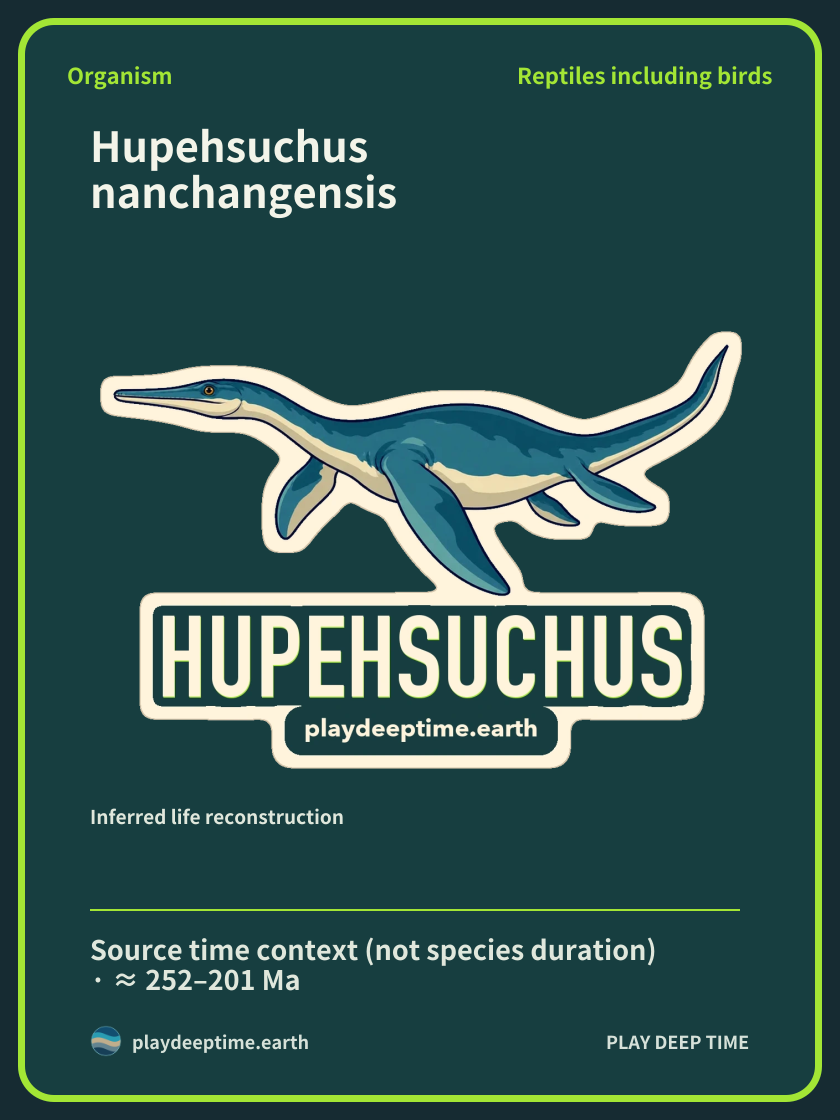
Inferred life reconstruction
Hupehsuchus nanchangensis
Overview
Hupehsuchus nanchangensis is an Early Triassic marine reptile known for a long snout and neck and a relatively deep trunk. A skeleton extending from the head to the limbs and anterior tail has been studied. The contrast between the slender front and deep trunk stands out.[1]
Loading illustration…
Key facts
The limb description of the type specimen shows forelimbs larger than the hind limbs. Not all four limbs create the same impression. Examining the front and rear of the body separately reveals different constructions.[1]
Time and place
It is studied in literature on Early Triassic marine reptiles. The Triassic as a whole was roughly 250–200 million years ago. Species-specific specimens were considered within research comparing several hupehsuchians.[1][2]
The time range describes source context, not the complete duration of this species.
Size, form and skeleton
WGSC26004 reveals connections among a long snout and neck, deep trunk, forelimbs and hind limbs, and the anterior tail axis. The limb description of type specimen IVPP V3232 adds the feature of forelimbs larger than hind limbs. Connections among several regions can be examined alongside front–rear differences.[1]
A 2020 study introduced Hupehsuchus as a marine reptile about 1m long.[3]
Loading illustration…
Habitat and reproduction
Did all marine reptiles have the same body construction? This species’ description addresses a slender snout, long neck, deep trunk, and differently sized front and rear limbs. Comparing several regions side by side reveals diverse marine reptile bodies.[1]
Fossil discovery
Specimen WGSC26004 in the study and type specimen IVPP V3232 convey different evidence. One reveals connections among several body regions, while the other’s limb description adds relative sizes at the front and rear. The study brings together information preserved in each specimen to examine species features.[1]
References
Research questions
What information does a specimen with its trunk and tail connected provide? The long vertebral axis is useful for comparing the positions of each region. An outline visible at a glance can be read in terms of several internal bone connections.[1]
Observation
Move your gaze from the slender snout to the neck and deep trunk. Examining the relative sizes of the front and rear limbs separately from the continuing tail axis reveals differences among several regions.[1]
Related organisms
 Dinocephalosaurus orientalisReptiles including birdsSource time context (not species duration) · ≈ 252–201 Ma
Different bodies among marine reptiles
Explore the bodies and living backgrounds of Hupehsuchus nanchangensis and Dinocephalosaurus orientalis together. Hupehsuchus nanchangensis: Hupehsuchus nanchangensis is an Early Triassic marine reptile known for a long snout and neck and a relatively deep trunk. A skeleton extending from the head to the limbs and anterior tail has been studied. Dinocephalosaurus orientalis: Dinocephalosaurus orientalis is a Triassic marine reptile with a neck much longer than its body. Behind the slender, long neck are the trunk, four limbs, and a long tail.