Organism · Placental mammals
Hydrochoerus hydrochaeris
Present
Living species illustration
Hydrochoerus hydrochaeris
Overview
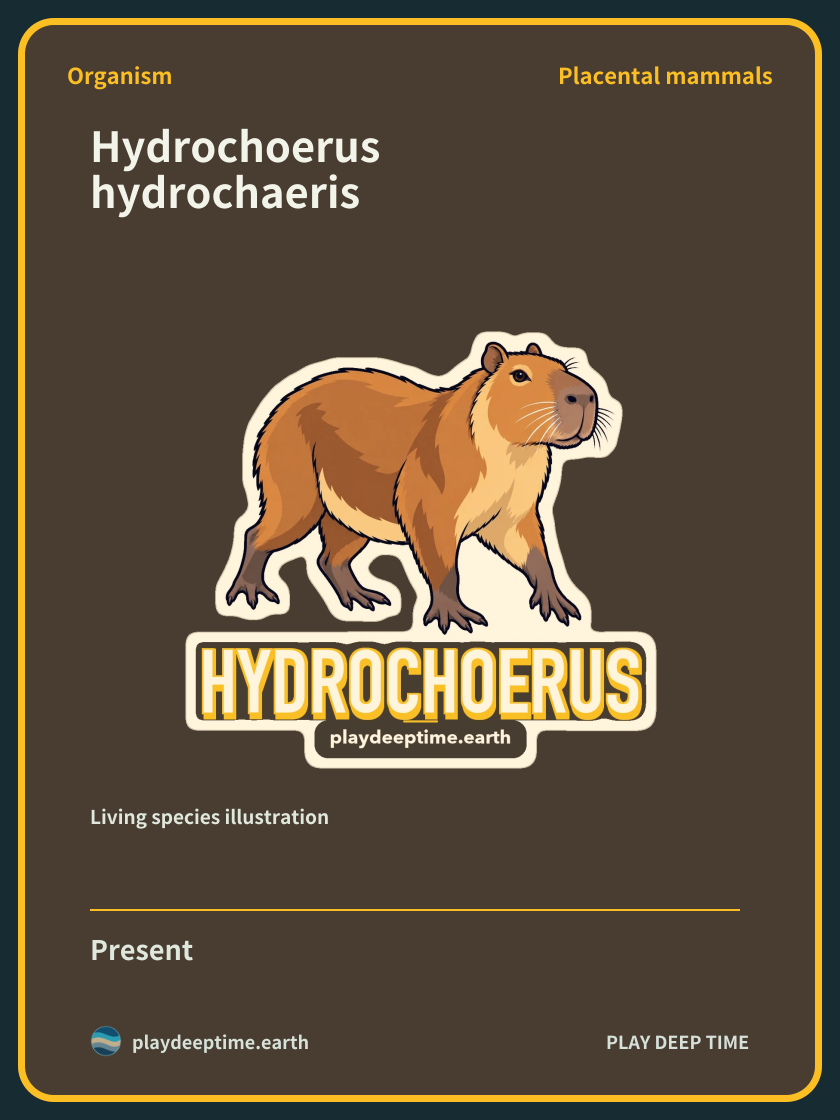
Meet the capybara, a large rodent that grazes beside the water. It has a sturdy, barrel-shaped body, with its eyes, ears, and nostrils grouped high on its head. This South American animal lives between water and land.[1]
Loading illustration…
Key facts
Birds sometimes follow capybaras. They feed on insects in their fur or catch insects disturbed as the capybaras graze. Behind the sight of one relaxed animal lies a small waterside ecosystem intertwined with other animals.[1]
Time and place
Today it lives along South American rivers and wetlands and in grasslands and forests with easy access to water. Places offering both nearby water and grass to eat are important settings for its life.[1]
The time range describes source context, not the complete duration of this species.
Size, form and skeleton
The forelimbs are slightly shorter than the hind limbs, and the feet are partially webbed. A head with eyes, ears, and nostrils positioned high also suits life near water. These structures are particularly apparent when only part of the head rises above the surface.[1]
The body length presented in a university animal guide is about 120 cm.[8]
The mass range presented in the same guide is about 35–66 kg.[8]
Loading illustration…
Habitat and reproduction
It mainly eats grasses and aquatic plants and lives in groups. Young begin to stand and walk soon after birth and may also nurse from other females in the group. Waterside grasslands are both feeding grounds and living spaces where the young grow up together.[1]
Fossil discovery
Knowing living capybaras makes meeting their fossil relatives more interesting. A separate fossil species called wayuu has been studied from Late Pliocene strata in La Guajira, Colombia. The researchers provisionally assigned it to the genus Hydrochoeropsis. Looking at living capybaras alongside ancient relatives opens up the long history of South American rodents.[2]
References
- Animal Diversity Web · Hydrochoerus hydrochaeris
- Pérez et al. (2017; online 2016), A New Pliocene Capybara from Northern South America (Guajira, Colombia)
- Animal Diversity Web · Hydrochoerus hydrochaeris
- Royal Botanic Gardens, Kew — Water chestnut Trapa natans
- 2024 species account — International Biological Flora: Trapa natans
- Nature — Holocene water chestnut pollen records from Britain
- Flora of North America — The life of Trapa natans and the genus Trapa
- University of Michigan Animal Diversity Web — Hydrochoerus hydrochaeris
Research questions
Observations of group life in living capybaras and comparisons of bones and teeth in their ancient relatives illuminate different times. How waterside ways of life relate to environmental change across the continent is an intriguing question for understanding this group of animals.[1][2]
Observation
Examine the combination of a rounded trunk and high-set eyes, ears, and nostrils.[1]
Related organisms
 Trapa natansFlowering plantsPresent
An animal moving between land and water and a plant floating at the surface
Read about the capybara, which moves between water and land, alongside the water caltrop, which spreads its leaves across the water. This South American rodent and aquatic plant native to Eurasia and Africa come from different regions, but their respective uses of watersides and water surfaces can be compared.