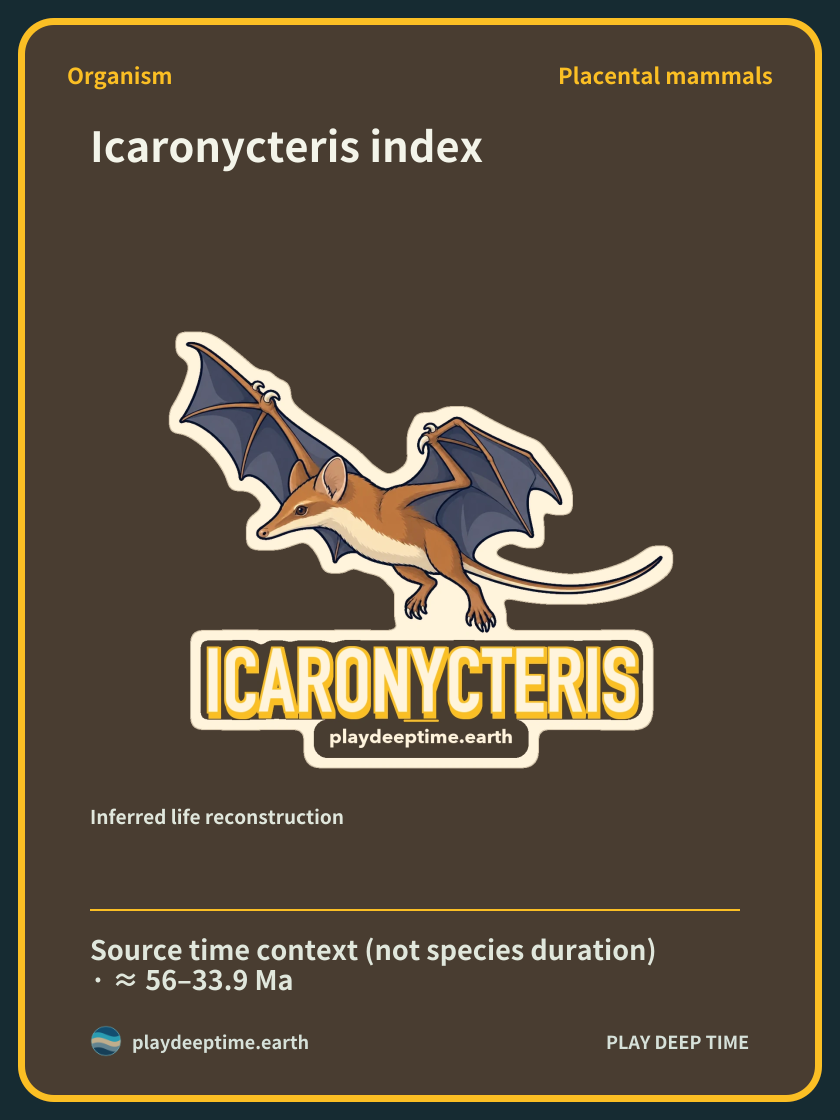
Organism · Placental mammals
Icaronycteris index
Source time context (not species duration) · ≈ 56–33.9 Ma
Inferred life reconstruction
Icaronycteris index
Overview
Icaronycteris index is a bat known from early Eocene Green River material. Its long, narrow head connects with wing bones, limbs, and a long tapering tail. Several regions allow comparisons of an early bat’s body.[1]
Loading illustration…
Key facts
Claws are described on both the thumb and index finger. This animal allows the features of individual fingers in the wing-forming hand to be examined.[1][3]
Time and place
Early Eocene Green River specimens have been studied. The Eocene as a whole spans roughly 56–34 million years ago. As other early bats became known, the Icaronycteris skeleton continued to serve as comparative material.[1][2][4]
The time range describes source context, not the complete duration of this species.
Size, form and skeleton
Descriptions include a long, narrow head, wing bones and limbs, and a long tapering tail. A relatively short radius and a robust femur are also described. Wings, hind limbs, and tail can be compared in turn.[1]
The body mass of Icaronycteris index is estimated in the literature at approximately 24–27 g. A 2023 study of early bats compared this value with the sizes of other early bats.[9]
Loading illustration…
Habitat and reproduction
Where should observations begin when examining a bat’s wing? In Icaronycteris, hand bones can be compared with thumb and index-finger claws. It is revealing to narrow the view from a broad wing outline to tiny structures at the fingertips.[1][3]
Fossil discovery
PU18150 in the 1966 description and YPM-PU18150 in later research refer to the same specimen. A 2023 study also compared it with other early bat material. An old fossil continues into new research through connected names and numbers.[1][2]
References
- Jepsen (1966) — Description of Icaronycteris index
- 2023 study — Comparing early bat skeletons
- US National Park Service — Bat guide in fossil mammals
- International Commission on Stratigraphy (2024) — Geological time chart
- Jepsen (1966) — Description of Icaronycteris index
- 2023 study — Comparing early bat skeletons
- Manchester1989 — Leaves and reproductive organs of Cedrelospermum attached to branches
- Florida Museum — A Cedrelospermum branch with attached leaves and winged fruits
- Rietbergen et al. (2023) — The oldest bat skeletons and Eocene bat diversification
Research questions
Which features did different early bat skeletons share? Considering the head, wing bones, finger claws, and tail side by side increases the number of comparisons. This research examines several body regions together rather than one alone.[1][2]
Observation
Move your gaze from the long, narrow head to the wing-forming hand and the tips of the thumb and index finger. Continue to the hind limbs and tapering tail to compare front and rear together.[1]
Related organisms
 Cedrelospermum nervosumFlowering plantsSource time context (not species duration) · ≈ 51–23 Ma
A bat and a plant from Green River Formation material
Icaronycteris and Cedrelospermum have been studied through material from the Eocene Green River Formation. Examine different fossils, such as a bat skeleton and plant leaves and twigs, to broaden the stories told by separate localities within the formation.