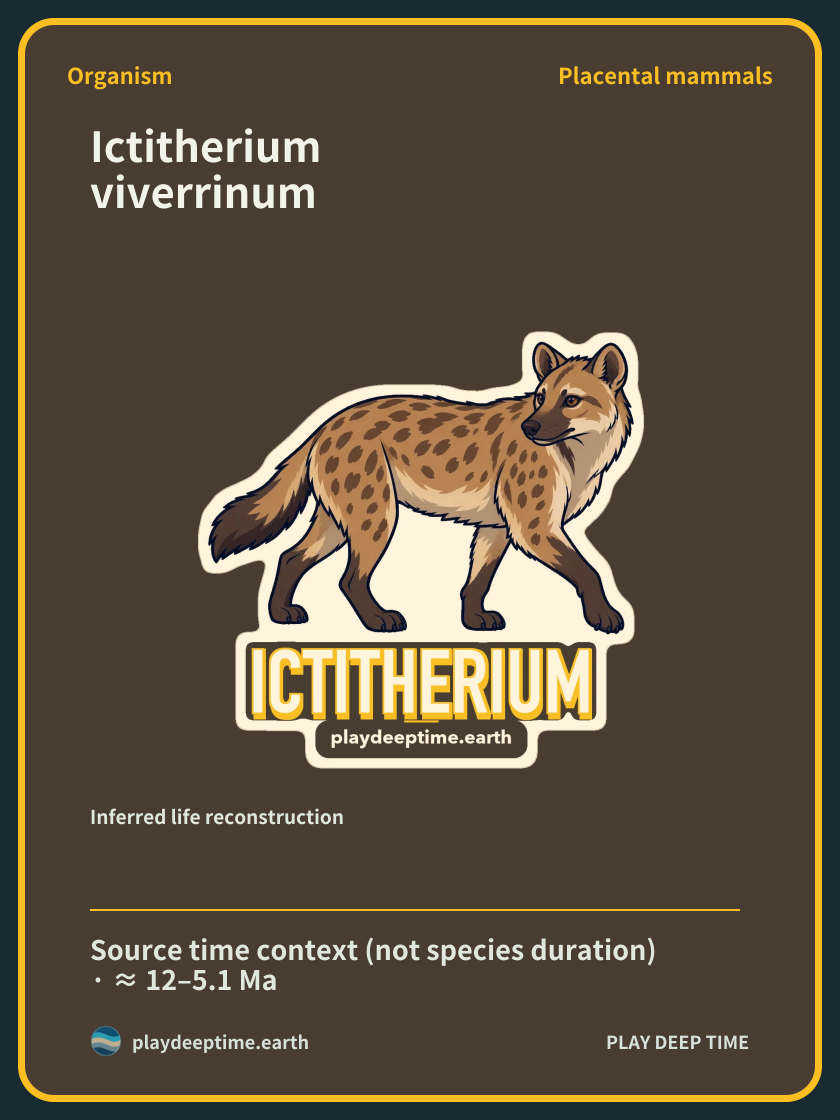
Organism · Placental mammals
Ictitherium viverrinum
Source time context (not species duration) · ≈ 12–5.1 Ma
Inferred life reconstruction
Ictitherium viverrinum
Overview
Ictitherium viverrinum was a small hyaenid studied from lower jaws and teeth. Canines and jaw material are known from different localities. The arrangement of small teeth and jaws provides clues for identifying an ancient mammal.[1][2]
Loading illustration…
Key facts
The lower jaw AK5-209 is described as having a shallow body and teeth. Jaw depth and tooth positions can be compared together.[2]
Time and place
It is studied in literature on Late Miocene material from Soblay in present-day Ain, France. Recorded fossil-bearing layers are summarized as a broad interval of approximately 12–5.1 million years ago. Jaw material from other localities has also been compared separately.[1][3]
The time range describes source context, not the complete duration of this species.
Size, form and skeleton
Material explicitly assigned to the species includes canines, a shallow lower jaw, and other upper jaw material. Reading each specimen’s teeth and jawbones separately allows the organization around the mouth to be compared. Small regions provide information about the species.[1][2]
A dental-data model in the 2021 CarniFOSS study estimates a body mass of about 16 kg.[4]
Loading illustration…
Habitat and reproduction
What can be compared in the jaw of a small hyaenid? Jaw depth and tooth positions can be examined. This research seeks differences in small regions rather than the impression of the whole head.[1][2]
Fossil discovery
A 2005 account of carnivores from Akkaşdağı described lower jaw AK5-209. A 2008 Soblay study examined canines FSL520101b/c. Fossils from different localities and body regions come together as material for comparing the same species.[1][2]
References
- Study of Late Miocene vertebrates from Soblay (2008) — Ictitherium
- Akkaşdağı carnivore study (2005) — Taxonomic treatment of Ictitherium
- Paleobiology Database — Age of fossil-bearing strata of Ictitherium
- Faurby·Morlo·Werdelin(2021) — CarniFOSS fossil carnivorous mammal body-mass data
- Sorkin (2006) — Ecomorphology of giant bear-dogs
Research questions
How can isolated canines and a lower jaw be compared together? Each specimen number, locality, and tooth position must be considered separately. This research gathers information about one animal from several partial fossils.[1][2]
Observation
Move your gaze from the shallow lower jaw to the tooth-bearing margin. Imagining separately known canines alongside it helps compare features conveyed by small bones and teeth.[1][2]
Related organisms
 Amphicyon ingensPlacental mammalsSource time context (not species duration) · ≈ 23–5.33 Ma
Different bodies among mammals
Compare the bodies and backgrounds of Ictitherium and Amphicyon. Ictitherium: Ictitherium viverrinum was a small hyaenid studied from lower jaws and teeth, with canines and jaw material known from different localities. Amphicyon: Amphicyon ingens was a bear-dog known for a long, narrow snout and powerful limbs. Research has compared its skull with several limb bones.