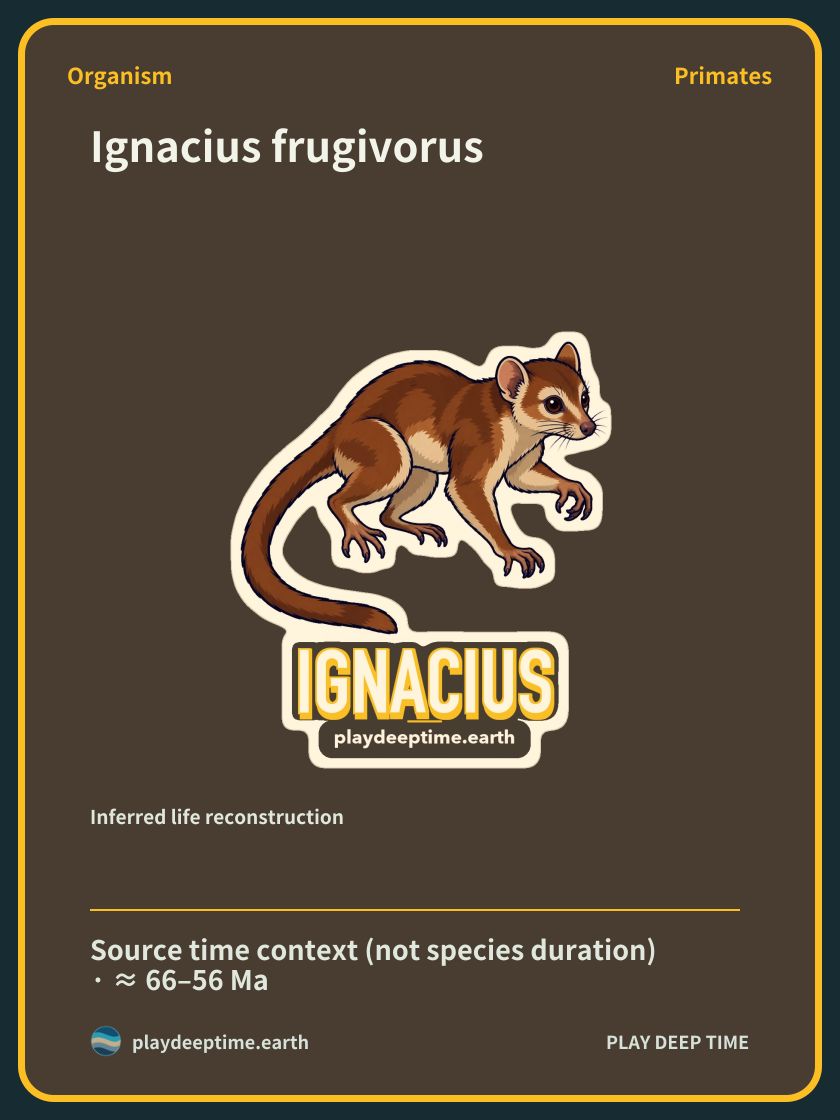
Organism · Primates
Ignacius frugivorus
Source time context (not species duration) · ≈ 66–56 Ma
Inferred life reconstruction
Ignacius frugivorus
Overview
Ignacius frugivorus is a small Paleocene relative of primates. The species is explored by comparing teeth preserved in the upper jaw side by side. Adding the skeleton of a close relative reveals varied bodies around the early primate lineage.[3][1]
Loading illustration…
Key facts
A species known from teeth and a relative known from a skeleton illuminate one another. Postcranial research in 2007 on clarkforkensis, in the same genus, helped explain arboreal life. Comparison beginning with small teeth expands to a body on tree branches.[1][4]
Time and place
It appears in material concerning the Late Paleocene Tiffanian, around 62–57 million years ago. The species is associated with the Mason Pocket locality in present-day Colorado, USA. It is one of the important names in comparisons of ancient North American mammals.[2]
The time range describes source context, not the complete duration of this species.
Size, form and skeleton
Type specimen AMNH17368 preserves upper premolars and molars. Tooth sizes, positions, and differences in chewing surfaces provide comparative evidence. This is also why heads and teeth of several relatives are examined together.[3]
The body mass of Ignacius frugivorus is estimated at approximately 230 g. A 2023 study calculated this from the size of the lower first molar. Even one small tooth can help estimate body size and compare size differences among close relatives.[9]
Loading illustration…
Habitat and reproduction
How did relatives within the genus Ignacius move in trees? Research on the clarkforkensis skeleton revealed a life of grasping and climbing trees. Such comparisons with a close species provide context for understanding life in the group containing frugivorus.[4][1]
Fossil discovery
Matthew and Granger named this species in 1921 while introducing new Paleocene mammals. In 2007, a new skeleton of the same genus contributed to research on relationships among primate relatives. Old tooth specimens and new bone discoveries engage in a scientific dialogue.[3][1]
References
- Bloch et al.2007 — Paleocene skeletons and early relatives of primates
- Secord — The Tiffanian North American mammal age
- Matthew & Granger1921 — New Palaeocene mammals
- Yale Peabody Museum2007 — Discovery of skeletons of Paleocene primate relatives
- Covert (1988), “Ankle and foot morphology of Cantius mckennai: adaptations and phylogenetic implications,” Journal of Human Evolution 17(1–2):57–70.
- Secord — The Tiffanian North American mammal age
- Matthew & Granger1921 — New Palaeocene mammals
- Bloch et al.2007 — Paleocene skeletons and early relatives of primates
- Miller·Tietjen·Beard (2023) — Arctic expansion and body-size changes of ancient primate relatives
Research questions
What bodies and ways of life did close relatives of primates have? Researchers compare hands, feet, and limbs together with skulls and teeth. These small mammals play important roles in asking which features appeared first.[1]
Observation
Examine the premolars and molars preserved in the upper jaw in sequence. Compare them with the body of a close relative and consider the questions to which small teeth lead.[3][1][4]
Related organisms
 Cantius mckennaiPrimatesSource time context (not species duration) · ≈ 56–48 Ma
Stories around primates in the Paleocene and Eocene
Read the ankle and foot bones of Cantius alongside the teeth of Ignacius. Different records from Early Eocene and Late Paleocene North America convey ancient stories of primates and their relatives.