Organism · Birds and early avialans
Inkayacu paracasensis
Source time context (not species duration) · ≈ 56–33.9 Ma
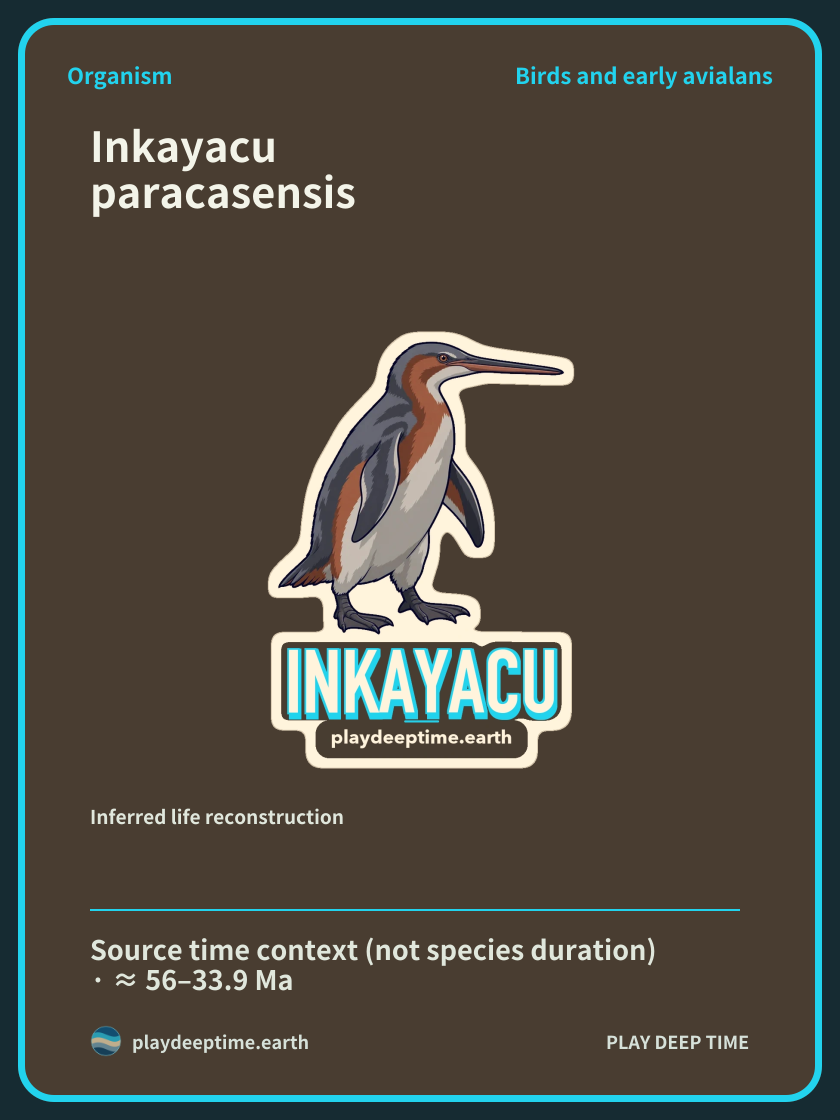
Inferred life reconstruction
Inkayacu paracasensis
Overview
Inkayacu paracasensis is a large Eocene penguin that left traces of feathers and scales. Fossils from the coast of present-day Peru allowed researchers to study not only the skeleton but also the structures covering its body. The discovery raised questions about when penguins acquired their black-and-white appearance.[1][2]
Loading illustration…
Key facts
Researchers compared tiny pigment structures within the feathers. They proposed the possibility of gray and reddish-brown plumage. The research broadened the story of fossil penguins from bone shapes to feather colors.[1][2]
Time and place
It is a Late Eocene penguin from roughly 36 million years ago. The fossil was discovered in the Paracas region of present-day Peru. Large penguins also lived in low-latitude seas far from Antarctica.[2]
The time range describes source context, not the complete duration of this species.
Size, form and skeleton
It had a very long beak and flipper-shaped wings. Researchers estimated its body length in swimming posture at about 1.5m. MUSM1444 preserves not only head, wing, and leg bones but also traces of feathers and scales on the feet.[1][2]
Loading illustration…
Habitat and reproduction
Penguin wings propel the body through water. Inkayacu’s wing and body feathers were compared with those of living penguins. They suggest that the overall form of feathers and the microscopic structures holding pigments may have evolved at different rates.[1][2]
Fossil discovery
Peruvian discoverer Ali Altamirano found the fossil in Paracas. The research team recognized soft tissues such as scales remaining on the foot and also examined feather traces. The 2010 publication is a case in which small traces beyond the bones became central to the discovery.[2]
References
- Fossil Evidence for Evolution of the Shape and Color of Penguin Feathers
- University of Texas2010 — Feathers and colours of a fossil penguin from Peru
- Slack et al. (2006), “Early Penguin Fossils, Plus Mitochondrial Genomes, Calibrate Avian Evolution,” Molecular Biology and Evolution 23(6):1144–1155.
- Clarke et al.2010 — Evolution of penguin feather shape and color
- Acosta Hospitaleche & Reguero2010 — An articulated skeleton of Palaeeudyptes gunnari
- Clarke et al.2010 — Evolution of penguin feather shape and color
Research questions
When did penguin feathers become distinctive in the way they are today? Fossil feather shafts, feather arrangement, and pigment structures are compared separately. Considering external form and microscopic structure together reveals an evolutionary story that no single feature could show.[1][2]
Observation
Move your gaze from the long beak to the flattened wings and body feathers. Remember that the skeleton and the feathers covering the body each left a different story.[1]
Related organisms
 Waimanu manneringiBirds and early avialansSource time context (not species duration) · ≈ 62–56 Ma
Early penguin relatives from different times
Compare Waimanu from Paleocene New Zealand with Inkayacu from Eocene Peru. Different evidence, such as leg bones and feathers, shows different scenes in the long evolution of penguins.
 Palaeeudyptes gunnariBirds and early avialansSource time context (not species duration) · ≈ 56–33.9 Ma
The varied forms of Eocene penguins
Palaeeudyptes from Antarctica reveals articulated body bones, while Inkayacu from Peru reveals fossil feathers. Looking at Eocene penguins from different regions side by side allows you to explore evolutionary stories connecting skeletons and feathers.