Organism · Molluscs
Inoceramus (Inoceramus) cuvierii
Source time context (not species duration) · ≈ 143–66 Ma
Inferred life reconstruction
Inoceramus (Inoceramus) cuvierii
Overview
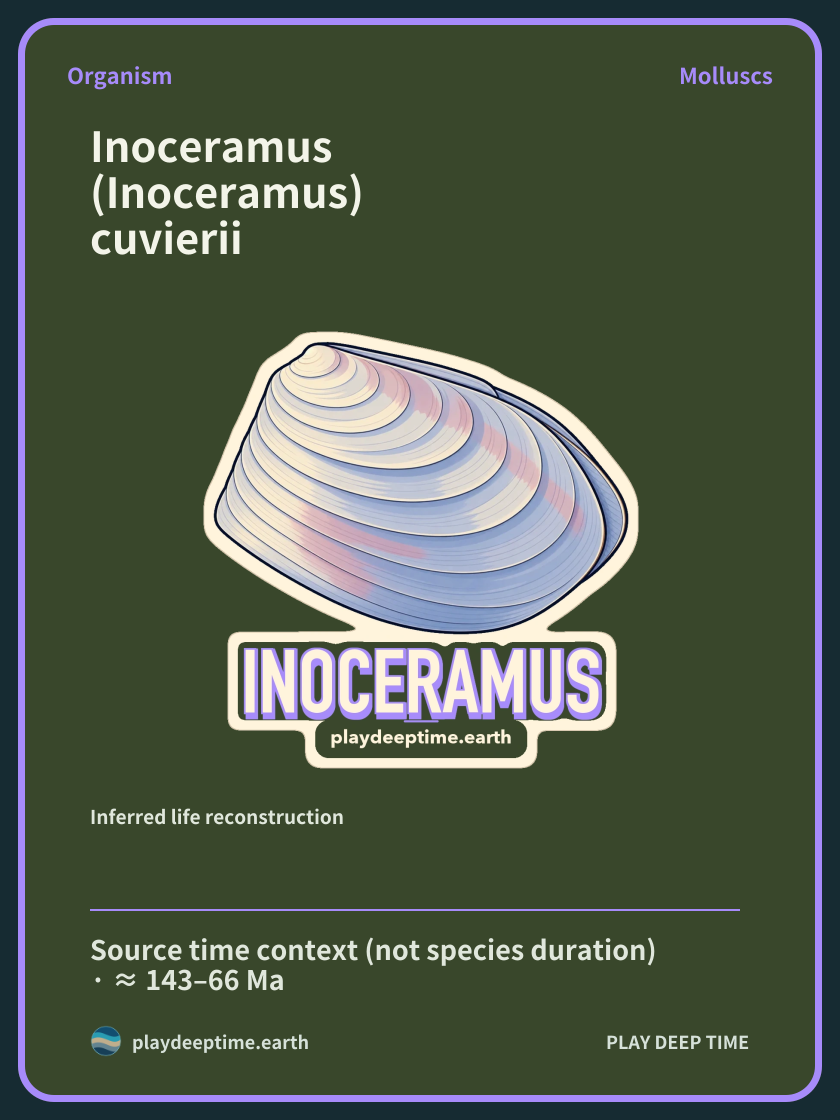
Inoceramus cuvierii is a Cretaceous bivalve distinguished by broad, low concentric folds. Its thick shell is described as flat or slightly convex. There is much to discover by examining both the overall outline and the fine growth lines.[1]
Loading illustration…
Key facts
Its shell outline is difficult to represent with a single geometric shape. The species description includes forms ranging from nearly triangular to nearly rectangular. This shows how comparisons of fossils bearing the same name also consider the range of variation across specimens.[1]
Time and place
A 2012 study examined Middle Turonian material from the Stara Bystrzyca quarry in present-day southwestern Poland. These are Late Cretaceous fossils; the Cretaceous as a whole spans roughly 140–66 million years ago. The study examined traces of ancient bivalves in limestone exposed in the present-day quarry.[1][2]
The time range describes source context, not the complete duration of this species.
Size, form and skeleton
Broad, low folds run concentrically across a thick, flat or slightly convex shell. Finer growth lines lie between the large folds. Distinguishing the overall outline from surface traces of different sizes makes its features easier to read.[1]
Loading illustration…
Habitat and reproduction
The hard shell that enclosed the body preserves its outer outline and traces of growth. The description of this species compares thickness, convexity, and the arrangement of folds together. Following small traces across the broad surface reveals a shell as more than a simple plate.[1]
Fossil discovery
Chrząstek's 2012 study presented numbered specimens together with descriptions of their form. MGUWr5455s–5457s are specimens presented as belonging to the same species. This is an example of establishing a species' features through comparisons of several fossils rather than a single representative shape.[1]
References
Research questions
How can low folds be distinguished from fine growth lines? First locate the broad, wave-like features, then examine the fine lines between them. Reading the overall body outline together with detailed surface structures helps in identifying fossils.[1]
Observation
Look at the broad, flat outline, then follow the low concentric folds. Finding the fine lines between the large folds distinguishes surface traces of different sizes.[1]
Related organisms
 Toucasia hancockensisMolluscsSource time context (not species duration) · ≈ 143–66 Ma
Different bodies among bivalves
Examine the bodies of Inoceramus cuvierii and Toucasia hancockensis together. Inoceramus cuvierii: Inoceramus cuvierii is a Cretaceous bivalve distinguished by broad, low concentric folds. Toucasia hancockensis: Toucasia hancockensis is a Cretaceous bivalve with two shell valves of different sizes.