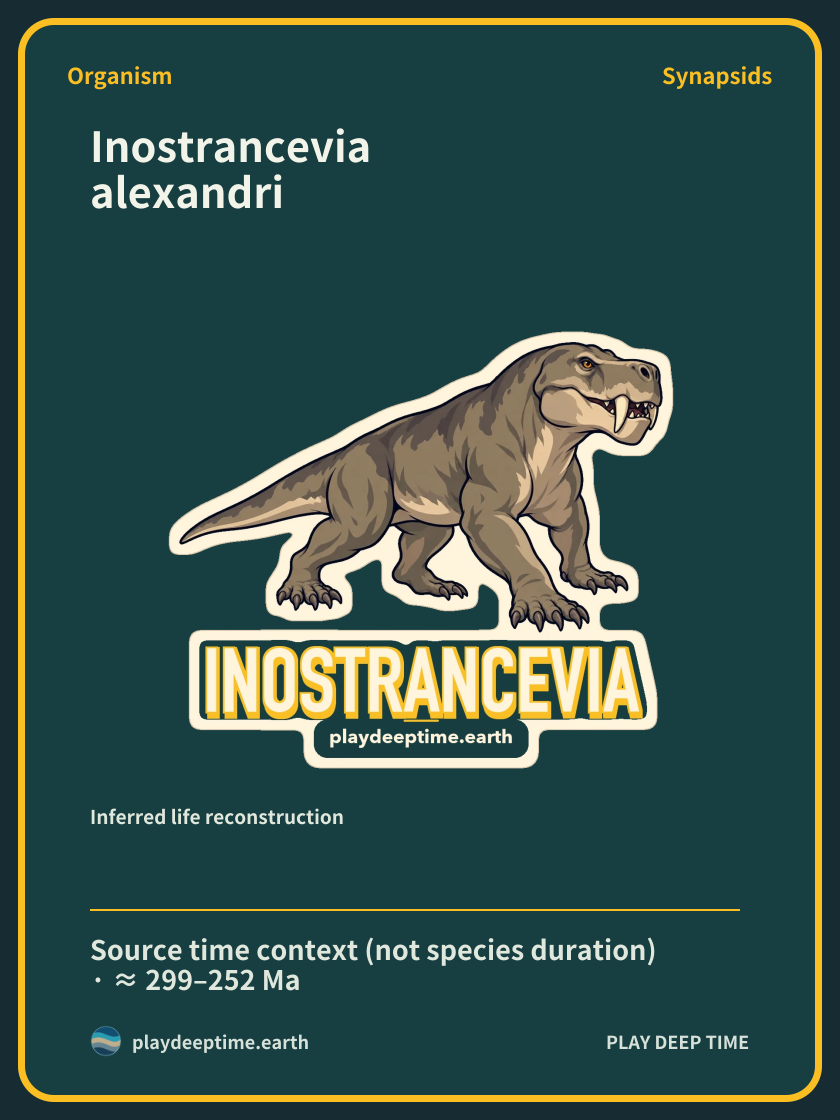
Organism · Synapsids
Inostrancevia alexandri
Source time context (not species duration) · ≈ 299–252 Ma
Inferred life reconstruction
Inostrancevia alexandri
Overview
Inostrancevia alexandri is a synapsid known for a large head and saber-like canines. It is presented through Late Permian material from present-day Russia. Several bony features can be compared within its broad head outline.[1]
Loading illustration…
Key facts
An institutional description includes a deep skull, tall nostrils, and large saber-like canines. The upper and lower organization of the head warrants attention alongside the long teeth.[1]
Time and place
It is known as a Late Permian organism from present-day Russia. The entire Permian spanned approximately 300–250 million years ago. Later research also compared its head with those of other Inostrancevia species.[1][2][3]
The time range describes source context, not the complete duration of this species.
Size, form and skeleton
The institution describes a large head, deep skull, tall nostrils, and long canines. The limbs are presented as intermediate between sprawling and more upright arrangements. Head and limbs provide clues to different body regions.[1]
Melbourne Museum presents Inostrancevia alexandri as approximately 3 m long. Beyond its long-canined head, its whole body made it a sizable predator.[9]
Loading illustration…
Habitat and reproduction
What does limb form reveal about possible posture? The institution describes a semi-sprawling, semi-erect arrangement. Connections between supporting bones allow the organization of posture to be explored.[1]
Fossil discovery
The museum explicitly identifies the species while presenting features of the head, canines, and limbs. A 2025 study of another Inostrancevia species also compared the tall jugal and postorbital bones of alexandri. Another species within the same genus thus prompts renewed examination of cranial structure.[1][2]
References
- Museums Victoria — Inostrancevia alexandri
- Macungo·Benoit·Araújo (2025) — Comparison of Inostrancevia skulls
- International Commission on Stratigraphy (2024) — Geological time chart
- Romano et al. (2021) — Body-volume reconstruction of Scutosaurus
- International Commission on Stratigraphy (2024) — Geological time chart
- Museums Victoria — Inostrancevia alexandri
- Macungo·Benoit·Araújo (2025) — Comparison of Inostrancevia skulls
- International Commission on Stratigraphy (2024) — Geological time chart
- Melbourne Museum — Inostrancevia in Dinosaur Walk
Research questions
Where might skulls within the same genus differ? Jugal height and expansion of the bone behind the eye in alexandri provide clues for later comparisons. Observations can narrow from the impression of its canines to skull connections.[2]
Observation
Move your gaze from the long canines to the deep skull and tall nostrils. Then consider limb placement to compare head features with structures supporting the body.[1]
Related organisms
 Scutosaurus karpinskiiReptiles including birdsSource time context (not species duration) · ≈ 299–252 Ma
Different faces of Late Permian Russia
Scutosaurus and Inostrancevia are encountered through Late Permian material from present-day Russia. Explore separately the features of a pareiasaur with a broad trunk and bony plates, and a synapsid with a large head and long canines.