Organism · Trilobites
Isotelus rex
Source time context (not species duration) · ≈ 487–443 Ma
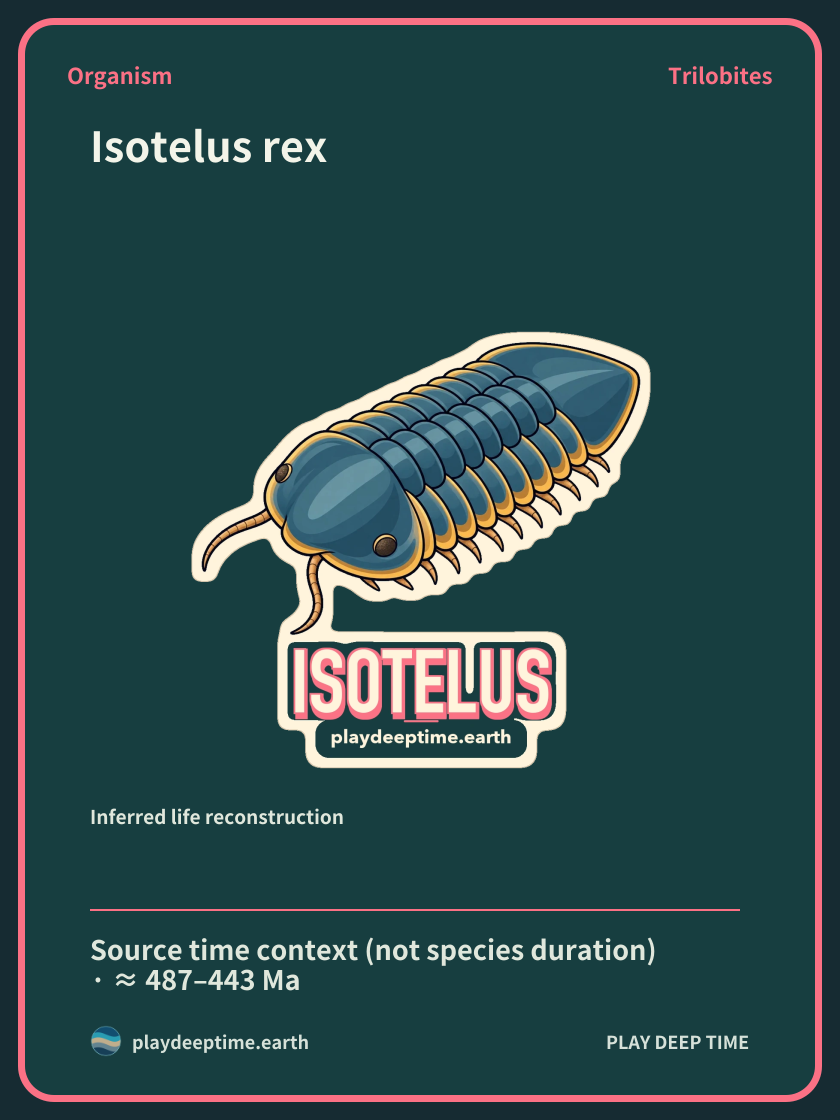
Inferred life reconstruction
Isotelus rex
Overview
Isotelus rex is a trilobite known for eight trunk segments and a smooth tail shield. Its eyes are low and laterally positioned, and adults are described as lacking genal spines. Several regions can be examined within its large dorsal exoskeleton.[1]
Loading illustration…
Key facts
The preserved dorsal exoskeleton of the type specimen has a reported median length of 68.3 cm. Part of the tip of the tail shield was lost to weathering. The specimen allows its large exoskeleton to be considered together with the state of its preserved end.[1]
Time and place
It is Late Ordovician material from the Churchill River Group of present-day Manitoba, Canada. The Ordovician as a whole spanned approximately 490–440 million years ago. The type specimen provides a reference for recognizing the trilobite from this place and time.[1][3]
The time range describes source context, not the complete duration of this species.
Size, form and skeleton
Low, laterally placed eyes, a head without genal spines in adults, eight trunk segments, and a smooth tail shield are described. The axis of the tail shield is weakly expressed. Within the broad outline, we can distinguish features of eyes, axis, and segments.[1]
Loading illustration…
Habitat and reproduction
What differences can be found in a trilobite’s hard exoskeleton? Head eyes and the presence or absence of genal spines, trunk segments, and the axis of the tail shield offer different clues. The same armored body can be compared through several regions.[1]
Fossil discovery
A 2003 study described Isotelus rex as a new species. The Manitoba Museum identifies MM I-2950 as the type specimen and also tells the story of making replicas. The original fossil leads to material that others can examine.[1][2]
References
- The world's biggest trilobite: Isotelus rex, new species from the Upper Ordovician of northern Manitoba, Canada
- Manitoba Museum — The story of replicating Isotelus rex
- International Commission on Stratigraphy (2024) — Geological time chart
- Bergström et al. (2003) — Comparisons of Asaphus from the Ordovician of Sweden
Research questions
What information can be shared by replicating a large fossil? The arrangement of the head, segmented trunk, and tail shield can be compared in more places. It illustrates the joint use of type-specimen records and replica material.[2]
Observation
Move your gaze from the low eyes on the head through the eight trunk segments to the tail shield. Examining the smooth shield and weak central axis connects broad body regions with small features.[1]
Related organisms
 Asaphus expansusTrilobitesSource time context (not species duration) · ≈ 487–443 Ma
Different bodies among trilobites
Explore the bodies of Isotelus and Asaphus expansus together. Isotelus: Isotelus rex is a trilobite known for eight trunk segments and a smooth tail shield. Asaphus expansus: Asaphus expansus is a trilobite with a segmented trunk connecting rounded head and tail shields.