Organism · Vascular plants
Johnstonia coriacea
Fossil record age bounds · ≈ 237–201 Ma
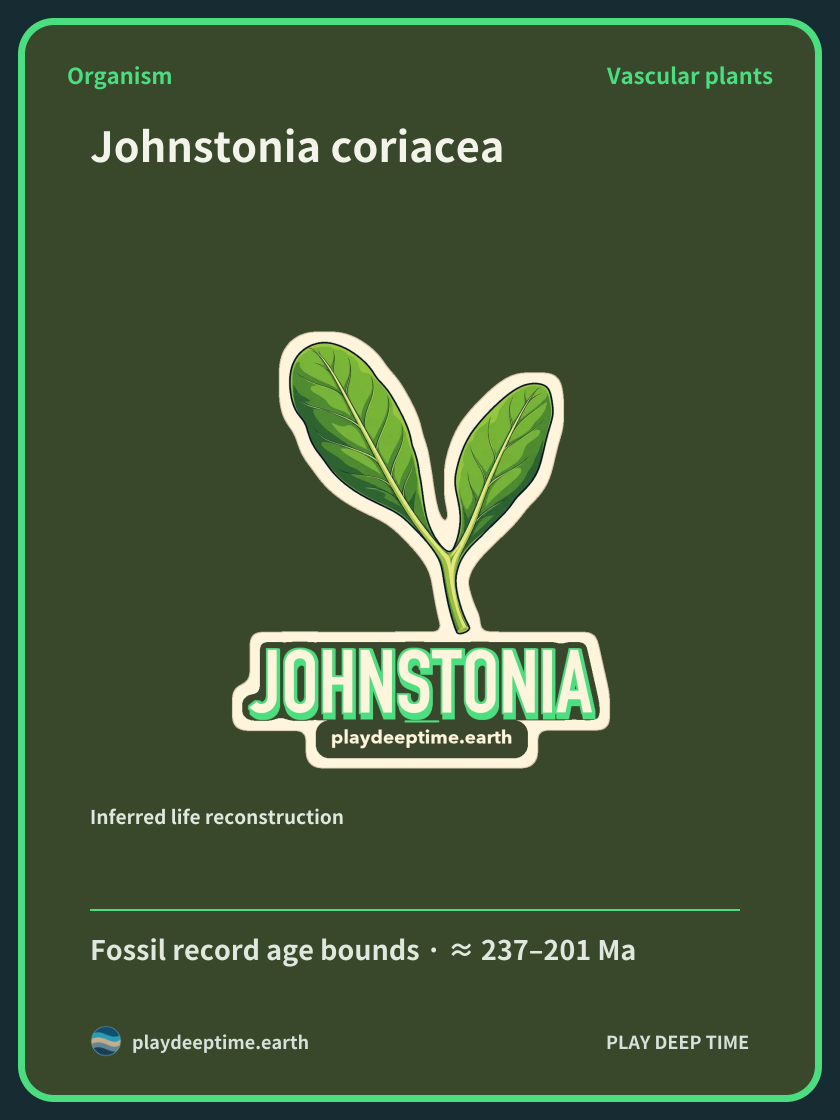
Inferred life reconstruction
Johnstonia coriacea
Overview
Johnstonia coriacea is an ancient plant encountered through fossil leaves with a forked axis. Following outlines preserved in compressions and impressions reveals the foliage recorded in stone.[1]
Loading illustration…
Key facts
Volcanoes also feature in research on this fossil flora. Evidence of lava intermittently entering river and lake depositional environments led the researchers to examine connections between volcanic activity and plant-fossil preservation.[1]
Time and place
It is presented as a Late Triassic fossil plant. The studied leaves came from the Agua de la Zorra Formation in the Cuyana Basin of present-day Mendoza Province, Argentina.[1]
The time range describes source context, not the complete duration of this species.
Size, form and skeleton
The leaf blade is relatively broad, with smooth margins and a rounded tip. The central axis supporting it forks in two, and a midvein is visible. Following the blade from the fork to the tips reveals its broad arrangement.[1]
The elongated leaf of Johnstonia coriacea divides into two around its middle. The complete leaf specimen UQF82600 from Queensland, Australia, is approximately 14.5 cm long and was designated as a new reference type for recognizing the plant in a 2016 study.[6]
Loading illustration…
Habitat and reproduction
The fossil-bearing strata were studied as deposits formed in deltas and lakes. Black shale and yellow mudstone preserve varied plant fragments as compressions or impressions, offering a view of ancient waterside environments.[1]
Fossil discovery
The researchers collected plant fossils during several field trips in 2015–2017. The fossil-bearing strata were divided into 18 intervals. Leaf IANIGLA-PB-692 was also introduced in this fossil-flora study.[1]
References
- Pedernera et al. (2019) — Volcanic activity and plant fossils of the Agua de la Zorra Formation
- Pedernera et al. (2019) — Volcanic activity and plant fossils of the Agua de la Zorra Formation
- Schoch·Sues (2020) — Origin of the turtle body plan
- Szczygielski·Sulej (2019) — Evolution of the early turtle shell
- International Commission on Stratigraphy (2024) — Geological time chart
- Pattemore (2016) — Reassessment of Triassic–Jurassic plant fossils from Australia
Research questions
Researchers’ interpretations have varied over whether similar leaves should be grouped in Dicroidium or separated into genera such as Johnstonia. This study distinguished genera according to morphological differences. Leaf names too carry a history of comparison and classification.[1]
Observation
The illustration is based on the preserved leaf fragment IANIGLA-PB-692. Follow the blade from the fork in its axis to its tip, locating the midvein and overall outline in turn.[1]
Related organisms
 Proganochelys quenstedtiiReptiles including birdsSource time context (not species duration) · ≈ 252–201 Ma
A Late Triassic plant and an early turtle
Read the leaf of Johnstonia alongside the armored body of Proganochelys. Different Late Triassic records from present-day Argentina and Germany convey contrasting stories of a plant and an early turtle.