Organism · Flowering plants
Juglans regia
Present
Living species illustration
Juglans regia
Overview
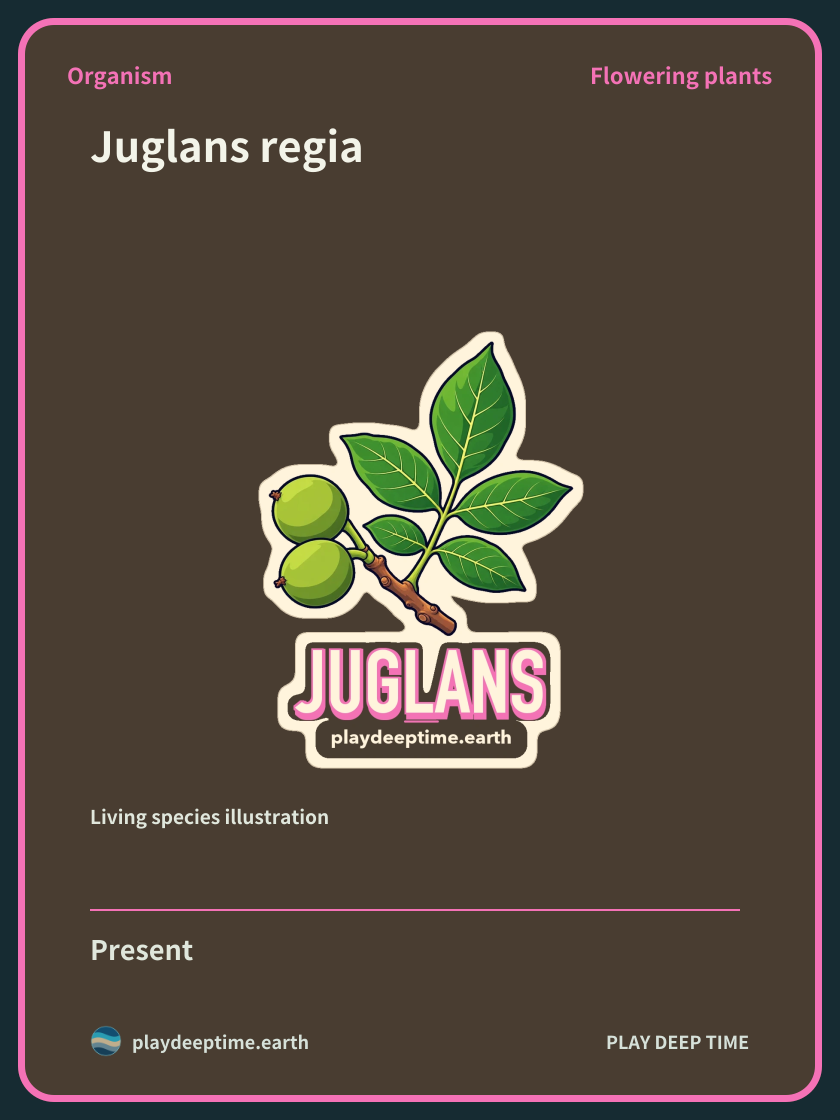
The walnut tree, Juglans regia, has a broad, spreading crown and large leaves made of several small leaflets. A rounded green fruit covering surrounds the hard walnut shell. A familiar food provides a starting point for seeing the whole tree anew.[1]
Loading illustration…
Key facts
A single large walnut leaf usually contains five to nine leaflets. The terminal leaflet is the largest, while lower pairs are smaller. Distinguishing a whole leaf from an individual leaflet changes how a branch appears.[1]
Time and place
It is a living temperate tree. Kew’s species account gives its native range as present-day northeastern and eastern Türkiye to Lebanon and the western Himalayas. Records from other regions where it is cultivated or introduced are also compiled.[2]
The time range describes source context, not the complete duration of this species.
Size, form and skeleton
The New Zealand flora describes a large tree exceeding 20 m tall with a broad, spreading crown. Leaflet margins are generally smooth, and the terminal leaflet is large. A hard shell and convoluted seed lie inside the rounded green fruit.[1]
Loading illustration…
Habitat and reproduction
It is described as a tree growing in temperate regions. The flora records male flowers in long, hanging inflorescences and female flowers in small groups. Looking at flowers and fruits alongside leaves and leaflets lets us follow changes in reproductive structures.[1]
Fossil discovery
The bibliographic history of the walnut name goes back to Linnaeus’s Species Plantarum of 1753. The 1988 New Zealand flora described the living tree’s leaves, flowers, and fruits in detail. Observations of plants from several regions have continued under an old name.[3][1]
References
- Flora of New Zealand · Taxon Profile — Juglans regia (citing the description by Webb, Sykes & Garnock-Jones 1988)
- Royal Botanic Gardens, Kew — Juglans regia
- International Plant Names Index — Juglans regia
- Xie et al. (2010) — Comparison and classification of Palaeocarya fruits from western Yunnan
- Webb, Sykes & Garnock-Jones (1988) — Juglans regia in the Flora of New Zealand
- Royal Botanic Gardens, Kew — Juglans regia
- International Plant Names Index — Juglans regia
Research questions
Where does one large leaf begin and end? Follow the petiole and central axis to examine the positions of its leaflets. Looking at flowers, green fruits, and the seeds inside shells alongside them allows comparison of several organs of a familiar tree.[1]
Observation
Choose one large leaf on the spreading branches. Find the paired leaflets and the larger terminal one, and picture the green fruit covering separately from the hard walnut shell.[1]
Related organisms
 Palaeocarya guangxiensisFlowering plantsFossil record age bounds · ≈ 3.6–2.58 Ma
Winged fossil fruits and today’s walnuts
Compare fruits of the walnut family in the past and present. Late Pliocene Palaeocarya material from present-day western Yunnan, China, preserves three wings, while living walnuts have a hard shell and convoluted seed inside a green fruit covering. Picturing a familiar walnut makes the varied fruit forms within the same family easier to appreciate.