Organism · Reptiles including birds
Keichousaurus hui
Source time context (not species duration) · ≈ 252–201 Ma
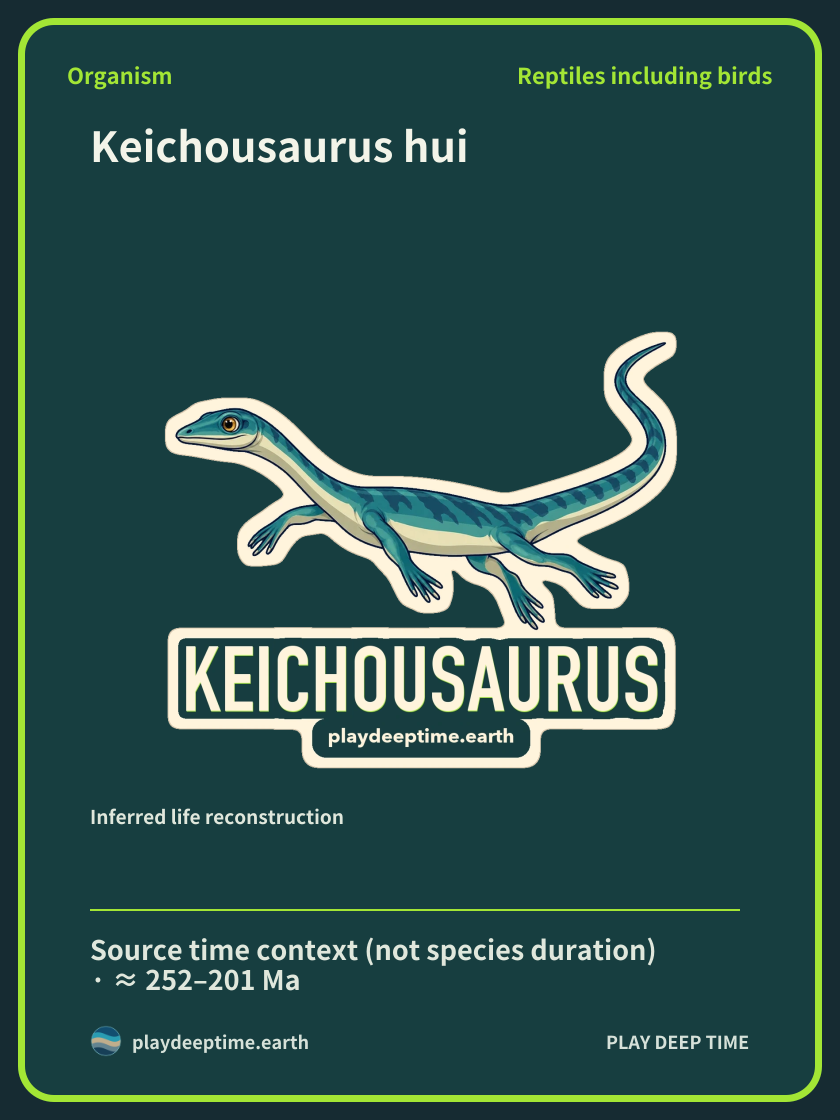
Inferred life reconstruction
Keichousaurus hui
Overview
Keichousaurus hui is a Triassic reptile with a long neck, tapering tail, and four limbs. It is studied from fossils with small body bones articulated. Several specimens of the same species allow examination of growth and differences in body proportions.[1]
Loading illustration…
Key facts
Forelimbs within the same species did not all have the same proportions. Researchers compared specimens of several sizes to study differences in forelimb bones related to growth and sex. There is interest in going beyond a single specimen to place several bodies side by side.[1]
Time and place
It is known from material of the Ladinian Age of the Middle Triassic, roughly 242–237 million years ago. Fossils from the Xingyi area of Guizhou in present-day southern China have been studied.[1][3]
The time range describes source context, not the complete duration of this species.
Size, form and skeleton
A trunk and four limbs lie between the long neck and rearward-tapering tail. Large eye sockets, a broad ulna, and thickened rib bases are also described as diagnostic features. Bones of the head, limbs, and trunk can be compared together.[1][2]
Adult male Keichousaurus specimen PCGU4281 has a preserved body length of about 22.3cm. A 2023 study also examined traces inside this specimen to investigate food and digestive organs.[4]
Loading illustration…
Habitat and reproduction
This reptile is studied for a body associated with aquatic life. Researchers consider the arrangement of the long neck, four limbs, and tail together and compare forelimb proportions among specimens. This raises questions about how a body changing with growth related to life in water.[1]
Fossil discovery
Articulated skeletons from Xingyi, Guizhou, reveal the construction of the head, trunk, and limbs. An abstract of a 2013 species-specific study summarized features of the large eye sockets, ribs, and ulna together. Growth studies add differences among individuals.[1][2]
References
- Study of growth and sexual differences in Keichousaurus
- 2013 study — Keichousaurus from Xingyi, Guizhou
- International Commission on Stratigraphy (2024) — Geological time chart
- (2023) Soft tissues and feeding ecology of Keichousaurus
- Study — Cranial diversity in Clevosaurus
- 2009 study — Postcranial skeletal comparisons of Clevosaurus
Research questions
Do forelimb proportions change at the same rate as the body grows? Researchers compare the same bones among individuals of different sizes. This fossil research examines growth-related changes alongside individual differences.[1]
Observation
Move your gaze from the small head along the long neck to the four limbs and tail. Comparing the proportions of forelimbs and hind limbs helps you examine small differences in the body.[1]
Related organisms
 Clevosaurus hudsoniLepidosaursSource time context (not species duration) · ≈ 252–201 Ma
Different bodies among reptiles
Explore the bodies and living backgrounds of Keichousaurus hui and Clevosaurus hudsoni together. Keichousaurus hui: Keichousaurus hui is a Triassic reptile with a long neck, tapering tail, and four limbs. It is studied from fossils with small body bones articulated. Clevosaurus hudsoni: Clevosaurus hudsoni is a Late Triassic reptile known from material from the head, neck, and forelimbs. Its body bones have also been compared with those of other Clevosaurus species.