Organism · Reptiles including birds
Kuehneosaurus latus
Source time context (not species duration) · ≈ 252–201 Ma
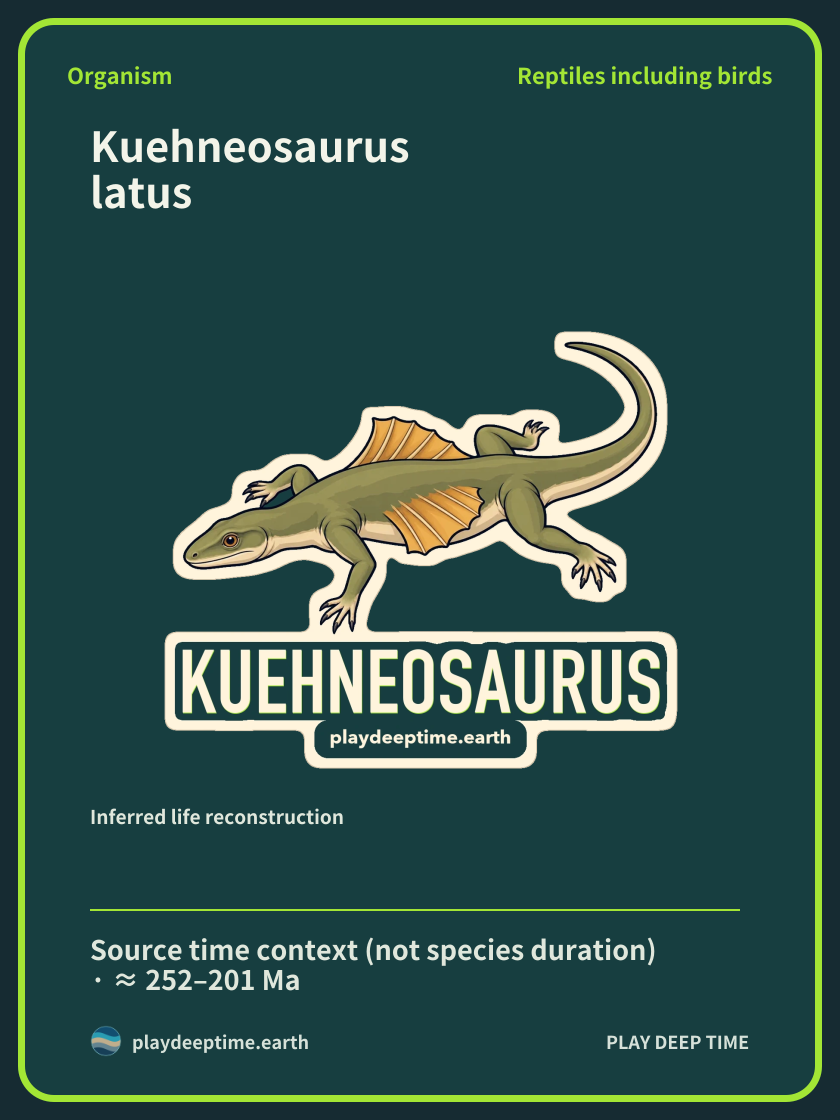
Inferred life reconstruction
Kuehneosaurus latus
Overview
Kuehneosaurus latus is a Late Triassic reptile with distinctive ribs extending sideways from its body. Researchers proposed a construction in which these ribs supported membranes. This differs from wings formed by enlarged forelimbs.[1]
Loading illustration…
Key facts
The clues to membranes on either side are trunk ribs extending sideways. This is not a construction based on greatly elongated arms or fingers. It prompts consideration of how different bones can be used to create broad surfaces.[1]
Time and place
Late Triassic specimens from present-day Britain were studied. The Triassic as a whole was roughly 250–200 million years ago. Research compared the group’s skeletons with models based on several specimens.[1][2]
The time range describes source context, not the complete duration of this species.
Size, form and skeleton
Short trunk ribs projecting sideways are described as a feature. BMNH R.8172 preserves a partly articulated trunk and the first four tail vertebrae. The author combined information from several specimens to propose a construction with four legs and membranes along the body’s sides.[1]
The reconstruction model of Kuehneosaurus latus used a body length of about 25cm excluding the tail. Laterally projecting ribs broadened both sides of the body, and researchers used life-sized models to test possible postures in airflow.[8]
Loading illustration…
Habitat and reproduction
How did structures broadening the sides of the body interact with air? Research on this group examined rib-based body construction and model aerodynamics. It is a case of expanding fossil-based questions into physical comparisons.[1]
Fossil discovery
The study compared head and trunk material from several specimens rather than using only one. A partly articulated trunk reveals bone positions, while other material adds comparative information on missing regions. Separate fossils lead to questions about the whole construction.[1]
References
- Study — Aerodynamics of Late Triassic British kuehneosaurids
- International Commission on Stratigraphy (2024) — Geological time chart
- Study — Aerodynamics of Late Triassic British kuehneosaurids
- International Commission on Stratigraphy (2024) — Geological time chart
- Study — Cranial diversity in Clevosaurus
- International Commission on Stratigraphy (2024) — Geological time chart
- 2009 study — Postcranial skeletal comparisons of Clevosaurus
- Stein et al. (2008) — Aerodynamics of Triassic kuehneosaurids
Research questions
What different information do an aerodynamic model and a fossil provide? Fossils reveal preserved bones, while models provide a way to physically compare a proposed body construction. This research connects observing structures with testing hypotheses.[1]
Observation
Examine the ribs extending from the trunk to either side and the surrounding membranes. Looking separately at the position of the forelimbs makes the difference from arm-based wings clearer.[1]
Related organisms
 Clevosaurus hudsoniLepidosaursSource time context (not species duration) · ≈ 252–201 Ma
Late Triassic reptiles of Britain
Compare Late Triassic material of Kuehneosaurus and Clevosaurus from present-day Britain. Clevosaurus is introduced through fossils from Cromhall. You can examine laterally projecting ribs in one reptile and structures of the head, neck, and forelimbs in the other.