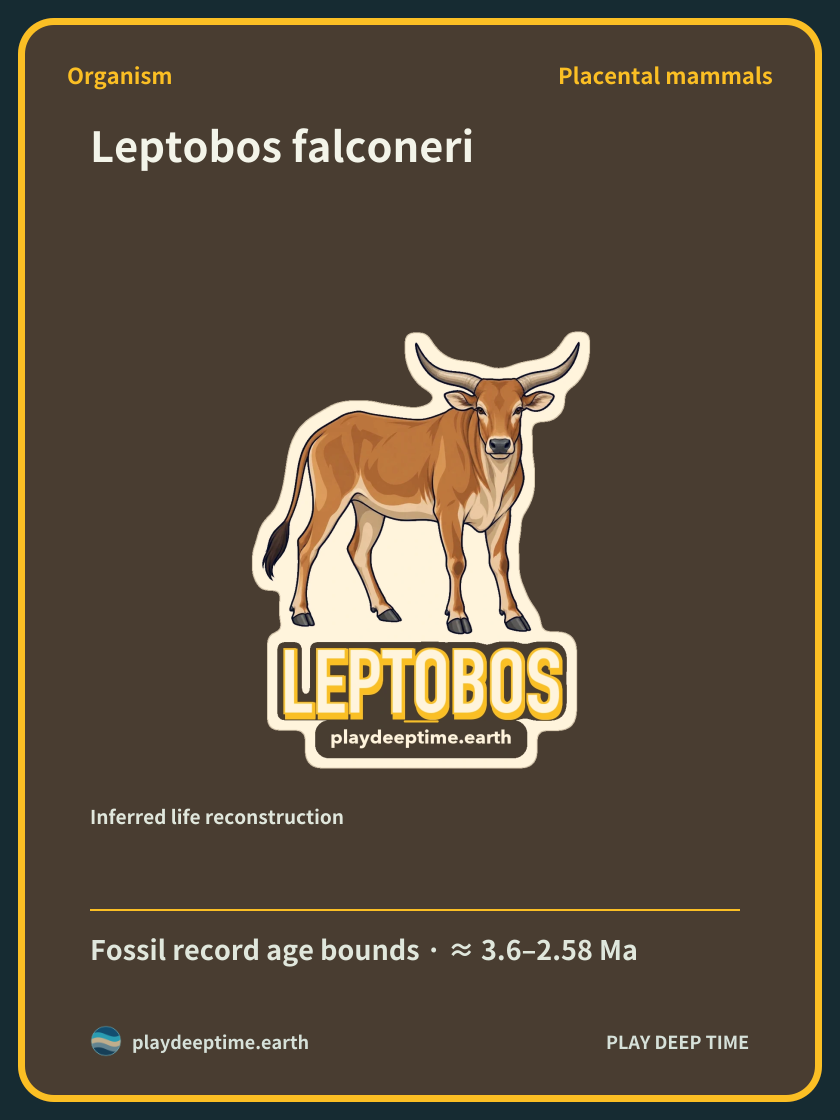
Organism · Placental mammals
Leptobos falconeri
Fossil record age bounds · ≈ 3.6–2.58 Ma
Inferred life reconstruction
Leptobos falconeri
Overview
Leptobos falconeri is an ancient bovine known from fossils of the Siwalik region. Researchers introduced it as a large bovine with a slender, lightly built appearance. Differences preserved in skulls and horn bases provide important clues to its identity.[2][1]
Loading illustration…
Key facts
Not every skull looks alike even within one studied species. A 1958 study distinguished several male skulls from a hornless female skull. Examining differences among specimens comes before reconstruction.[1]
Time and place
Later comparative research associates this species’ fossil skulls with the Early Pleistocene Pinjor horizon. The locality named in the research lies in the Siwalik region of present-day Pakistan. Following the age of a particular fossil introduces the setting of ancient bovines.[3]
The time range describes source context, not the complete duration of this species.
Size, form and skeleton
Outward-spreading horn bases survive on the skull. Some specimens have missing or reconstructed upper horn portions. Distinguishing preserved bases from added upper sections clarifies the outline directly conveyed by the fossil.[1]
In Leptobos falconeri specimen PUA/SK-07/63 from the Indian Siwaliks, the upper second molar is 30.4 mm long and 23.2 mm wide. A single molar longer than 3 cm shows the substantial size of this animal’s chewing tools.[4]
Loading illustration…
Habitat and reproduction
Its relationship to other bovines provides a starting point for questions about its life. Skulls and horns, however, cannot reveal everything about the movement of legs and hooves. We can ask what stories would emerge if other body bones were added to the head evidence.[1]
Fossil discovery
Museum skulls offered an opportunity to reconsider an old species name. Hooijer compared the type specimen held in London with several other skulls. The work checked one specimen’s name against differences among many specimens.[1]
References
- Hooijer (1958) — Comparing skulls of Leptobos falconeri
- Croitor (2013) — Morphology and taxonomic problems of leptobovines
- Cherin et al. (2019) — Fossil bovines from Umbria, Italy, and reassessment of Leptobos
- Kumar & Gaur (2015), Leptobos (Bovidae, Artiodactyla) from the Tatrot Formation of the Upper Siwaliks of the Indian Subcontinent
- Taxonomic study of ruminants from the Oligocene–Early Miocene of western Europe
- 2014 study — Reassessment of gelocid skeletons and classification
Research questions
Which skulls should be grouped in the same genus? Studies of Leptobos and related forms present several classifications interpreting horns and skulls. Relationships among similar-looking ancient bovines raise new questions depending on the features compared.[2]
Observation
Find where the horns begin as they spread to either side of the head. Then distinguish the surviving outline from parts completed by reconstruction. There is interest in reading different layers of evidence within an apparently complete form.[1]
Related organisms
 Gelocus communisPlacental mammalsSource time context (not species duration) · ≈ 33.9–23 Ma
Different bodies among ruminants
Explore the bodies and life settings of Leptobos falconeri and Gelocus communis together. Leptobos falconeri: Leptobos falconeri is an ancient bovine known from fossils of the Siwalik region. Researchers introduced it as a large bovine with a slender, lightly built appearance. Gelocus communis: Gelocus communis is an extinct Oligocene ruminant. It appears in research comparing head and limb features and is the type species of the genus Gelocus.