Organism · Tetrapod lineage
Lethiscus stocki
Source time context (not species duration) · ≈ 359–299 Ma
Inferred life reconstruction
Lethiscus stocki
Overview
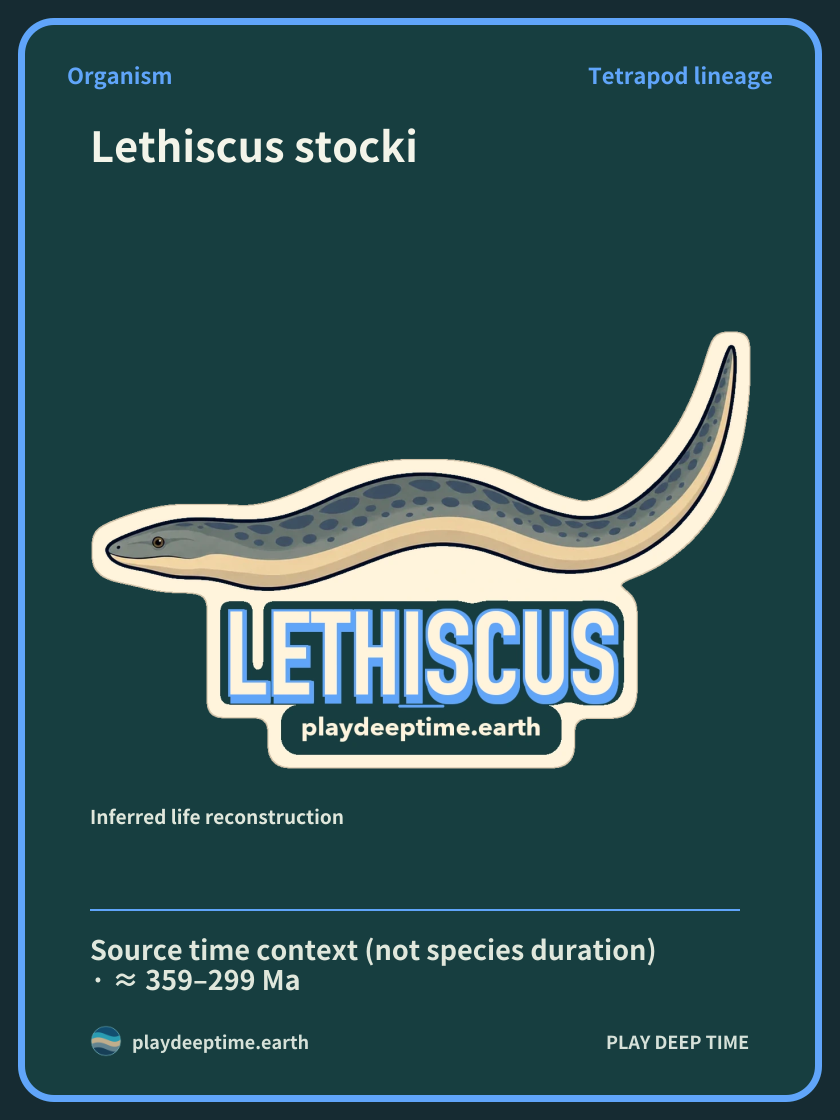
Lethiscus stocki is a long-bodied, limbless tetrapod relative that lived in the Carboniferous. It evokes a snake but belongs to a separate ancient group called aïstopods. CT studies of a small fossil even changed its position in the animal family tree.[1][2]
Loading illustration…
Key facts
The type specimen preserves 78 vertebrae. A 2003 CT study reexamined a fragment previously regarded as a shoulder bone. Bone positions and internal structures can change old interpretations.[1]
Time and place
It is an animal from the Viséan Age of the Carboniferous, around 335 million years ago. The fossil came from shale at Wardie Shore near Edinburgh in present-day Scotland. The same strata also preserve diverse fishes and other aquatic animals.[1][3]
The time range describes source context, not the complete duration of this species.
Size, form and skeleton
A long vertebral column extends behind the narrow head. The 78 vertebrae in the known specimen are a count of the preserved portion. The braincase inside the head is also an important region for comparisons with other ancient tetrapod relatives.[1][2]
The total length of slender Lethiscus is reconstructed at about 15cm. This estimate compares the parts identified in the fossil with the body proportions of related organisms.[10]
Loading illustration…
Habitat and reproduction
The fossil beds at Wardie reveal an environment inhabited by aquatic animals. Sharks, several fishes, bivalves, and small crustaceans were studied together. Viewing long-bodied Lethiscus alongside these organisms broadens the view of a Carboniferous waterside world.[3]
Fossil discovery
Specimen MCZ2185 has been reexamined by several generations of researchers. High-resolution CT in 2003 was followed by a more detailed comparison of internal head structures published in 2017. New observational methods allowed one small fossil to tell a different story.[1][2]
References
- Anderson, Carroll & Rowe2003 — Lethiscus examined with CT
- Pardo et al.2017 — The head of Lethiscus and early tetrapod evolution
- Coates et al.2019 — Feeding structures of Carboniferous sharks and the Wardie fossil beds
- Anderson, Carroll & Rowe2003 — Lethiscus examined with CT
- Pardo et al.2017 — The head of Lethiscus and early tetrapod evolution
- Coates et al.2019 — Feeding structures of Carboniferous sharks and the Wardie fossil beds
- Carroll (2007) — The origin of amphibians and the skeleton of Balanerpeton
- International Commission on Stratigraphy (2024) — Geological time chart
- Milner·Sequeira — Original description of Balanerpeton from East Kirkton
- Sallan·Galimberti (2015) — Changes in vertebrate size before and after the end-Devonian extinction
Research questions
How early in tetrapod history did long, limbless bodies appear? A 2017 study placed aïstopods on an earlier stem lineage based on primitive braincase features. It invites reconsideration of the idea that snake-like bodies arose only late in evolution.[2]
Observation
Follow the long vertebral column from the narrow head. Remembering that this body has a different history from superficially similar snakes makes it even more intriguing.[1][2]
Related organisms
 Balanerpeton woodiTetrapod lineageSource time context (not species duration) · ≈ 359–299 Ma
Different bodies of Early Carboniferous Scotland
Lethiscus and Balanerpeton are known from different Early Carboniferous localities around Edinburgh in present-day Scotland. Compare a long, limbless relative with an amphibian bearing four limbs to explore the diversity of ancient tetrapods.