Organism · Birds and early avialans
Lithornis vulturinus
Source time context (not species duration) · ≈ 59–48 Ma
Inferred life reconstruction
Lithornis vulturinus
Overview
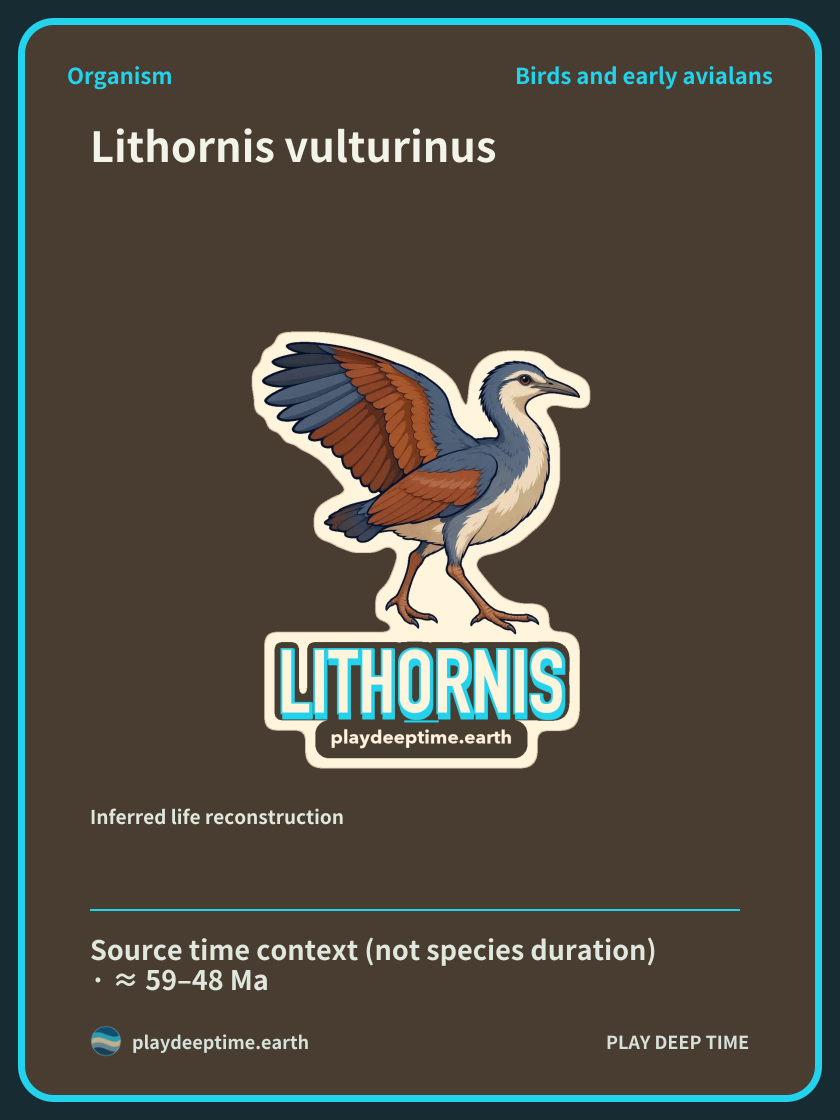
Not all ostrich relatives were flightless. Lithornis vulturinus is associated with a group of flying palaeognaths from the Eocene. Spaces inside its small skull reveal part of the history of changes in bird brains.[1]
Loading illustration…
Key facts
A braincase kept separately in a museum was reunited with other bones of the same specimen. A 2024 study examined its internal cavity and identified a brain shape resembling that of living tinamous. A bone in an old drawer became a starting point for new questions.[1]
Time and place
The key research specimen comes from early Eocene Europe, approximately 53 million years ago. It is known from the London Clay in present-day Britain. Alongside other bird fossils from the same formation, it offers a view of early Cenozoic birds.[1]
The time range describes source context, not the complete duration of this species.
Size, form and skeleton
Researchers estimated a body mass of approximately 1 kg from the circumference of the humerus. They compared the internal cavity as well as the exterior of the partial braincase. This is a bird whose small cranial details, rather than a large mounted skeleton, take center stage.[1]
Loading illustration…
Habitat and reproduction
Lithornithids were an ancient flying group of palaeognaths, the group that includes living ostriches and kiwis. Their living comparison, the tinamou, can also fly. Considering movement on the ground and flight together reveals a greater past variety of palaeognath lifestyles.[1]
Fossil discovery
NHMUK A5204 is the neotype, a new reference specimen for the species. A 2024 study examined a partial braincase that had not previously been studied in detail. Even fossils already given a name continue to yield new subjects for research.[1]
References
- Widrig, Navalón & Field (2024) · Paleoneurology of stem palaeognaths clarifies the plesiomorphic condition of the crown bird central nervous system · Journal of Morphology285(6):e21710
- Mayr (2008), “A skull of the giant bony-toothed bird Dasornis (Aves: Pelagornithidae) from the Lower Eocene of the Isle of Sheppey,” Palaeontology 51(5):1107–1116.
- Widrig, Navalón & Field (2024) · Paleoneurology of stem palaeognaths clarifies the plesiomorphic condition of the crown bird central nervous system · Journal of Morphology285(6):e21710
Research questions
How far back does the brain shape of living tinamous extend? Comparison with Lithornis suggests that some features may have persisted since the early Cenozoic. Bird evolution can be read inside the head as well as in the wings.[1]
Observation
Move your gaze from the head and beak to the trunk and wings.[1]
Related organisms
 Dasornis emuinusBirds and early avialansSource time context (not species duration) · ≈ 56–33.9 Ma
Different birds of the London Clay
Dasornis and Lithornis are early Eocene birds known from the London Clay in present-day Britain. Read the head material of a seabird with tooth-like projections on its beak alongside that of a palaeognath bird, and explore different forms from the same broad geological setting.