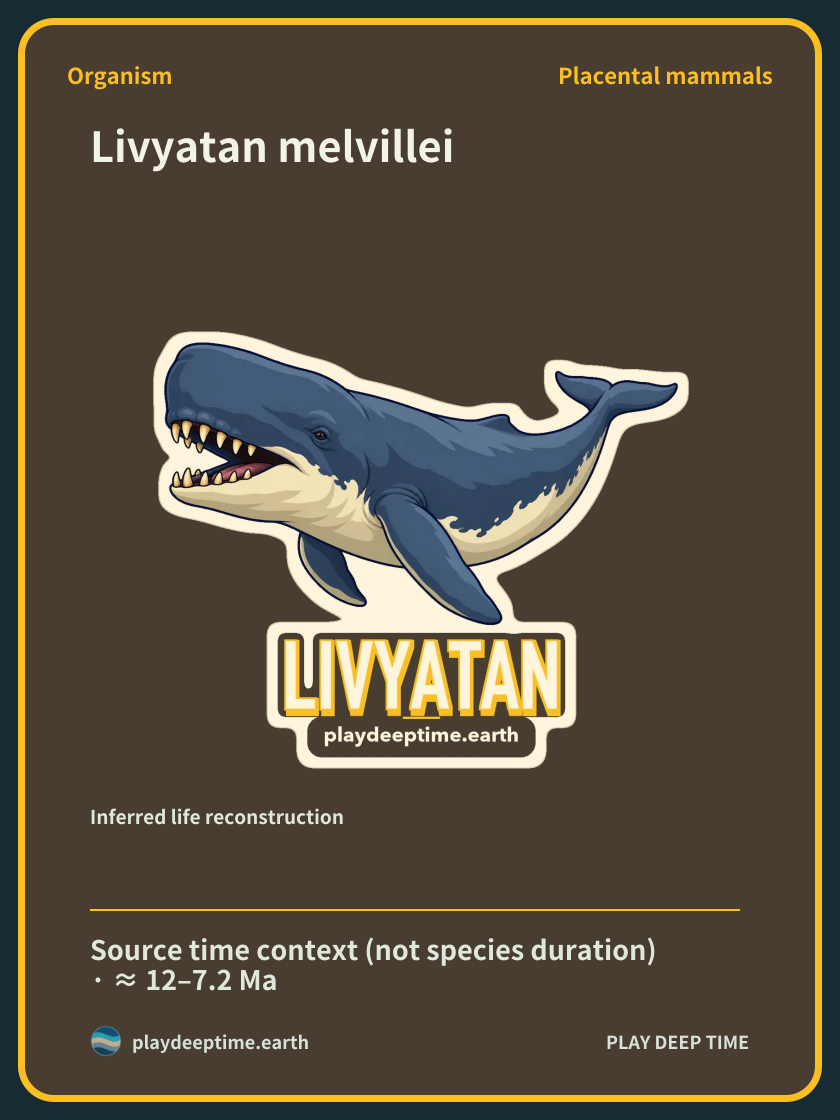
Organism · Placental mammals
Livyatan melvillei
Source time context (not species duration) · ≈ 12–7.2 Ma
Inferred life reconstruction
Livyatan melvillei
Overview
Livyatan melvillei is a fossil toothed whale from Miocene Peru. A skull and lower jaw bearing teeth formed the basis of its description. It invites exploration of the varied head shapes of ancient sperm whales.[1]
Loading illustration…
Key facts
This whale had to have its original name changed. A 2010 correction proposed the genus name Livyatan in place of Leviathan, which had already been used for another animal. Biological names also contain a history of checking which names were used first.[2]
Time and place
It is studied from Miocene fossils in present-day Peru. Later literature provided further discussion of the skull from Cerro Colorado. The registered fossil-bearing strata are summarized within a broad time window of roughly 12–7.2 million years ago.[1][3][4]
The time range describes source context, not the complete duration of this species.
Size, form and skeleton
The original description is based on a skull and lower jaw bearing teeth. Researchers associated this material with Physeteroidea, the sperm-whale group. Bones of the head and jaw are direct evidence for understanding an ancient toothed whale.[1]
Livyatan’s body length is estimated at about 13.5–17.5m when its skull is compared with living sperm whales and other extinct sperm whales. This reconstruction range varies with the animal chosen for comparison.[5]
Loading illustration…
Habitat and reproduction
Toothed-whale jaws and teeth are important evidence for comparing feeding apparatuses. Research on Miocene sperm whales from Peru considered Livyatan alongside other large predatory sperm whales. Different head shapes allow exploration of questions about how they obtained food.[1][3]
Fossil discovery
Lambert and colleagues described the Peruvian fossil as a new toothed whale in 2010. A correction announcing a replacement genus name appeared that same year. Later comparative research added information about the skull from Cerro Colorado.[1][2][3]
References
- Lambert et al. (2010) — Livyatan from the Miocene of Peru
- Lambert et al. (2010) — Correction of the replacement genus name Livyatan
- Comparison of large-prey-hunting sperm whales from the Miocene of Peru
- Paleobiology Database — Fossil-bearing strata of Livyatan
- Lambert et al. — Anatomy and evolution of predatory sperm whales
- 1993 study — A toothed whale with a short snout and asymmetric tusks
- Study of the delphinoid relationships of Odobenocetops
Research questions
How do a whale’s name and form enter the research record? The head and jaw account in the original description, the correction of the name, and later comparative studies add different information. As papers accumulate, the whale’s name and head become better understood.[1][2][3]
Observation
Move your gaze from the head to the outline of the lower jaw. Remember that inside the appearance of a soft body lie direct fossil clues: teeth and jawbones.[1]
Related organisms
 Odobenocetops peruvianusPlacental mammalsSource time context (not species duration) · ≈ 7.2–5.3 Ma
Different bodies among whales
Explore the bodies of Livyatan and Odobenocetops together. Livyatan: Livyatan melvillei is a fossil toothed whale from Miocene Peru. Odobenocetops: Odobenocetops peruvianus is a fossil toothed whale with a short, rounded snout and asymmetrical tusks.