Organism · Ray-finned fishes
Luganoia lepidosteoides
Source time context (not species duration) · ≈ 252–201 Ma
Inferred life reconstruction
Luganoia lepidosteoides
Overview
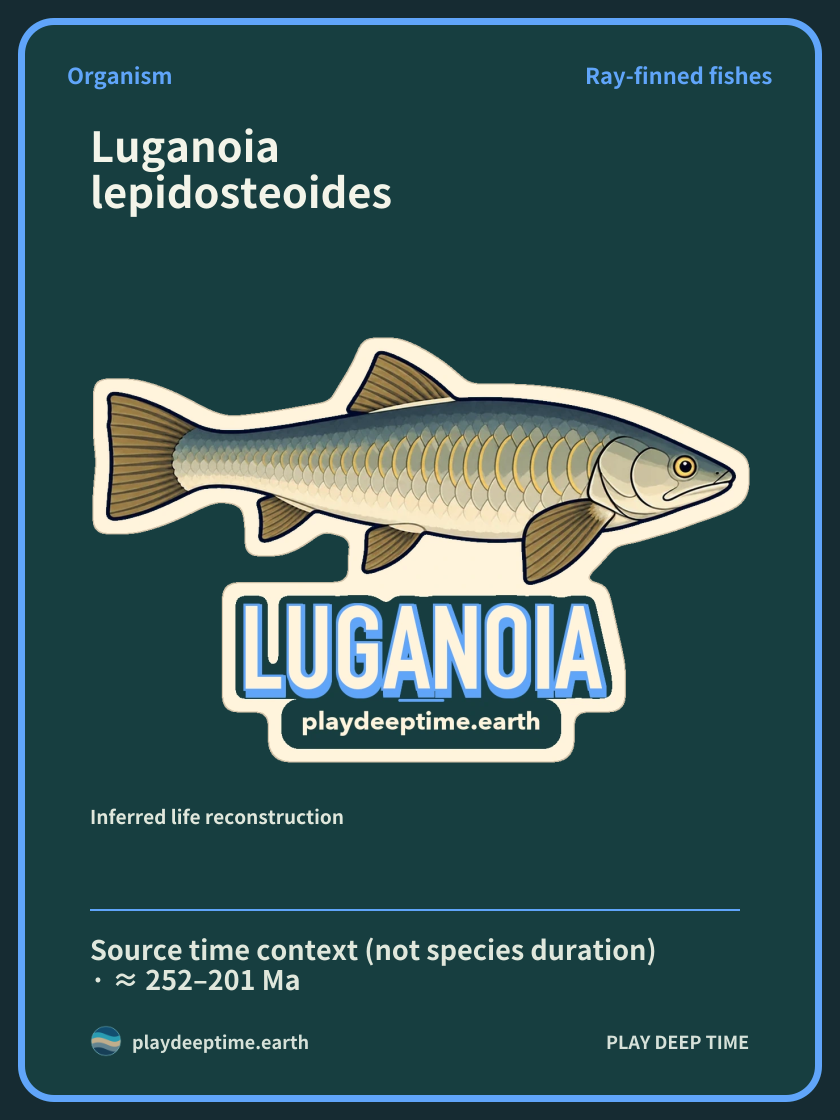
Luganoia lepidosteoides is a fish compared using Triassic material from Europe. Deep scales on the flanks and scale rows changing toward the rear are treated as features of the genus. Scale and fin construction can be examined together.[1]
Loading illustration…
Key facts
The anal fin of this species is compared as being nearly the same size as the pelvic fins. In another species of the genus, their relative sizes differ. Even among similar fishes, examining which fin is larger provides a distinguishing clue.[1]
Time and place
Material of the Triassic species from Europe was used in later comparative research. The Triassic was roughly 250–200 million years ago. A study addressing a new Chinese species also compared differences from the European species side by side.[1][2]
The time range describes source context, not the complete duration of this species.
Size, form and skeleton
The genus diagnosis includes deep anterior flank scales and scale rows shortening toward the rear. Species comparisons address the truncated rear outline of the tail and the relative sizes of anal and pelvic fins. Different features can be found on the body’s surface and margin.[1]
Luganoia lepidosteoides is introduced as a small fish with a standard length of about 5cm. This is measured excluding the tail fin. A 2020 study compared this size with that of its close relative Luganoia fortuna.[3]
Loading illustration…
Habitat and reproduction
Do fishes in the same genus share fin sizes and positions? Comparative research on Luganoia examined differences in pelvic fins, anal fins, and tails together. Even when the broad outline resembles another fish, each region can have a different construction.[1]
Fossil discovery
Later research compared material of a new species with the European lepidosteoides side by side. An earlier author’s composite morphological illustration was also used as reference material. A new discovery prompted a fresh reading of features in a long-known fish.[1]
References
Research questions
Scales and fins provide clues at different sizes. Repeated scale rows reveal the body surface, while relative fin sizes reveal the construction of its outline. Examining several parts together helps distinguish similar fishes.[1]
Observation
Move your gaze from the deep scales on the anterior flank to scale rows shortening toward the rear. Comparing the pelvic fins, anal fin, and tail tip in sequence reveals different body features.[1]
Related organisms
 Perleidus altolepisRay-finned fishesSource time context (not species duration) · ≈ 252–201 Ma
Different bodies among fishes
Explore the bodies and living backgrounds of Luganoia lepidosteoides and Perleidus altolepis together. Luganoia lepidosteoides: Luganoia lepidosteoides is a fish compared using Triassic material from Europe. Deep scales on the flanks and scale rows changing toward the rear are treated as features of the genus. Perleidus altolepis: Perleidus altolepis is a fish known for a transition from deep scales at the front of the body to small scales toward the rear. It was studied from Middle Triassic material.