Organism · Placental mammals
Macrauchenia patagonica
Source time context (not species duration) · ≈ 2.58–0 Ma
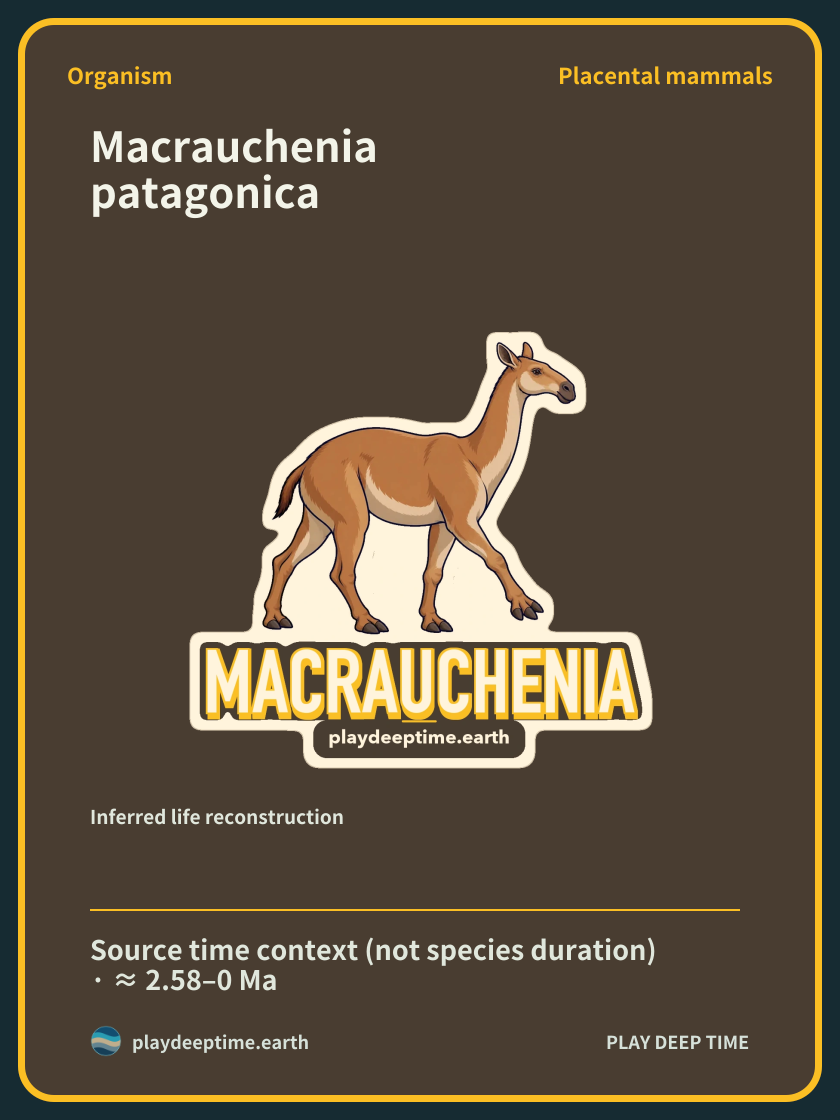
Inferred life reconstruction
Macrauchenia patagonica
Overview
Macrauchenia patagonica was an extinct South American mammal with a long neck and three toes. The retracted nasal opening in its skull has prompted several hypotheses about its face. This intriguing animal invites us to reconstruct a living body starting from bones.[1][2]
Loading illustration…
Key facts
Even the name assigned to a first neck vertebra remained wrongly connected for more than a century. A 2023 study distinguished old material identified as bovid from the actual neck vertebra of Macrauchenia. Reexamining familiar bones can reveal a different body’s story.[2]
Time and place
It is studied from Pleistocene and early Holocene South American material. This mammal invites exploration of an interval roughly from hundreds of thousands of years ago to around 10,000 years ago. Present-day South American rock layers and museum skeletons reveal its ancient body organization.[1][2][3]
The time range describes source context, not the complete duration of this species.
Size, form and skeleton
It is presented as a litoptern with a long neck and three toes. The bony nasal opening lies far back on the skull. Considering head, neck, and feet together reveals a combination unlike familiar living mammals.[1][2]
A study comparing two Macrauchenia specimens using the width of the skull–neck articulation estimated body masses of about 592–619 kg. Even for the same animal, reconstructed mass varies with the bones and calculation methods used.[4]
Loading illustration…
Habitat and reproduction
The long neck and three toes raise questions about body support and interaction with the surroundings. The position of the nasal opening has also prompted several reconstructions of the soft tissues of the nose. Relationships between bone form and life can be explored in several body regions.[1]
Fossil discovery
An incomplete skeleton collected by Darwin led to digital reconstruction research at a museum. Later researchers also reexamined an old, misidentified first neck vertebra. Collection, storage, digital technology, and redescription add different paths toward understanding the body.[1][2]
References
- Natural History Museum — The body and digital reconstruction of Macrauchenia
- 2023 study — The long-standing misidentification of the first neck vertebra of Macrauchenia
- International Commission on Stratigraphy (2024) — Geological time chart
- (2023) Anatomy and body-mass comparisons of small macraucheniids
- Harington (2007) — The flat-headed peccary of the Ice Age
Research questions
How much of the face can be inferred from the skull’s nasal opening alone? Researchers examine several nose shapes by comparing bone positions and soft tissues of related mammals. The connection between the long neck and head is also considered.[1][2]
Observation
Move your gaze from the long neck to the nasal opening’s position in the skull. Then examine the trunk and three-toed feet to reveal this South American mammal’s unfamiliar combination.[1]
Related organisms
 Platygonus compressusPlacental mammalsFossil record age bounds · ≈ 3.6–0 Ma
Different bodies among mammals
Compare the bodies and backgrounds of Macrauchenia patagonica and the flat-headed peccary. Macrauchenia patagonica: an extinct South American mammal with a long neck and three toes, whose retracted nasal opening prompted several facial hypotheses. Flat-headed peccary: Platygonus compressus was an Ice Age North American peccary characterized by a short, deep snout and relatively long legs.