Organism · Placental mammals
Mammut americanum
Source time context (not species duration) · ≈ 2.58–0 Ma
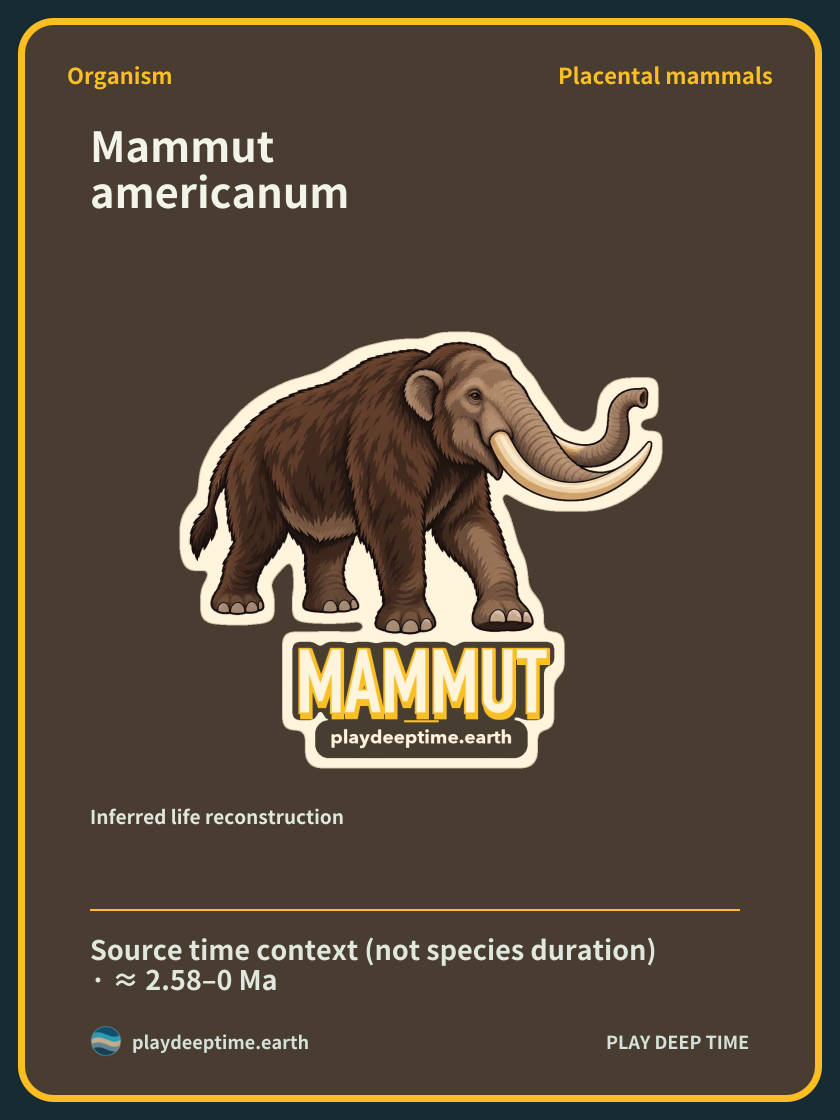
Inferred life reconstruction
Mammut americanum
Overview
The American mastodon is an elephant relative with a long trunk, gently curved tusks, and broad feet. It lived in the forests and watersides of ice-age North America. The story of a skeleton once displayed as a monster is as intriguing as its fossil body.[1]
Loading illustration…
Key facts
Several bones of this animal were once assembled into a huge monster called the Missouri Leviathan. The exhibitor inserted wood between vertebrae and spread the tusks sideways to exaggerate its size. Later reassembly brought it closer to the actual form of a mastodon.[1]
Time and place
It is known from fossils of ice-age North America. An important discovery came from present-day Missouri, USA. The Pleistocene spanned approximately 2.6 million to 12,000 years ago, offering a setting for exploring large mammals of forests and watersides.[1]
The time range describes source context, not the complete duration of this species.
Size, form and skeleton
It is introduced as having a long trunk and tusks, strong legs, and a hairy body. Its feet are broad, with short, splayed toe bones. Tusks shorter and more gently curved than a mammoth’s, together with broad feet, are conspicuous features.[1]
A national park account gives a shoulder height of approximately 3 m.[4]
Loading illustration…
Habitat and reproduction
The museum explains that it lived in pine forests and wetlands with larch and spruce. It ate twigs, leaves, and waterside plants. Broad feet and short, splayed toe bones are connected with walking on soft, wet ground beside ponds and lakes.[1]
Fossil discovery
Large fossil bones were discovered on a Missouri farm in 1840. Albert Koch gathered them and toured North America and Europe with the exhibit. After Richard Owen purchased the bones in 1844, the exaggerated skeleton was dismantled and reassembled.[1]
References
Research questions
How much can an animal’s appearance change with the arrangement of several bones? Body proportions and the positions of vertebrae, ribs, and tusks are compared together. The mastodon’s exhibition history shows that research continues after fossil discovery.[1]
Observation
Move your gaze from the tusks to the long trunk, strong legs, and broad feet. Picture a body that walked over soft ground beside forest waters.[1]
Related organisms
 Aenocyon dirusPlacental mammalsSource time context (not species duration) · ≈ 2.58–0.0117 Ma
Mammals of ice-age La Brea
Dire wolf and American mastodon fossils are known from La Brea in present-day Los Angeles. Compare the diverse bodies from the same locality side by side.
 Mammuthus columbiPlacental mammalsSource time context (not species duration) · ≈ 2.58–0.0117 Ma
Two elephant relatives from La Brea
Columbian mammoth and American mastodon fossils are known from La Brea in present-day Los Angeles, USA. Examine their curved tusks and bodies side by side to compare these ice-age elephant relatives.