Organism · Dinosaurs
Massospondylus carinatus
Source time context (not species duration) · ≈ 201–143 Ma
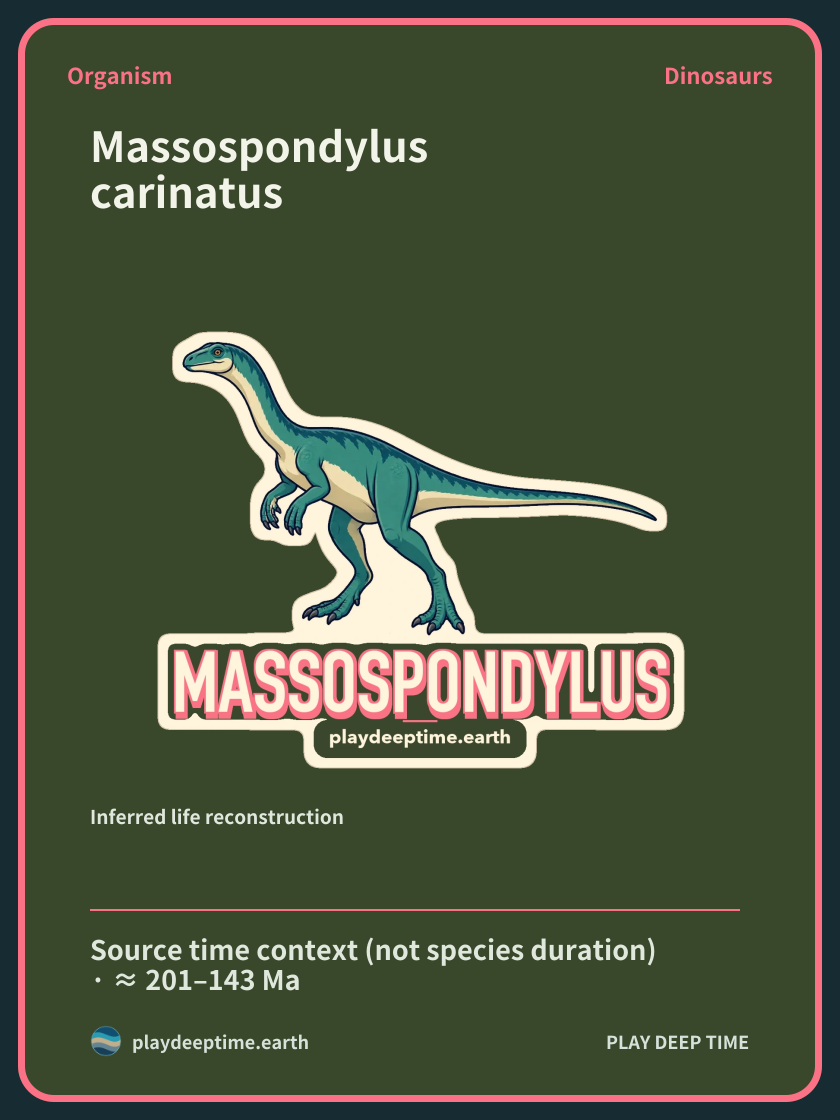
Inferred life reconstruction
Massospondylus carinatus
Overview
Massospondylus carinatus is an Early Jurassic dinosaur known for a small head and long neck. Studies have compared body proportions of embryos and adults. One animal can thus be explored at several growth stages.[1]
Loading illustration…
Key facts
Adults are described as having relatively smaller heads, shorter forelimbs, and longer neck vertebrae than embryos. The comparison shows that not all body parts grew in the same proportions.[1]
Time and place
Adult neotype material from the upper Elliot Formation in present-day South Africa has been studied. Its broad occurrence context is the Early Jurassic. The Jurassic as a whole spans roughly 200–140 million years ago.[2][3]
The time range describes source context, not the complete duration of this species.
Size, form and skeleton
The adult’s small head, elongated neck vertebrae, and relatively short forelimbs have been used in growth comparisons. The hand of BP/1/4934 also preserves a described fifth metacarpal and two phalanges. Broad body proportions and small hand bones can be examined together.[1][2]
Loading illustration…
Habitat and reproduction
Did young and fully grown dinosaurs use the same posture? A 2005 study of differing embryonic and adult proportions interpreted adults as capable of using two legs at least occasionally. Changes in a growing body lead to questions about possible postures.[1]
Fossil discovery
A 2005 embryo study examined proportional differences from adults. In 2019, the postcranial bones of adult neotype BP/1/4934 were studied in detail. Growth and small adult hand bones offer different scales of understanding the same dinosaur.[1][2]
References
- Reisz et al. (2005) — Embryos and growth of Early Jurassic dinosaurs
- Postcranial osteology of the neotype specimen of Massospondylus carinatus Owen, 1854 (Dinosauria: Sauropodomorpha) from the upper Elliot formation of South Africa
- International Commission on Stratigraphy (2024) — Geological time chart
- Redescription study of Gargoyleosaurus parkpinorum
Research questions
Did the head, neck, and forelimbs all grow at the same rate? Embryos and adults placed side by side show changing relative proportions. Growth stories involve changes in proportion as well as size.[1]
Observation
Move your gaze from the small head to the long neck and forelimbs. Picture the different proportions of embryos and adults, then examine small hand bones to compare growth and form together.[1][2]
Related organisms
 Gargoyleosaurus parkpinorumDinosaursFossil record age bounds · ≈ 152–145 Ma
Different bodies among dinosaurs
Explore the bodies and backgrounds of Massospondylus carinatus and Gargoyleosaurus parkpinorum together. Massospondylus carinatus: an Early Jurassic dinosaur known for a small head and long neck, with studies comparing embryonic and adult body proportions. Gargoyleosaurus parkpinorum: an armored dinosaur from Late Jurassic North America, studied for its long head and the armor on its neck and trunk.